Department of Psychiatry and Psychotherapy, University of Regensburg, Universitaetsstraße 84, Regensburg 93053, Germany.
Trials. 2013 Aug 23;14:269. doi: 10.1186/1745-6215-14-269.
Several years ago, repetitive transcranial magnetic stimulation (rTMS) of the auditory cortex has been introduced as a treatment approach for chronic tinnitus. Even if this treatment is beneficial for a subgroup of patients, the overall effects are limited. This limitation may be due to the fact that the auditory cortex is only one of several brain areas involved in tinnitus. Whereas auditory areas are considered to code for tinnitus loudness, conscious perception of and attention allocation to tinnitus is supposed to be reflected by network activity involving frontal and parietal cortical areas. The aim of the present study is to influence this frontoparietal network more efficiently by perturbing the most important nodes with rTMS.
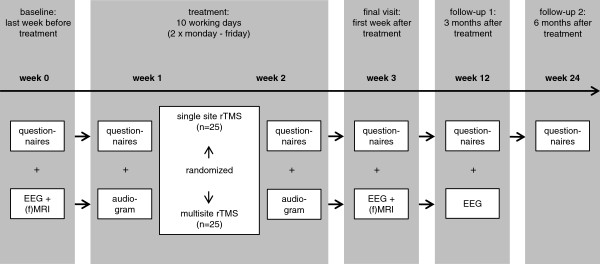
METHODS/DESIGN: This is a randomized, double-blind, parallel-group study. Patients receive rTMS treatment on 10 consecutive working days using either the multisite rTMS protocol (left dorsolateral prefrontal, 1,000 stimuli, 20 Hz; left temporoparietal, 1,000 stimuli, 1 Hz; right temporoparietal stimulation, 1,000 stimuli, 1 Hz) or a single-site protocol (unilateral stimulation of the temporoparietal cortex, 3,000 stimuli, 1 Hz). Individuals aged 18 to 70 years with chronic tinnitus ≥6-month duration and a Tinnitus Handicap Inventory score ≥38 are recruited for the study. A total of 50 patients are needed to detect a clinical relevant change of tinnitus severity (α = 0.05; 1 - β = 0.80). Primary outcome measures are the change in the Tinnitus Questionnaire score from baseline to the end of treatment as well as the number of treatment responders as defined by a reduction in the Tinnitus Questionnaire score of ≥5 points. Furthermore, changes in brain structure and activity are assessed using (functional) magnetic resonance imaging and electroencephalography in the resting state. Those measurements are also performed in 25 healthy control subjects.
This study is designed to reveal whether network stimulation is superior to single-site stimulation in the treatment of chronic tinnitus. Furthermore, the comparison between tinnitus patients and healthy controls and the longitudinal effects of both rTMS treatment protocols on brain structure and function allow inferences to be made about the neural correlates of tinnitus.
Clinical Trials: NCT01663324.
几年前,重复经颅磁刺激(rTMS)已被引入作为治疗慢性耳鸣的一种方法。即使这种治疗对一部分患者有益,但总体效果是有限的。这种局限性可能是由于听觉皮层只是参与耳鸣的几个大脑区域之一。虽然听觉区域被认为是耳鸣响度的编码,但对耳鸣的意识感知和注意力分配应该反映出涉及额顶皮质区域的网络活动。本研究的目的是通过使用 rTMS 干扰最重要的节点来更有效地影响这个额顶网络。
方法/设计:这是一项随机、双盲、平行组研究。患者在 10 个连续工作日内接受 rTMS 治疗,使用多点 rTMS 方案(左侧背外侧前额叶,1000 次刺激,20 Hz;左侧颞顶叶,1000 次刺激,1 Hz;右侧颞顶叶刺激,1000 次刺激,1 Hz)或单点方案(单侧颞顶叶皮层刺激,3000 次刺激,1 Hz)。招募年龄在 18 至 70 岁之间、慢性耳鸣持续时间≥6 个月且耳鸣障碍量表评分≥38 的个体参加该研究。需要 50 名患者来检测耳鸣严重程度的临床相关变化(α=0.05;1-β=0.80)。主要观察指标是从基线到治疗结束时耳鸣问卷评分的变化,以及定义为耳鸣问卷评分降低≥5 分的治疗应答者的数量。此外,还使用(功能)磁共振成像和脑电图在静息状态下评估脑结构和活动的变化。这些测量也在 25 名健康对照者中进行。
本研究旨在揭示网络刺激是否优于慢性耳鸣的单点刺激治疗。此外,耳鸣患者与健康对照组之间的比较以及两种 rTMS 治疗方案对脑结构和功能的纵向影响,可以推断出耳鸣的神经相关性。
临床试验:NCT01663324。