• 文献检索
  • 文档翻译
  • 深度研究
  • 学术资讯
  • Suppr Zotero 插件Zotero 插件
  • 邀请有礼
  • 套餐&价格
  • 历史记录
应用&插件
Suppr Zotero 插件Zotero 插件浏览器插件Mac 客户端Windows 客户端微信小程序
定价
高级版会员购买积分包购买API积分包
服务
文献检索文档翻译深度研究API 文档MCP 服务
关于我们
关于 Suppr公司介绍联系我们用户协议隐私条款
关注我们

Suppr 超能文献

核心技术专利:CN118964589B侵权必究
粤ICP备2023148730 号-1Suppr @ 2026

文献检索

告别复杂PubMed语法,用中文像聊天一样搜索,搜遍4000万医学文献。AI智能推荐,让科研检索更轻松。

立即免费搜索

文件翻译

保留排版,准确专业,支持PDF/Word/PPT等文件格式,支持 12+语言互译。

免费翻译文档

深度研究

AI帮你快速写综述,25分钟生成高质量综述,智能提取关键信息,辅助科研写作。

立即免费体验

一项关于重复经颅磁刺激治疗慢性耳鸣疗效的安慰剂对照随机研究的设计。

Design of a placebo-controlled, randomized study of the efficacy of repetitive transcranial magnetic stimulation for the treatment of chronic tinnitus.

作者信息

Landgrebe Michael, Binder Harald, Koller Michael, Eberl Yvonne, Kleinjung Tobias, Eichhammer Peter, Graf Erika, Hajak Goeran, Langguth Berthold

机构信息

Department of Psychiatry, Psychosomatics, and Psychotherapy, University of Regensburg, Germany.

出版信息

BMC Psychiatry. 2008 Apr 15;8:23. doi: 10.1186/1471-244X-8-23.

DOI:10.1186/1471-244X-8-23
PMID:18412944
原文链接:https://pmc.ncbi.nlm.nih.gov/articles/PMC2358898/
Abstract

BACKGROUND

Chronic tinnitus is a frequent condition, which can have enormous impact on patient's life and which is very difficult to treat. Accumulating data indicate that chronic tinnitus is related to dysfunctional neuronal activity in the central nervous system. Repetitive transcranial magnetic stimulation (rTMS) is a non-invasive method which allows to focally modulate neuronal activity. An increasing amount of studies demonstrate reduction of tinnitus after repeated sessions of low-frequency rTMS and indicate that rTMS might represent a new promising approach for the treatment of tinnitus. However available studies have been mono-centric and are characterized by small sample sizes. Therefore, this multi-center trial will test the efficacy of rTMS treatment in a large sample of chronic tinnitus patients.

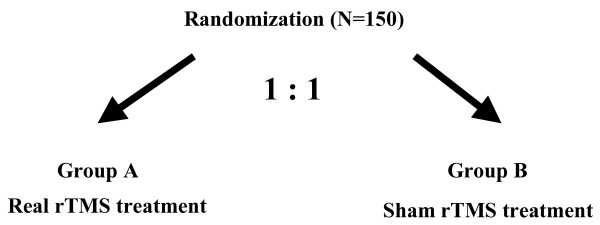
METHODS/DESIGN: This is a randomized, placebo-controlled, double-blind multi-center trial of two weeks 1 Hz rTMS-treatment in chronic tinnitus patients. Eligible patients will be randomized to either 2 weeks real or sham rTMS treatment. Main eligibility criteria: male or female individuals aged 18-70 years with chronic tinnitus (duration > 6 months), tinnitus-handicap-inventory-score > or = 38, age-adjusted normal sensorineural hearing (i.e. not more than 5 dB below the 10% percentile of the appropriate age and gender group (DIN EN ISO 7029), conductive hearing loss < or = 15dB. The primary endpoint is a change of tinnitus severity according to the tinnitus questionnaire of Goebel and Hiller (baseline vs. end of treatment period). A total of 138 patients are needed to detect a clinical relevant change of tinnitus severity (i.e. 5 points on the questionnaire of Goebel and Hiller; alpha = 0.05; 1-beta = 0.80). Assuming a drop-out rate of less than 5% until the primary endpoint, 150 patients have to be randomized to guarantee the target number of 138 evaluable patients. The study will be conducted by otorhinolaryngologists and psychiatrists of 7 university hospitals and 1 municipal hospital in Germany.

DISCUSSION

This study will provide important information about the efficacy of rTMS in the treatment of chronic tinnitus.

TRIAL REGISTRATION

Current Controlled Trials ISRCTN89848288.

摘要

背景

慢性耳鸣是一种常见病症,会对患者生活产生巨大影响且极难治疗。越来越多的数据表明,慢性耳鸣与中枢神经系统中功能失调的神经元活动有关。重复经颅磁刺激(rTMS)是一种非侵入性方法,可局部调节神经元活动。越来越多的研究表明,低频rTMS多次治疗后耳鸣减轻,这表明rTMS可能是一种治疗耳鸣的新的有前景的方法。然而,现有研究多为单中心研究,且样本量较小。因此,这项多中心试验将在大量慢性耳鸣患者样本中测试rTMS治疗的疗效。

方法/设计:这是一项针对慢性耳鸣患者进行的为期两周的1Hz rTMS治疗的随机、安慰剂对照、双盲多中心试验。符合条件的患者将被随机分为接受2周真实rTMS治疗或假rTMS治疗。主要入选标准:年龄在18 - 70岁之间的男性或女性慢性耳鸣患者(病程>6个月),耳鸣 handicap 量表评分≥38,年龄校正后的正常感音神经性听力(即不超过相应年龄和性别组第10百分位数以下5dB(DIN EN ISO 7029)),传导性听力损失≤15dB。主要终点是根据Goebel和Hiller耳鸣问卷评估的耳鸣严重程度变化(基线与治疗期末)。需要总共138名患者来检测耳鸣严重程度的临床相关变化(即Goebel和Hiller问卷上5分的变化;α = 0.05;1-β = 0.80)。假设在主要终点前脱落率低于5%,则必须随机分配150名患者以确保有138名可评估患者的目标数量。该研究将由德国7所大学医院和1所市立医院的耳鼻喉科医生和精神科医生进行。

讨论

本研究将提供有关rTMS治疗慢性耳鸣疗效的重要信息。

试验注册

当前受控试验ISRCTN89848288。

https://cdn.ncbi.nlm.nih.gov/pmc/blobs/bbe9/2358898/e8bc3170bb19/1471-244X-8-23-1.jpg

相似文献

1
Design of a placebo-controlled, randomized study of the efficacy of repetitive transcranial magnetic stimulation for the treatment of chronic tinnitus.一项关于重复经颅磁刺激治疗慢性耳鸣疗效的安慰剂对照随机研究的设计。
BMC Psychiatry. 2008 Apr 15;8:23. doi: 10.1186/1471-244X-8-23.
2
1-Hz rTMS in the treatment of tinnitus: A sham-controlled, randomized multicenter trial.1-Hz rTMS 治疗耳鸣:一项假刺激对照、随机、多中心试验。
Brain Stimul. 2017 Nov-Dec;10(6):1112-1120. doi: 10.1016/j.brs.2017.08.001. Epub 2017 Aug 5.
3
Efficacy of repetitive transcranial magnetic stimulation for the treatment of refractory chronic tinnitus: a randomized, placebo controlled study.重复经颅磁刺激治疗难治性慢性耳鸣的疗效:一项随机、安慰剂对照研究。
Neuro Endocrinol Lett. 2010;31(2):238-49.
4
Long-term effects of repetitive transcranial magnetic stimulation (rTMS) in patients with chronic tinnitus.重复经颅磁刺激(rTMS)对慢性耳鸣患者的长期影响。
Otolaryngol Head Neck Surg. 2005 Apr;132(4):566-9. doi: 10.1016/j.otohns.2004.09.134.
5
Comparing single-site with multisite rTMS for the treatment of chronic tinnitus - clinical effects and neuroscientific insights: study protocol for a randomized controlled trial.单部位与多部位重复经颅磁刺激治疗慢性耳鸣的比较:一项随机对照试验的临床效果和神经科学见解研究方案。
Trials. 2013 Aug 23;14:269. doi: 10.1186/1745-6215-14-269.
6
Low-frequency repetitive transcranial magnetic stimulation to the temporoparietal junction for tinnitus: four-week stimulation trial.低频重复经颅磁刺激颞顶交界处治疗耳鸣:四周刺激试验。
JAMA Otolaryngol Head Neck Surg. 2013 Apr;139(4):388-95. doi: 10.1001/jamaoto.2013.233.
7
Repetitive transcranial magnetic stimulation improve tinnitus in normal hearing patients: a double-blind controlled, clinical and neuroimaging outcome study.重复经颅磁刺激改善正常听力患者耳鸣:一项双盲对照、临床和神经影像学结局研究。
Eur J Neurol. 2010 Jan;17(1):38-44. doi: 10.1111/j.1468-1331.2009.02730.x. Epub 2009 Jul 9.
8
A proof-of-concept study on the combination of repetitive transcranial magnetic stimulation and relaxation techniques in chronic tinnitus.一项关于重复经颅磁刺激与放松技术联合治疗慢性耳鸣的概念验证研究。
J Neural Transm (Vienna). 2016 Oct;123(10):1147-57. doi: 10.1007/s00702-016-1588-4. Epub 2016 Jun 17.
9
Repetitive transcranial magnetic stimulation for tinnitus.重复经颅磁刺激治疗耳鸣
Cochrane Database Syst Rev. 2011 Oct 5(10):CD007946. doi: 10.1002/14651858.CD007946.pub2.
10
Efficacy of different protocols of transcranial magnetic stimulation for the treatment of tinnitus: Pooled analysis of two randomized controlled studies.不同经颅磁刺激方案治疗耳鸣的疗效:两项随机对照研究的汇总分析
World J Biol Psychiatry. 2014 May;15(4):276-85. doi: 10.3109/15622975.2012.708438. Epub 2012 Aug 22.

引用本文的文献

1
A Systematic Review and Meta-analysis of Randomized Controlled Trials on the Effect of Transcranial Magnetic Stimulation on Tinnitus Management.经颅磁刺激对耳鸣治疗效果的随机对照试验的系统评价和荟萃分析
Cent Asian J Glob Health. 2020 Mar 31;9(1):e356. doi: 10.5195/cajgh.2020.356. eCollection 2020.
2
Standardized Clinical Profiling in Spanish Patients with Chronic Tinnitus.西班牙慢性耳鸣患者的标准化临床剖析
J Clin Med. 2022 Feb 13;11(4):978. doi: 10.3390/jcm11040978.
3
Management of Chronic Tinnitus and Insomnia with Repetitive Transcranial Magnetic Stimulation and Cognitive Behavioral Therapy - a Combined Approach.

本文引用的文献

1
Consensus for tinnitus patient assessment and treatment outcome measurement: Tinnitus Research Initiative meeting, Regensburg, July 2006.耳鸣患者评估与治疗结果测量的共识:耳鸣研究倡议会议,雷根斯堡,2006年7月
Prog Brain Res. 2007;166:525-36. doi: 10.1016/S0079-6123(07)66050-6.
2
Which tinnitus patients benefit from transcranial magnetic stimulation?哪些耳鸣患者能从经颅磁刺激中获益?
Otolaryngol Head Neck Surg. 2007 Oct;137(4):589-95. doi: 10.1016/j.otohns.2006.12.007.
3
Transcranial magnetic stimulation for the treatment of tinnitus: effects on cortical excitability.
重复经颅磁刺激与认知行为疗法联合治疗慢性耳鸣和失眠——一种综合方法
Front Psychol. 2017 Apr 21;8:575. doi: 10.3389/fpsyg.2017.00575. eCollection 2017.
4
Therapeutic impact of repetitive transcranial magnetic stimulation (rTMS) on tinnitus: a systematic review and meta-analysis.重复经颅磁刺激(rTMS)对耳鸣的治疗作用:一项系统评价和荟萃分析。
Eur Arch Otorhinolaryngol. 2016 Jul;273(7):1663-75. doi: 10.1007/s00405-015-3642-5. Epub 2015 May 13.
5
Dimensional or categorical approach to tinnitus severity: an item response mixture modeling analysis of tinnitus handicap.耳鸣严重程度的维度或分类方法:耳鸣致残的项目反应混合模型分析
Int J Behav Med. 2014 Dec;21(6):982-8. doi: 10.1007/s12529-013-9375-1.
6
Comparison of two protocols of transcranial magnetic stimulation for treatment of chronic tinnitus: a randomized controlled clinical trial of burst repetitive versus high-frequency repetitive Transcranial Magnetic Stimulation.两种经颅磁刺激治疗慢性耳鸣方案的比较:突发重复经颅磁刺激与高频重复经颅磁刺激的随机对照临床试验。
Neurol Sci. 2014 Feb;35(2):227-32. doi: 10.1007/s10072-013-1487-5. Epub 2013 Jul 13.
7
Tinnitus assessment by means of standardized self-report questionnaires: psychometric properties of the Tinnitus Questionnaire (TQ), the Tinnitus Handicap Inventory (THI), and their short versions in an international and multi-lingual sample.通过标准化自评问卷评估耳鸣:国际多语言样本中耳鸣问卷(TQ)、耳鸣残疾量表(THI)及其简短版本的心理测量特性。
Health Qual Life Outcomes. 2012 Oct 18;10:128. doi: 10.1186/1477-7525-10-128.
8
Methodological aspects of clinical trials in tinnitus: a proposal for an international standard.耳鸣临床试验的方法学方面:国际标准建议。
J Psychosom Res. 2012 Aug;73(2):112-21. doi: 10.1016/j.jpsychores.2012.05.002. Epub 2012 Jun 22.
9
Linking the Tinnitus Questionnaire and the subjective Clinical Global Impression: which differences are clinically important?将耳鸣问卷与主观临床整体印象联系起来:哪些差异具有临床重要性?
Health Qual Life Outcomes. 2012 Jul 10;10:79. doi: 10.1186/1477-7525-10-79.
10
Predictors for rTMS response in chronic tinnitus.慢性耳鸣 rTMS 反应的预测因素。
Front Syst Neurosci. 2012 Feb 23;6:11. doi: 10.3389/fnsys.2012.00011. eCollection 2012.
经颅磁刺激治疗耳鸣:对皮质兴奋性的影响
BMC Neurosci. 2007 Jul 2;8:45. doi: 10.1186/1471-2202-8-45.
4
Repetitive transcranial magnetic stimulation for tinnitus: a pilot study.重复经颅磁刺激治疗耳鸣:一项初步研究。
Laryngoscope. 2007 Mar;117(3):529-34. doi: 10.1097/MLG.0b013e31802f4154.
5
Effects of repetitive transcranial magnetic stimulation on chronic tinnitus: a randomised, crossover, double blind, placebo controlled study.重复经颅磁刺激对慢性耳鸣的影响:一项随机、交叉、双盲、安慰剂对照研究。
J Neurol Neurosurg Psychiatry. 2007 Aug;78(8):857-63. doi: 10.1136/jnnp.2006.105007. Epub 2007 Feb 21.
6
Moderate therapeutic efficacy of positron emission tomography-navigated repetitive transcranial magnetic stimulation for chronic tinnitus: a randomised, controlled pilot study.正电子发射断层扫描导航下重复经颅磁刺激治疗慢性耳鸣的中度疗效:一项随机对照试验性研究
J Neurol Neurosurg Psychiatry. 2007 Feb;78(2):152-6. doi: 10.1136/jnnp.2006.095612. Epub 2006 Aug 4.
7
Transcranial magnetic stimulation for the treatment of tinnitus: a new coil positioning method and first results.经颅磁刺激治疗耳鸣:一种新的线圈定位方法及初步结果。
Brain Topogr. 2006 Summer;18(4):241-7. doi: 10.1007/s10548-006-0002-1. Epub 2006 Jul 15.
8
Structural brain alterations following 5 days of intervention: dynamic aspects of neuroplasticity.干预5天后的脑结构改变:神经可塑性的动态方面
Cereb Cortex. 2007 Jan;17(1):205-10. doi: 10.1093/cercor/bhj138. Epub 2006 Feb 15.
9
Structural brain changes in tinnitus.耳鸣患者的大脑结构变化
Cereb Cortex. 2006 Sep;16(9):1283-8. doi: 10.1093/cercor/bhj070. Epub 2005 Nov 9.
10
Transcranial magnetic stimulation for tinnitus: influence of tinnitus duration on stimulation parameter choice and maximal tinnitus suppression.经颅磁刺激治疗耳鸣:耳鸣持续时间对刺激参数选择及最大耳鸣抑制的影响
Otol Neurotol. 2005 Jul;26(4):616-9. doi: 10.1097/01.mao.0000178146.91139.3c.