Department of Mechanical Engineering, Massachusetts Institute of Technology, Cambridge, MA, USA; Laboratory of Nanomedicine and Biomaterials, Department of Anesthesiology, Brigham and Women's Hospital - Harvard Medical School, Boston, MA, USA; David H. Koch Institute for Integrative Cancer Research, Massachusetts Institute of Technology, Cambridge, MA, USA.
David H. Koch Institute for Integrative Cancer Research, Massachusetts Institute of Technology, Cambridge, MA, USA.
Nanomedicine. 2014 Feb;10(2):401-9. doi: 10.1016/j.nano.2013.08.003. Epub 2013 Aug 20.
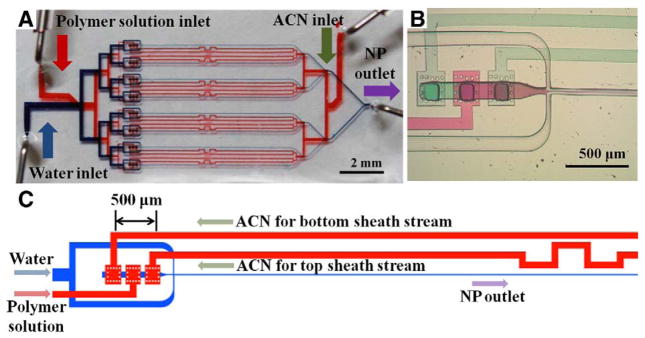
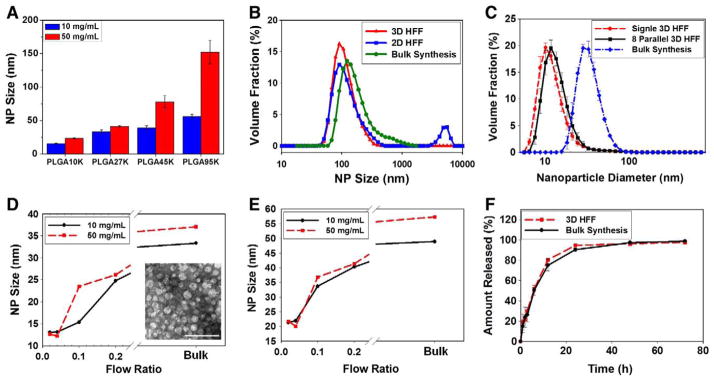
Microfluidic synthesis of nanoparticles (NPs) can enhance the controllability and reproducibility in physicochemical properties of NPs compared to bulk synthesis methods. However, applications of microfluidic synthesis are typically limited to in vitro studies due to low production rates. Herein, we report the parallelization of NP synthesis by 3D hydrodynamic flow focusing (HFF) using a multilayer microfluidic system to enhance the production rate without losing the advantages of reproducibility, controllability, and robustness. Using parallel 3D HFF, polymeric poly(lactide-co-glycolide)-b-polyethyleneglycol (PLGA-PEG) NPs with sizes tunable in the range of 13-150 nm could be synthesized reproducibly with high production rate. As a proof of concept, we used this system to perform in vivo pharmacokinetic and biodistribution study of small (20 nm diameter) PLGA-PEG NPs that are otherwise difficult to synthesize. Microfluidic parallelization thus enables synthesis of NPs with tunable properties with production rates suitable for both in vitro and in vivo studies.
Applications of nanoparticle synthesis with microfluidic methods are typically limited to in vitro studies due to low production rates. The team of authors of this proof-of-principle study reports on the successful parallelization of NP synthesis by 3D hydrodynamic flow focusing using a multilayer microfluidic system to enhance production rate without losing the advantages of reproducibility, controllability, and robustness.
与批量合成方法相比,微流控合成纳米粒子(NPs)可以增强 NPs 理化性质的可控性和重现性。然而,由于生产速率低,微流控合成的应用通常仅限于体外研究。在此,我们报告了使用多层微流控系统通过 3D 流体动力学聚焦(HFF)对 NP 合成进行并行化,以在不丧失重现性、可控性和鲁棒性优势的情况下提高生产速率。使用并行 3D HFF,可以以高生产速率可重现地合成尺寸可调范围为 13-150nm 的聚合聚(乳酸-共-乙醇酸)-b-聚乙二醇(PLGA-PEG)NP。作为概念验证,我们使用该系统对小(20nm 直径)PLGA-PEG NP 进行了体内药代动力学和生物分布研究,否则这些 NP 很难合成。因此,微流控并行化能够以适合体外和体内研究的生产速率合成具有可调性质的 NPs。
由于生产速率低,应用纳米粒子合成的微流控方法通常仅限于体外研究。本原理验证研究的作者团队报告了使用多层微流控系统通过 3D 流体动力学聚焦(HFF)成功地对 NP 合成进行了并行化,以在不丧失重现性、可控性和鲁棒性优势的情况下提高生产速率。