Department of Psychology, University of Milano-Bicocca Milano, Italy.
Front Hum Neurosci. 2013 Aug 20;7:451. doi: 10.3389/fnhum.2013.00451. eCollection 2013.
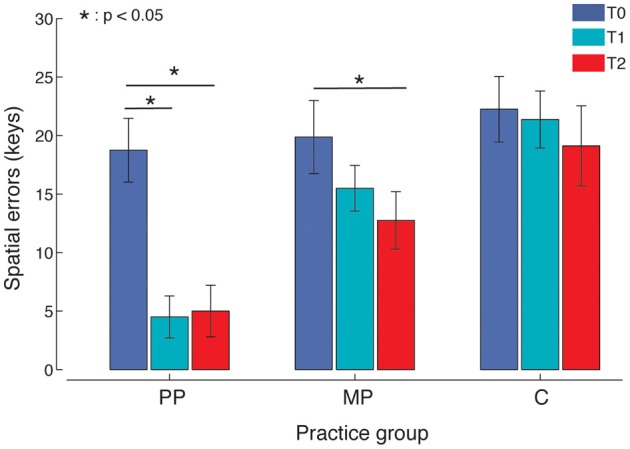
Mental practice (MP) has been shown to improve movement accuracy and velocity, but it is not known whether MP can also optimize movement timing. We addressed this question by studying two groups of expert pianists who performed challenging music sequences after either MP or physical practice (PP). Performance and motion-capture data were collected along with responses to imagery questionnaires. The results showed that MP produced performance improvements, although to a lower degree than PP did. MP and PP induced changes in both movement velocity and movement timing, promoting the emergence of movement anticipatory patterns. Furthermore, motor imagery was associated with greater changes in movement velocity, while auditory imagery was associated with greater movement anticipation. Data from a control group that was not allowed to practice confirmed that the changes in accuracy and kinematics were not due to mere repetition of the sequence during testing. This study provides the first evidence of an anticipatory control following MP and extends the present knowledge on the effectiveness of MP to a task of unparalleled motor complexity. The practical implications of MP in the motor domain are discussed.
心理练习(MP)已被证明可以提高运动的准确性和速度,但目前尚不清楚 MP 是否也可以优化运动的时机。我们通过研究两组专家钢琴家来解决这个问题,他们在进行 MP 或物理练习(PP)后演奏具有挑战性的音乐序列。收集了表现和运动捕捉数据,并对想象问卷做出了回应。结果表明,MP 确实可以提高表现,尽管程度低于 PP。MP 和 PP 引起了运动速度和运动时机的变化,促进了运动预期模式的出现。此外,运动想象与更大的运动速度变化有关,而听觉想象与更大的运动预期有关。来自一个不允许练习的对照组的数据证实,准确性和运动学的变化不是由于在测试过程中仅仅重复序列。本研究首次提供了 MP 后出现预期控制的证据,并将 MP 的有效性扩展到了一项具有无与伦比的运动复杂性的任务。讨论了 MP 在运动领域的实际意义。