Potvin Stéphane, Bourque Josiane, Durand Myriam, Lipp Olivier, Lalonde Pierre, Stip Emmanuel, Grignon Sylvain, Mendrek Adrianna
Centre de Recherche de l'Institut Universitaire de Santé Mentale de Montréal, 7331 Hochelaga, Montreal, QC, Canada H1N 3V2 ; Department of Psychiatry, Faculty of Medicine, University of Montreal, 2900 Edouard-Montpetit, Montreal, QC, Canada H3C 3J7.
Schizophr Res Treatment. 2013;2013:543842. doi: 10.1155/2013/543842. Epub 2013 Jul 17.
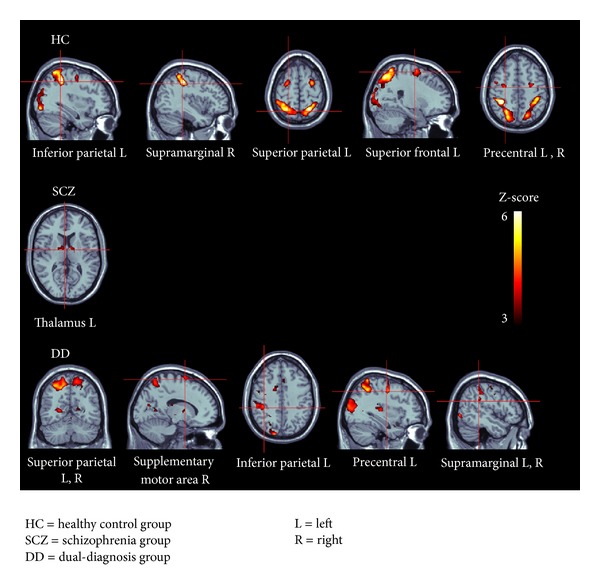
Growing evidence suggests that cannabis abuse/dependence is paradoxically associated with better cognition in schizophrenia. Accordingly, we performed a functional magnetic resonance imaging (fMRI) study of visuospatial abilities in 14 schizophrenia patients with cannabis abuse (DD), 14 nonabusing schizophrenia patients (SCZ), and 21 healthy controls (HCs). Participants performed a mental rotation task while being scanned. There were no significant differences in the number of mistakes between schizophrenia groups, and both made more mistakes on the mental rotation task than HC. Relative to HC, SCZ had increased activations in the left thalamus, while DD patients had increased activations in the right supramarginal gyrus. In both cases, hyper-activations are likely to reflect compensatory efforts. In addition, SCZ patients had decreased activations in the left superior parietal gyrus compared to both HC and DD patients. This latter result tentatively suggests that the neurophysiologic processes underlying visuospatial abilities are partially preserved in DD, relative to SCZ patients, consistently with the findings showing that cannabis abuse in schizophrenia is associated with better cognitive functioning. Further fMRI studies are required to examine the neural correlates of other cognitive dysfunctions in schizophrenia patients with and without comorbid cannabis use disorder.
越来越多的证据表明,大麻滥用/依赖与精神分裂症患者较好的认知能力存在矛盾关联。因此,我们对14名有大麻滥用情况的精神分裂症患者(DD组)、14名无大麻滥用的精神分裂症患者(SCZ组)和21名健康对照者(HC组)进行了一项关于视觉空间能力的功能磁共振成像(fMRI)研究。参与者在接受扫描时执行一项心理旋转任务。精神分裂症组之间的错误数量没有显著差异,且两组在心理旋转任务上的错误都比HC组多。相对于HC组,SCZ组左侧丘脑激活增加,而DD组患者右侧缘上回激活增加。在这两种情况下,过度激活可能反映了代偿性努力。此外,与HC组和DD组患者相比,SCZ组患者左侧顶上叶激活减少。后一结果初步表明,相对于SCZ组患者,DD组视觉空间能力背后的神经生理过程部分得以保留,这与表明精神分裂症中的大麻滥用与更好的认知功能相关的研究结果一致。需要进一步的fMRI研究来检查有和没有合并大麻使用障碍的精神分裂症患者其他认知功能障碍的神经相关性。