CC Aerospace Biomedical Science & Technology; Space Biology Group; University of Applied Sciences and Arts; Hergiswil, Switzerland; Institute for Biomechanics; Eidgenössische Technische Hochschule Zürich; Zürich, Switzerland.
Cell Cycle. 2013 Sep 15;12(18):3001-12. doi: 10.4161/cc.26029. Epub 2013 Aug 14.
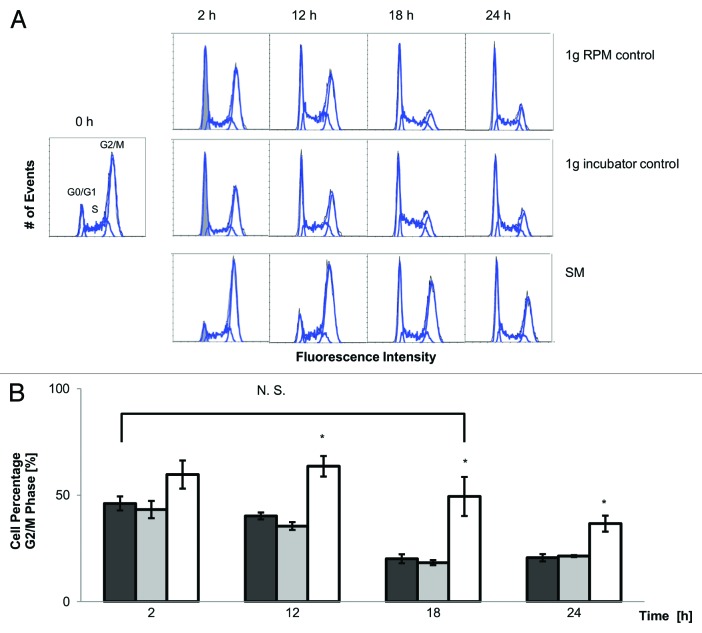
Prolonged spaceflight gives rise to muscle loss and reduced strength, a condition commonly referred to as space atrophy. During exposure to microgravity, skeletal muscle myoblasts are mechanically unloaded and respond with attenuated cell proliferation, slowed cell cycle progression, and modified protein expression. To elucidate the underlying mechanisms by which muscle mass declines in response to prolonged microgravity exposure, we grew C2C12 mouse muscle cells under conditions of simulated microgravity (SM) and analyzed their proliferative capacity, cell cycle progression, and cyclin B and D expression. We demonstrated that the retarded cell growth observed in SM was correlated with an approximate 16 h delay in G2/M phase progression, where cells accumulated specifically between the G2 checkpoint and the onset of anaphase, concomitantly with a positive expression for cyclin B. The effect was specific for gravitational mechanical unloading as cells grown under conditions of hypergravity (HG, 4 g) for similar durations of time exhibited normal proliferation and normal cell cycle progression. Our results show that SM and HG exert phenomenological distinct responses over cell cycle progression. The deficits of SM can be restored by terrestrial gravitational force, whereas the effects of HG are indistinguishable from the 1 g control. This suggests that the mechanotransduction apparatus of cells responds differently to mechanical unloading and loading.
长时间的太空飞行会导致肌肉损失和力量减弱,这种情况通常被称为太空萎缩。在微重力环境下,骨骼肌成肌细胞受到机械卸载的作用,其细胞增殖减弱、细胞周期进程减缓、蛋白表达发生改变。为了阐明肌肉质量因长时间微重力暴露而下降的潜在机制,我们在模拟微重力(SM)条件下培养 C2C12 小鼠肌肉细胞,并分析其增殖能力、细胞周期进程以及细胞周期蛋白 B 和 D 的表达。我们发现,SM 中观察到的细胞生长迟缓与 G2/M 期进程的大约 16 小时延迟相关,细胞在 G2 检查点和后期开始之间特定地积累,同时细胞周期蛋白 B 呈阳性表达。这种影响是针对重力机械卸载的,因为在高重力(HG,4 g)条件下培养相同时间的细胞表现出正常的增殖和正常的细胞周期进程。我们的结果表明,SM 和 HG 对细胞周期进程产生了不同的现象学反应。SM 的缺陷可以通过地球引力恢复,而 HG 的影响与 1 g 对照无法区分。这表明细胞的机械转导装置对机械卸载和加载的反应不同。