Department of Neurobiology, David Geffen School of Medicine, University of California, Los Angeles, California 90048, USA.
Nature. 2013 Sep 26;501(7468):543-6. doi: 10.1038/nature12485. Epub 2013 Aug 25.
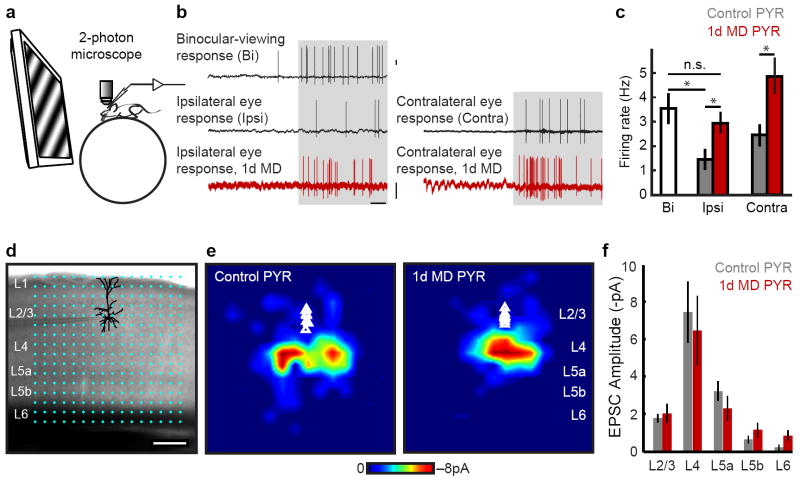
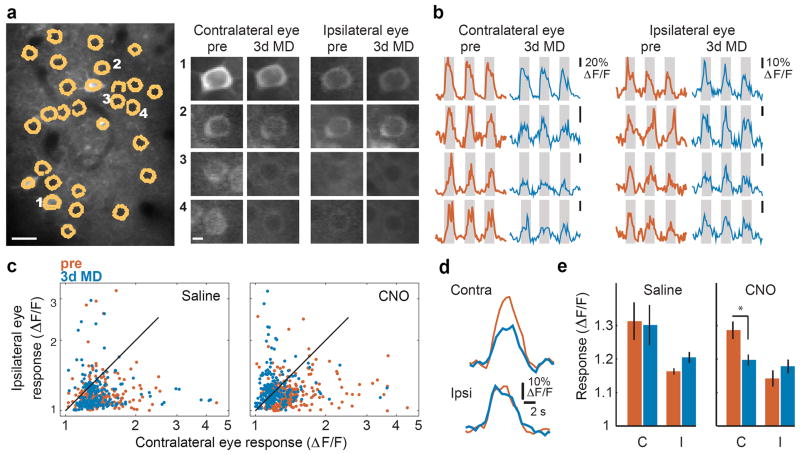
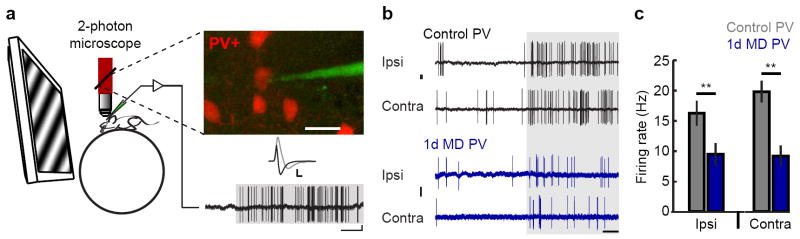
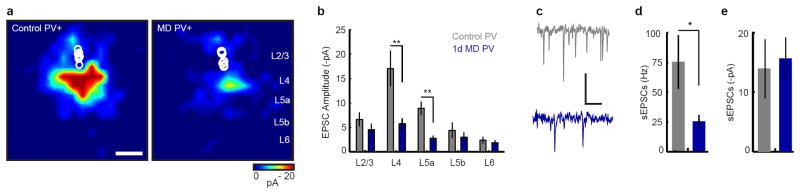
Early sensory experience instructs the maturation of neural circuitry in the cortex. This has been studied extensively in the primary visual cortex, in which loss of vision to one eye permanently degrades cortical responsiveness to that eye, a phenomenon known as ocular dominance plasticity (ODP). Cortical inhibition mediates this process, but the precise role of specific classes of inhibitory neurons in ODP is controversial. Here we report that evoked firing rates of binocular excitatory neurons in the primary visual cortex immediately drop by half when vision is restricted to one eye, but gradually return to normal over the following twenty-four hours, despite the fact that vision remains restricted to one eye. This restoration of binocular-like excitatory firing rates after monocular deprivation results from a rapid, although transient, reduction in the firing rates of fast-spiking, parvalbumin-positive (PV) interneurons, which in turn can be attributed to a decrease in local excitatory circuit input onto PV interneurons. This reduction in PV-cell-evoked responses after monocular lid suture is restricted to the critical period for ODP and appears to be necessary for subsequent shifts in excitatory ODP. Pharmacologically enhancing inhibition at the time of sight deprivation blocks ODP and, conversely, pharmacogenetic reduction of PV cell firing rates can extend the critical period for ODP. These findings define the microcircuit changes initiating competitive plasticity during critical periods of cortical development. Moreover, they show that the restoration of evoked firing rates of layer 2/3 pyramidal neurons by PV-specific disinhibition is a key step in the progression of ODP.
早期的感官体验指导了大脑皮层中神经回路的成熟。这在初级视觉皮层中已经得到了广泛的研究,在初级视觉皮层中,一只眼睛的视觉丧失会永久性地降低大脑皮层对该眼睛的反应性,这种现象称为眼优势可塑性(ODP)。皮质抑制介导了这个过程,但特定类型的抑制性神经元在 ODP 中的精确作用存在争议。在这里,我们报告说,当一只眼睛的视觉受到限制时,初级视觉皮层中的双眼兴奋性神经元的诱发放电率立即下降一半,但在接下来的 24 小时内逐渐恢复正常,尽管视觉仍然受到限制一只眼睛。这种在单眼剥夺后恢复类似双眼的兴奋性放电率是由于快速但短暂的抑制性神经元的放电率降低所致,快速放电的 parvalbumin 阳性(PV)中间神经元的放电率降低,这反过来又可以归因于局部兴奋性回路对 PV 中间神经元的输入减少。这种在单眼缝合后 PV 细胞诱发反应的减少仅限于 ODP 的关键时期,并且似乎是随后兴奋性 ODP 转变所必需的。在剥夺视力的同时增强抑制作用会阻止 ODP 的发生,相反,通过药理学降低 PV 细胞的放电率可以延长 ODP 的关键时期。这些发现定义了在皮层发育的关键时期引发竞争可塑性的微电路变化。此外,它们表明,通过 PV 特异性去抑制恢复第 2/3 层锥体神经元的诱发放电率是 ODP 进展的关键步骤。