Commonwealth Scientific and Industrial Research Organisation Plant Industry, Canberra, Australia ; Biotechnology Research Institute/The National Key Facility for Crop Gene Resources and Genetic Improvement, Chinese Academy of Agricultural Sciences, Beijing, China.
PLoS One. 2013 Aug 20;8(8):e71756. doi: 10.1371/journal.pone.0071756. eCollection 2013.
As a by product of higher value cotton fibre, cotton seed has been increasingly recognised to have excellent potential as a source of additional food, feed, biofuel stock and even a renewable platform for the production of many diverse biological molecules for agriculture and industrial enterprises. The large size difference between cotyledon and embryo axis that make up a cotton seed results in the under-representation of embryo axis gene transcript levels in whole seed embryo samples. Therefore, the determination of gene transcript levels in the cotyledons and embryo axes separately should lead to a better understanding of metabolism in these two developmentally diverse tissues.
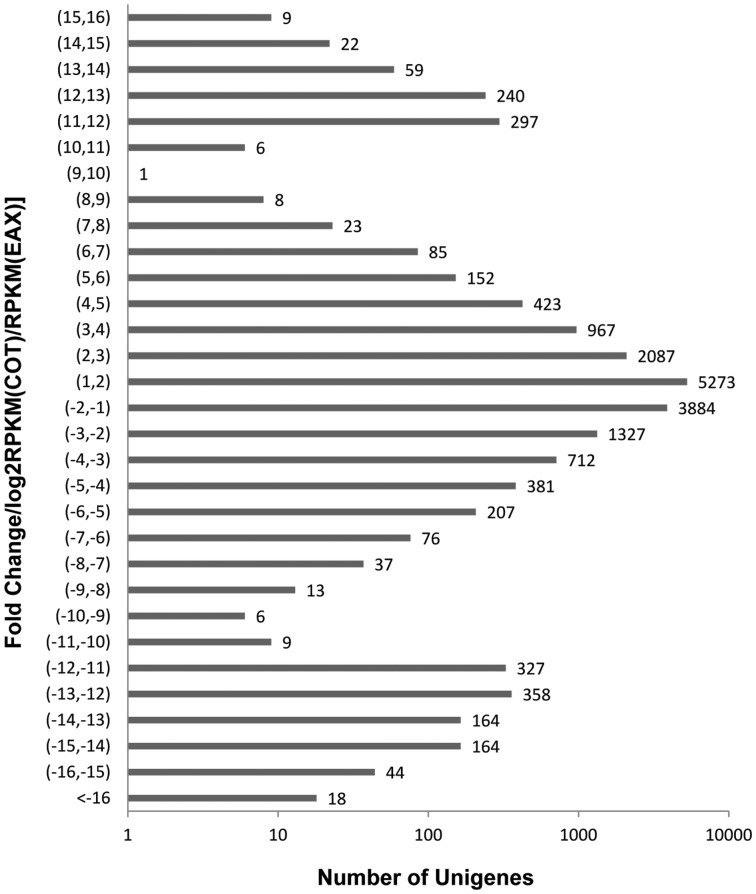
A comparative study of transcriptome changes between cotton developing cotyledon and embryo axis has been carried out. 17,384 unigenes (20.74% of all the unigenes) were differentially expressed in the two adjacent embryo tissues, and among them, 7,727 unigenes (44.45%) were down-regulated and 9,657 unigenes (55.55%) were up-regulated in cotyledon.
Our study has provided a comprehensive dataset that documents the dynamics of the transcriptome at the mid-maturity of cotton seed development and in discrete seed tissues, including embryo axis and cotyledon tissues. The results showed that cotton seed is subject to many transcriptome variations in these two tissue types and the differential gene expression between cotton embryo axis and cotyledon uncovered in our study should provide an important starting point for understanding how gene activity is coordinated during seed development to make a seed. Further, the identification of genes involved in rapid metabolite accumulation stage of seed development will extend our understanding of the complex molecular and cellular events in these developmental processes and provide a foundation for future studies on the metabolism, embryo differentiation of cotton and other dicot oilseed crops.
作为高价值棉花纤维的副产品,棉籽越来越被认为具有巨大的潜力,可以作为额外的食物、饲料、生物燃料的来源,甚至可以作为农业和工业企业生产多种不同生物分子的可再生平台。组成棉籽的子叶和胚轴之间的大小差异很大,导致整个种子胚样品中胚轴基因转录本水平的代表性不足。因此,分别对子叶和胚轴中的基因转录本水平进行测定,应该可以更好地了解这两种在发育上不同的组织中的代谢情况。
对棉花发育中的子叶和胚轴的转录组变化进行了比较研究。在这两个相邻的胚组织中,有 17384 个基因(所有基因的 20.74%)差异表达,其中 7727 个基因(44.45%)下调,9657 个基因(55.55%)上调。
我们的研究提供了一个全面的数据集,记录了棉籽发育中期和离散种子组织(包括胚轴和子叶组织)中转录组的动态变化。结果表明,棉籽在这两种组织类型中存在许多转录组变化,我们在研究中发现的棉胚轴和子叶之间的差异基因表达应该为理解基因活性在种子发育过程中是如何协调的,从而形成种子,提供一个重要的起点。此外,鉴定参与种子发育中快速代谢物积累阶段的基因,将扩展我们对这些发育过程中复杂分子和细胞事件的理解,并为未来研究棉花和其他双子叶油料作物的代谢、胚分化提供基础。