Great Lakes Genetics/Genomics Laboratory, Lake Erie Center and Department of Environmental Sciences, The University of Toledo, Toledo, Ohio, United States of America.
PLoS One. 2013 Aug 20;8(8):e71851. doi: 10.1371/journal.pone.0071851. eCollection 2013.
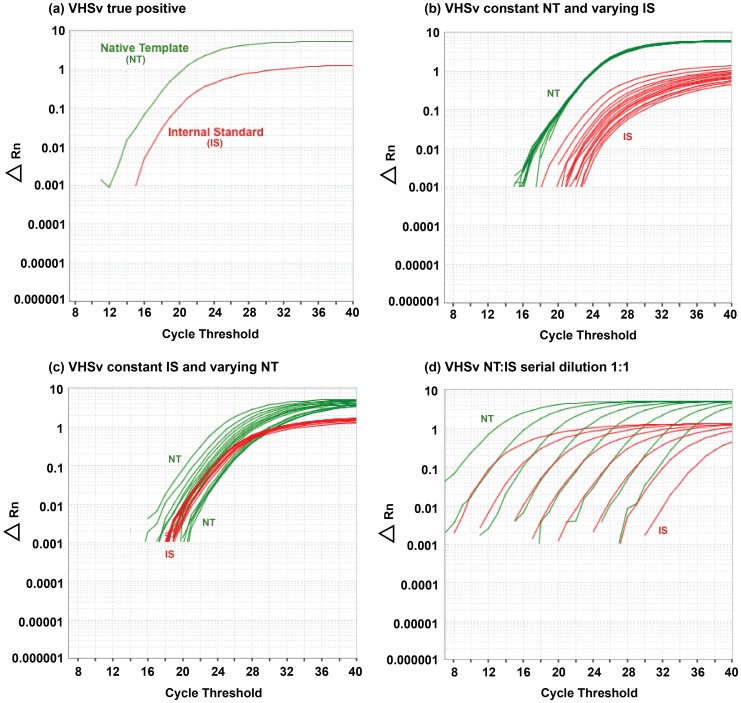
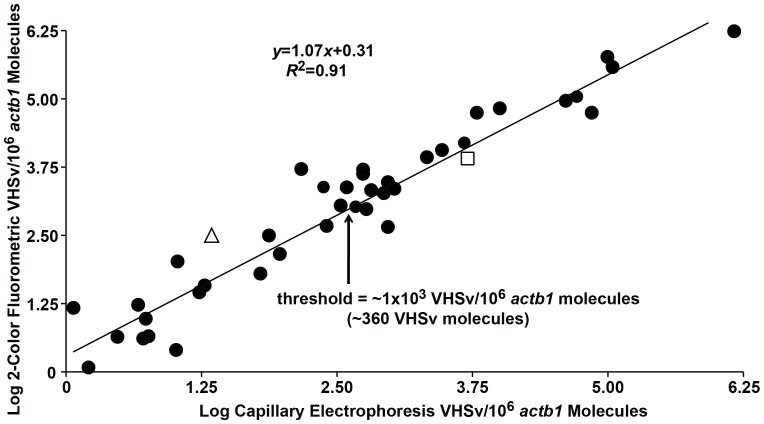
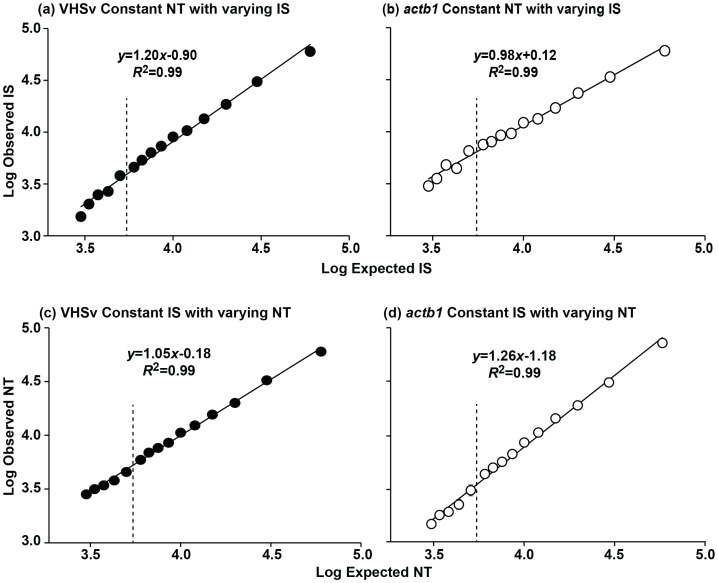
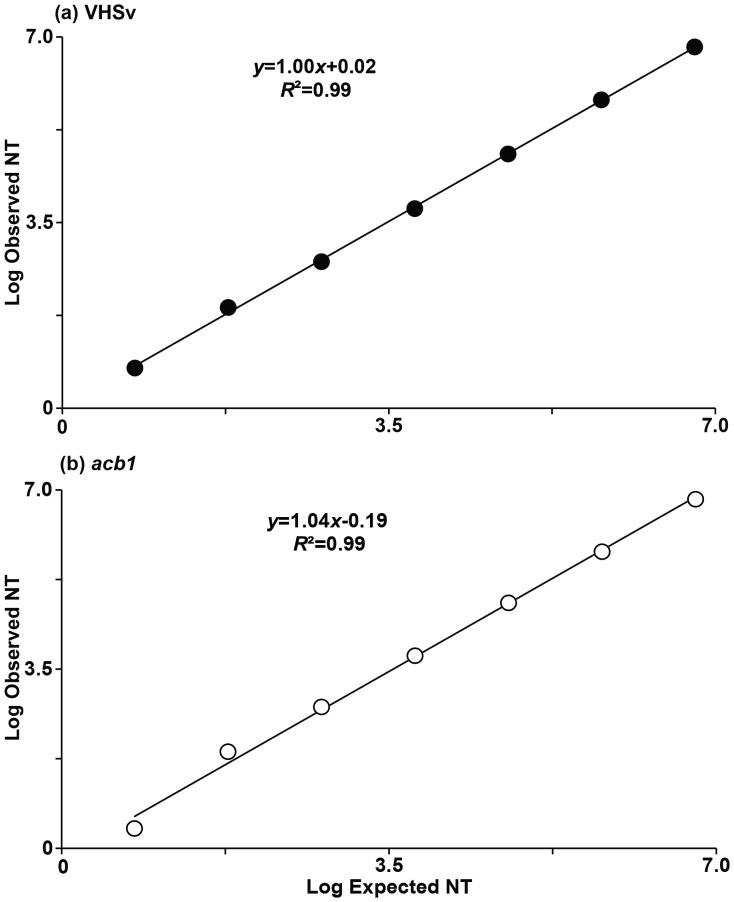
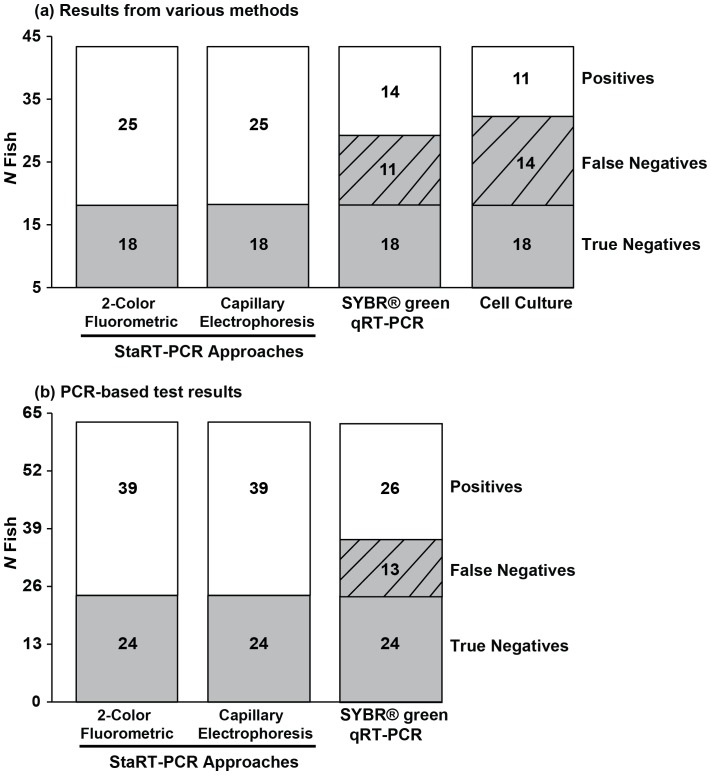
Viral Hemorrhagic Septicemia virus (VHSv) is one of the world's most serious fish pathogens, infecting >80 marine, freshwater, and estuarine fish species from Eurasia and North America. A novel and especially virulent strain - IVb - appeared in the Great Lakes in 2003, has killed many game fish species in a series of outbreaks in subsequent years, and shut down interstate transport of baitfish. Cell culture is the diagnostic method approved by the USDA-APHIS, which takes a month or longer, lacks sensitivity, and does not quantify the amount of virus. We thus present a novel, easy, rapid, and highly sensitive real-time quantitative reverse transcription PCR (qRT-PCR) assay that incorporates synthetic competitive template internal standards for quality control to circumvent false negative results. Results demonstrate high signal-to-analyte response (slope = 1.00±0.02) and a linear dynamic range that spans seven orders of magnitude (R(2) = 0.99), ranging from 6 to 6,000,000 molecules. Infected fishes are found to harbor levels of virus that range to 1,200,000 VHSv molecules/10(6) actb1 molecules with 1,000 being a rough cut-off for clinical signs of disease. This new assay is rapid, inexpensive, and has significantly greater accuracy than other published qRT-PCR tests and traditional cell culture diagnostics.
病毒性出血性败血症病毒(VHSv)是世界上最严重的鱼类病原体之一,感染了来自欧亚大陆和北美的 80 多种海洋、淡水和咸水鱼类。一种新型的、特别具有毒性的菌株-IVb-于 2003 年出现在五大湖中,随后的几年里,它在一系列爆发中杀死了许多游钓鱼类物种,并关闭了州际之间的诱饵鱼运输。细胞培养是美国农业部动植物卫生检验局批准的诊断方法,需要一个月或更长时间,缺乏敏感性,并且不能定量病毒的数量。因此,我们提出了一种新型的、简单的、快速的、高度敏感的实时定量逆转录 PCR(qRT-PCR)检测方法,该方法结合了合成竞争性模板内标,用于质量控制,以避免假阴性结果。结果表明,高信号与分析物的响应(斜率=1.00±0.02)和线性动态范围跨越七个数量级(R(2)=0.99),范围从 6 到 6,000,000 个分子。发现受感染的鱼类携带的病毒水平高达 1,200,000 个 VHSv 分子/10(6)actb1 分子,1,000 个是疾病临床症状的粗略截止值。这种新的检测方法快速、廉价,并且比其他已发表的 qRT-PCR 检测方法和传统的细胞培养诊断方法具有更高的准确性。