Stepien Carol A, Niner Megan D
Genetics and Genomics Group (G3) NOAA Pacific Marine Environmental Laboratory (PMEL) Seattle WA USA.
Genetics and Genomics Group (G3), Department of Environmental Sciences University of Toledo Toledo OH USA.
Ecol Evol. 2020 Sep 2;10(18):9740-9775. doi: 10.1002/ece3.6611. eCollection 2020 Sep.
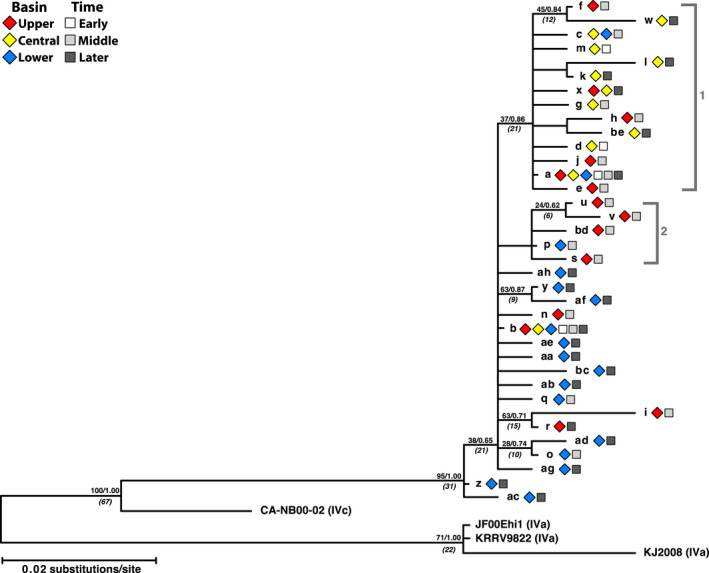
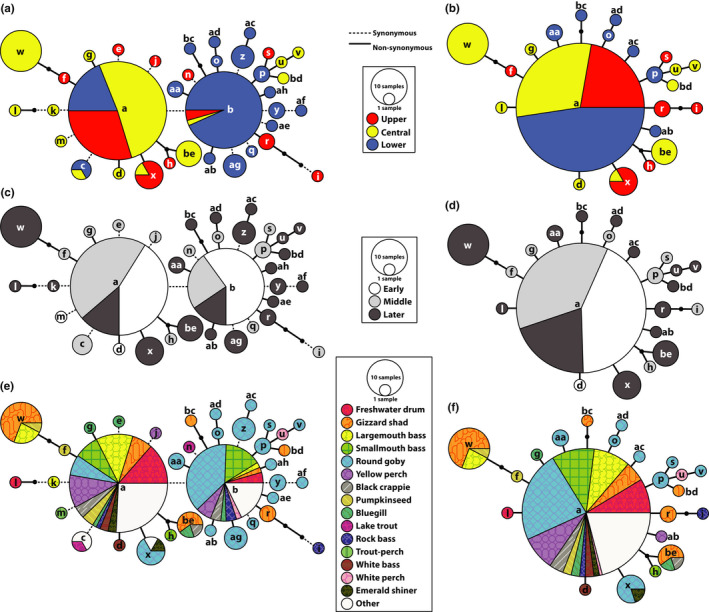
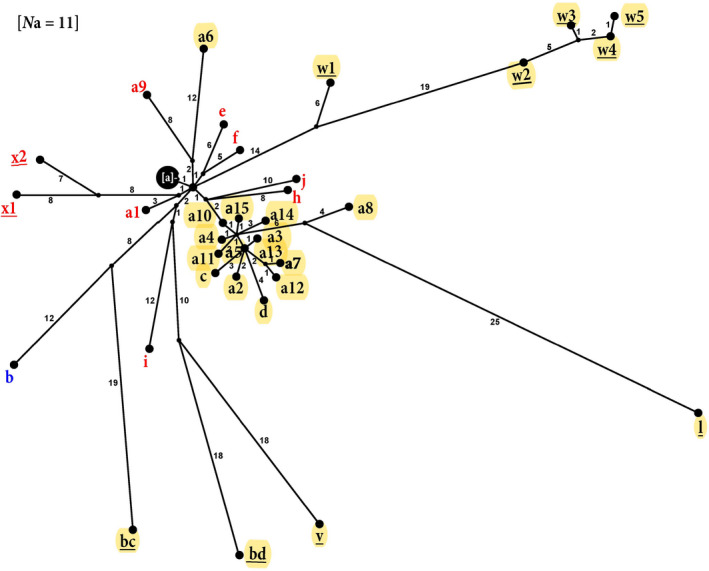
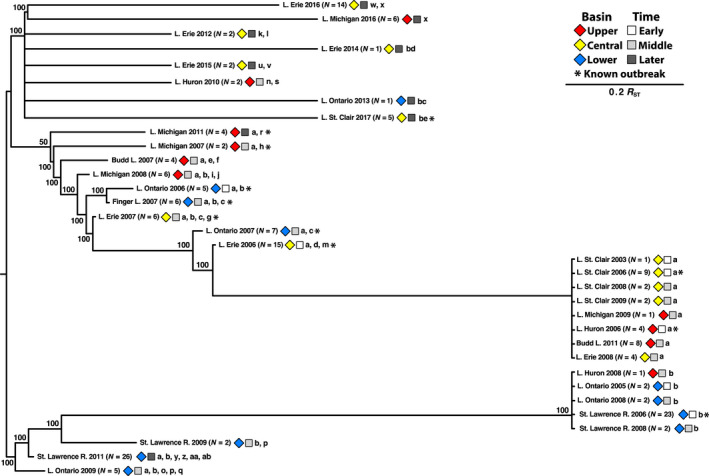
= Viral Hemorrhagic Septicemia Virus (VHSV) first appeared in the Laurentian Great Lakes with large outbreaks from 2005 to 2006, as a new and novel RNA rhabdovirus subgenogroup (IVb) that killed >30 fish species. Interlude periods punctuated smaller more localized outbreaks in 2007, 2010, and 2017, although some fishes tested positive in the intervals. There have not been reports of outbreaks or positives from 2018, 2019, or 2020. Here, we employ a combined population genetics and phylogenetic approach to evaluate spatial and temporal evolutionary trajectory on its gene sequence variation, in comparison with whole-genome sequences (11,083 bp) from a subset of 44 individual isolates (including 40 newly sequenced ones). Our results show that IVb ( = 184 individual fish isolates) diversified into 36 -gene haplotypes from 2003 to 2017, stemming from two originals ("a" and "b"). -gene haplotypes "a" and "b" differed by just one synonymous single-nucleotide polymorphism (SNP) substitution, remained the most abundant until 2011, then disappeared. Group "a" descendants (14 haplotypes) remained most prevalent in the Upper and Central Great Lakes, with eight (51%) having nonsynonymous substitutions. Group "b" descendants primarily have occurred in the Lower Great Lakes, including 22 haplotypes, of which 15 (68%) contained nonsynonymous changes. Evolutionary patterns of the whole-genome sequences (which had 34 haplotypes among 44 isolates) appear congruent with those from the -gene. Virus populations significantly diverged among the Upper, Central, and Lower Great Lakes, diversifying over time. Spatial divergence was apparent in the overall patterns of nucleotide substitutions, while amino acid changes increased temporally. VHSV-IVb thus significantly differentiated across its less than two decades in the Great Lakes, accompanied by declining outbreaks and virulence. Continuing diversification likely allowed the virus to persist at low levels in resident fish populations, and may facilitate its potential for further and future spread to new habitats and nonacclimated hosts.
病毒性出血性败血症病毒(VHSV)于2005年至2006年在劳伦琴五大湖首次大规模爆发,它是一种新型的RNA弹状病毒亚基因组(IVb),导致30多种鱼类死亡。在2007年、2010年和2017年期间有间断,期间有规模较小、范围更局限的疫情爆发,尽管在此期间一些鱼类检测呈阳性。2018年、2019年或2020年没有疫情爆发或阳性报告。在这里,我们采用群体遗传学和系统发育相结合的方法,与44个个体分离株(包括40个新测序的分离株)的子集的全基因组序列(11,083 bp)相比,评估其基因序列变异的时空进化轨迹。我们的结果表明,IVb(=184个个体鱼类分离株)在2003年至2017年间分化为36个基因单倍型,起源于两个原始类型(“a”和“b”)。基因单倍型“a”和“b”仅相差一个同义单核苷酸多态性(SNP)替换,直到2011年一直是最丰富的,然后消失。“a”组后代(14个单倍型)在上五大湖和中五大湖仍然最为普遍,其中八个(51%)有非同义替换。“b”组后代主要出现在下五大湖,包括22个单倍型,其中15个(68%)包含非同义变化。全基因组序列(44个分离株中有34个单倍型)的进化模式似乎与基因的进化模式一致。病毒群体在上五大湖、中五大湖和下五大湖之间有显著差异,且随时间推移而多样化。核苷酸替换的总体模式中空间差异明显,而氨基酸变化随时间增加。因此,VHSV-IVb在五大湖不到二十年的时间里有显著分化,同时疫情爆发和毒力下降。持续的多样化可能使病毒在本地鱼类种群中以低水平持续存在,并可能促进其进一步传播到新栖息地和未适应宿主中的潜力。