National Reference Centre for Bacterial Meningitis, Department of Epidemiology and Clinical Microbiology, National Medicines Institute, Warsaw, Poland.
PLoS One. 2013 Aug 20;8(8):e71943. doi: 10.1371/journal.pone.0071943. eCollection 2013.
Neisseria meningitidis is a leading etiologic agent of severe invasive disease. The objective of the study was to characterise invasive meningococcal disease (IMD) epidemiology in Poland during the last decade, based on laboratory confirmed cases.
The study encompassed all invasive meningococci collected between 2002 and 2011 in the National Reference Centre for Bacterial Meningitis. The isolates were re-identified and characterised by susceptibility testing, MLST analysis, porA and fetA sequencing. A PCR technique was used for meningococcal identification directly from clinical materials.
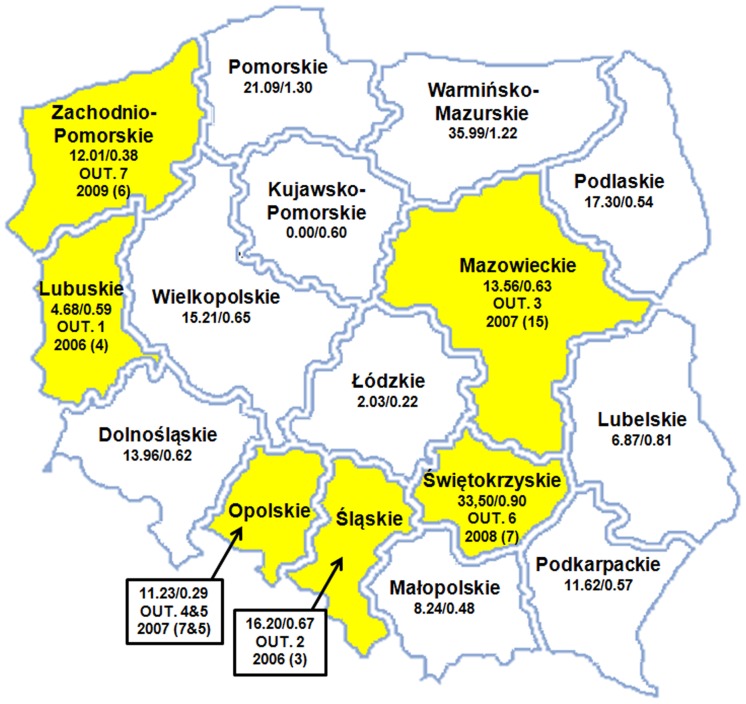
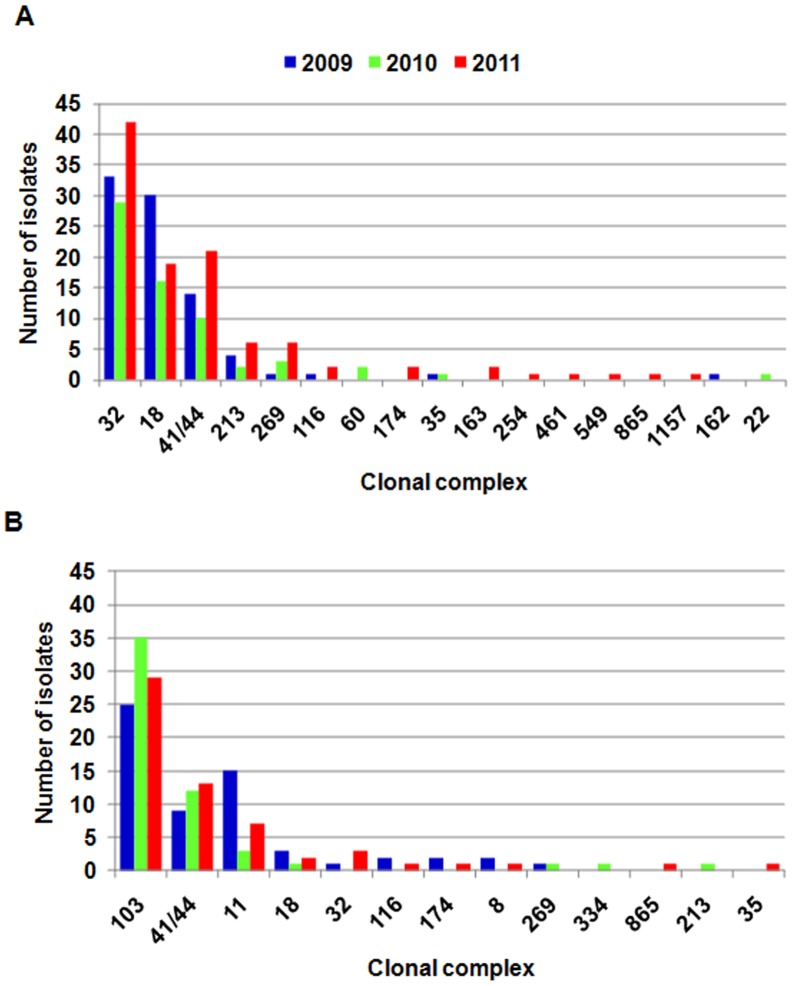
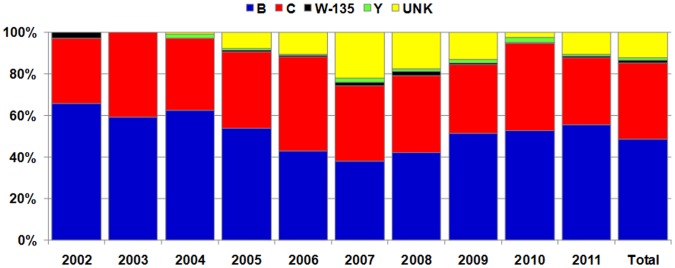
In the period studied, 1936 cases of IMD were confirmed, including 75.6% identified by culture. Seven IMD outbreaks, affecting mostly adolescents, were reported; all were caused by serogroup C meningococci of ST-11. The highest incidence was observed among children under one year of age (15.71/100,000 in 2011). The general case fatality rate in the years 2010-2011 was 10.0%. Meningococci of serogroup B, C, Y and W-135 were responsible for 48.8%, 36.6%, 1.2% and 1.2% of cases, respectively. All isolates were susceptible to third generation cephalosporins, chloramphenicol, ciprofloxacin, and 84.2% were susceptible to penicillin. MLST analysis (2009-2011) revealed that among serogroup B isolates the most represented were clonal complexes (CC) ST-32CC, ST-18CC, ST-41/44CC, ST-213CC and ST-269CC, and among serogroup C: ST-103CC, ST-41/44CC and ST-11CC.
The detection of IMD in Poland has changed over time, but observed increase in the incidence of the disease was mostly attributed to changes in the surveillance system including an expanded case definition and inclusion of data from non-culture diagnostics.
脑膜炎奈瑟菌是严重侵袭性疾病的主要病原体。本研究的目的是基于实验室确诊病例,描述波兰过去十年侵袭性脑膜炎奈瑟菌病( IMD )的流行病学特征。
本研究纳入了 2002 年至 2011 年间在国家细菌脑膜炎参考中心收集的所有侵袭性脑膜炎奈瑟菌。通过药敏试验、MLST 分析、porA 和 fetA 测序对分离株进行重新鉴定和特征分析。使用 PCR 技术直接从临床标本中鉴定脑膜炎奈瑟菌。
在所研究的期间,共确诊了 1936 例 IMD 病例,其中 75.6% 通过培养鉴定。报告了 7 起 IMD 暴发疫情,主要影响青少年;均由 ST-11 血清群 C 脑膜炎奈瑟菌引起。发病率最高的是一岁以下的儿童(2011 年为 15.71/100,000)。2010-2011 年总病死率为 10.0%。血清群 B、C、Y 和 W-135 脑膜炎奈瑟菌分别导致 48.8%、36.6%、1.2%和 1.2%的病例。所有分离株均对第三代头孢菌素、氯霉素、环丙沙星敏感,84.2%对青霉素敏感。MLST 分析(2009-2011 年)显示,血清群 B 分离株中最常见的克隆复合体(CC)为 ST-32CC、ST-18CC、ST-41/44CC、ST-213CC 和 ST-269CC,血清群 C 中最常见的为 ST-103CC、ST-41/44CC 和 ST-11CC。
波兰 IMD 的检测情况随时间发生了变化,但疾病发病率的上升主要归因于监测系统的变化,包括扩大病例定义和纳入非培养诊断数据。