Department of Liver Disease, Jinan Infectious Disease Hospital, Shandong University School of Medicine, Jinan 250021, China.
BMC Infect Dis. 2013 Aug 27;13:394. doi: 10.1186/1471-2334-13-394.
Reactivation of hepatitis B virus (HBV), characterized by increased levels of serum HBV DNA, abnormal liver function and hepatic failure, is a frequent complication of immunosuppressive therapy and chemotherapy in patients with HBV infection. However, reactivation of occult HBV infection with immunosuppressive therapy or chemotherapy is rare.
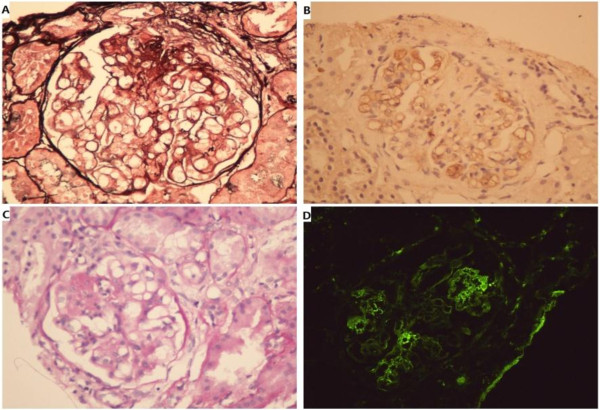
A 77-year-old man was diagnosed with nephrotic syndrome and IgM nephropathy with unclear pathogenesis. Liver function was normal, HBV-related serum markers were negative and HBV DNA titer was below the upper limits of normal. Two months following the start of prednisone therapy for his nephrotic syndrome, laboratory tests revealed a substantial increase in serum transaminase levels (ALT: 490 IU/L; AST: 149 IU/L) and an elevation of HBV DNA level (3.42×10(6) copies/ml). We tested stored kidney tissue for HBsAg and HBcAg using immunohistochemistry and found the sample to be HBcAg positive, allowing us to confirm the etiology of nephropathy as an occult HBV infection. The cause of the hepatitis was thought to be HBV reactivation, so we immediately administered lamivudine. One month after the initiation of daily lamivudine treatment, laboratory tests revealed that serum levels of transaminases had improved (ALT: 35 IU/L; AST: 17 IU/L). Patient examination one year later showed that HBeAg had decreased with a concomitant increase of HBeAb, the quantity of HBV DNA was undetectable, and liver function and renal function had stabilized.
This is the first report describing HBV reactivation in an occult HBV infection patient treated with oral prednisone for nephrotic syndrome. HBV-associated antigen should be regularly tested for in patients with unknown etiological glomerulonephritis in areas with high HBV viral popular and even in those with no clinical evidence for diagnosis of HBV.
乙型肝炎病毒(HBV)再激活的特征是血清 HBV DNA 水平升高、肝功能异常和肝衰竭,这是乙型肝炎病毒感染患者接受免疫抑制治疗和化疗的常见并发症。然而,隐匿性乙型肝炎病毒感染在免疫抑制治疗或化疗后再激活较为罕见。
一名 77 岁男性被诊断为肾病综合征和病因不明的 IgM 肾病。肝功能正常,乙型肝炎相关血清标志物阴性,HBV DNA 载量低于正常值上限。开始肾病综合征泼尼松治疗两个月后,实验室检查显示血清转氨酶水平显著升高(ALT:490IU/L;AST:149IU/L),HBV DNA 水平升高(3.42×10(6)拷贝/ml)。我们使用免疫组织化学法检测储存的肾脏组织中的 HBsAg 和 HBcAg,发现该样本 HBcAg 阳性,从而确认肾病的病因是隐匿性 HBV 感染。乙型肝炎的病因被认为是 HBV 再激活,因此我们立即给予拉米夫定治疗。开始每日拉米夫定治疗一个月后,实验室检查显示血清转氨酶水平改善(ALT:35IU/L;AST:17IU/L)。一年后患者检查发现 HBeAg 减少,同时 HBeAb 增加,HBV DNA 数量不可检测,肝功能和肾功能稳定。
这是首例描述隐匿性 HBV 感染患者在口服泼尼松治疗肾病综合征后发生 HBV 再激活的病例。在乙型肝炎病毒流行率较高的地区,即使无明确乙型肝炎诊断依据,对于病因不明的肾小球肾炎患者也应定期检测 HBV 相关抗原。