Department of East-West Medicine, Graduate School, Kyung Hee University, Seoul 130-701, Republic of Korea.
Evid Based Complement Alternat Med. 2013;2013:436913. doi: 10.1155/2013/436913. Epub 2013 Jul 31.
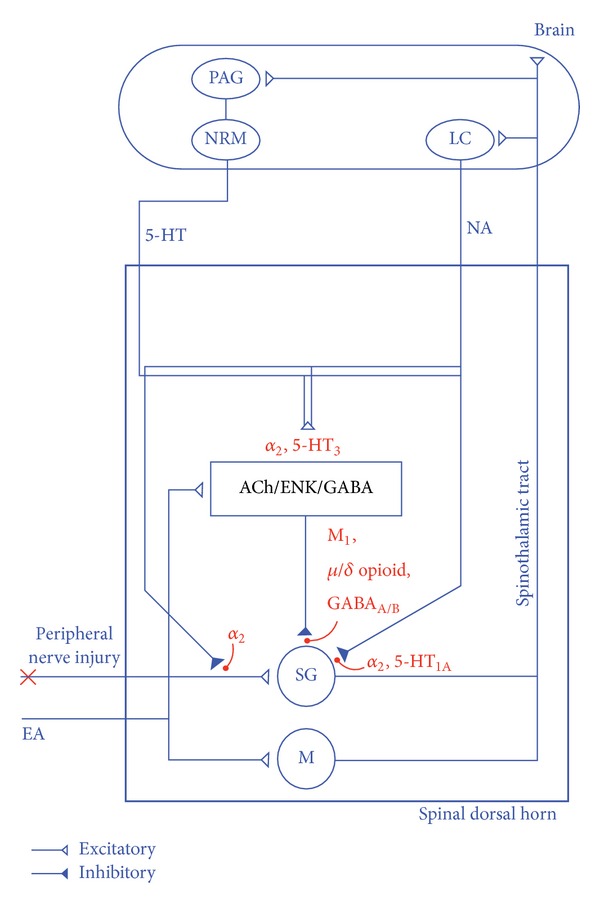
Neuropathic pain remains as one of the most difficult clinical pain syndromes to treat. Electroacupuncture (EA), involving endogenous opioids and neurotransmitters in the central nervous system (CNS), is reported to be clinically efficacious in various fields of pain. Although multiple experimental articles were conducted to assess the effect of EA-induced analgesia, no review has been published to assess the efficacy and clarify the mechanism of EA on neuropathic pain. To this aim, this study was firstly designed to evaluate the EA-induced analgesic effect on neuropathic pain and secondly to guide and help future efforts to advance the neuropathic pain treatment. For this purpose, articles referring to the analgesic effect of acupuncture on neuropathic pain and particularly the work performed in our own laboratory were analyzed. Based on the articles reviewed, the role of spinal opioidergic, adrenergic, serotonergic, cholinergic, and GABAergic receptors in the mechanism of EA-induced analgesia was studied. The results of this research demonstrate that μ and δ opioid receptors, α 2-adrenoreceptors, 5-HT1A and 5-HT3 serotonergic receptors, M1 muscarinic receptors, and GABAA and GABAB GABAergic receptors are involved in the mechanisms of EA-induced analgesia on neuropathic pain.
神经性疼痛仍然是最难治疗的临床疼痛综合征之一。电针(EA)被报道在各种疼痛领域具有临床疗效,它涉及中枢神经系统(CNS)中的内源性阿片类物质和神经递质。尽管进行了多项实验性文章来评估 EA 诱导的镇痛效果,但尚未发表综述来评估 EA 治疗神经性疼痛的疗效和阐明其机制。为此,本研究旨在首先评估 EA 对神经性疼痛的镇痛作用,其次为推进神经性疼痛治疗的未来研究提供指导和帮助。为此,分析了有关针刺治疗神经性疼痛的镇痛作用的文章,特别是我们自己实验室的工作。基于综述的文章,研究了脊髓阿片能、肾上腺素能、5-羟色胺能、胆碱能和 GABA 能受体在 EA 诱导的镇痛机制中的作用。这项研究的结果表明,μ 和 δ 阿片受体、α 2-肾上腺素能受体、5-HT1A 和 5-HT3 5-羟色胺能受体、M1 毒蕈碱受体以及 GABA A 和 GABA B GABA 能受体参与了 EA 诱导的神经性疼痛的镇痛机制。