• 文献检索
  • 文档翻译
  • 深度研究
  • 学术资讯
  • Suppr Zotero 插件Zotero 插件
  • 邀请有礼
  • 套餐&价格
  • 历史记录
应用&插件
Suppr Zotero 插件Zotero 插件浏览器插件Mac 客户端Windows 客户端微信小程序
定价
高级版会员购买积分包购买API积分包
服务
文献检索文档翻译深度研究API 文档MCP 服务
关于我们
关于 Suppr公司介绍联系我们用户协议隐私条款
关注我们

Suppr 超能文献

核心技术专利:CN118964589B侵权必究
粤ICP备2023148730 号-1Suppr @ 2026

文献检索

告别复杂PubMed语法,用中文像聊天一样搜索,搜遍4000万医学文献。AI智能推荐,让科研检索更轻松。

立即免费搜索

文件翻译

保留排版,准确专业,支持PDF/Word/PPT等文件格式,支持 12+语言互译。

免费翻译文档

深度研究

AI帮你快速写综述,25分钟生成高质量综述,智能提取关键信息,辅助科研写作。

立即免费体验

在旱季感染恶性疟原虫:针对冈比亚按蚊唾液 gSG6-P1 肽的 IgG 反应作为塞内加尔北部疟疾风险的敏感生物标志物。

Plasmodium falciparum infection during dry season: IgG responses to Anopheles gambiae salivary gSG6-P1 peptide as sensitive biomarker for malaria risk in Northern Senegal.

机构信息

Centre de Recherche Biomédicale Espoir Pour La Santé, 269 Route de la corniche, Sor, BP: 226, Saint-Louis, Sénégal.

出版信息

Malar J. 2013 Aug 30;12:301. doi: 10.1186/1475-2875-12-301.

DOI:10.1186/1475-2875-12-301
PMID:23988032
原文链接:https://pmc.ncbi.nlm.nih.gov/articles/PMC3766161/
Abstract

BACKGROUND

The Northern part of Senegal is characterized by a low and seasonal transmission of malaria. However, some Plasmodium falciparum infections and malaria clinical cases are reported during the dry season. This study aims to assess the relationship between IgG antibody (Ab) responses to gSG6-P1 mosquito salivary peptide and the prevalence of P. falciparum infection in children during the dry season in the Senegal River Valley. The positive association of the Ab response to gSG6-P1, as biomarker of human exposure to Anopheles vector bite, and P. falciparum infectious status (uninfected, infected-asymptomatic or infected-symptomatic) will allow considering this biomarker as a potential indicator of P. falciparum infection risk during the dry season.

METHODS

Microscopic examination of thick blood smears was performed in 371 and 310 children at the start (January) and at the end (June) of the dry season, respectively, in order to assess the prevalence of P. falciparum infection. Collected sera were used to evaluate IgG response to gSG6-P1 by ELISA. Association between parasitological and clinical data (infected-asymptomatic or infected-symptomatic) and the anti-gSG6-P1 IgG levels were evaluated during this period.

RESULTS

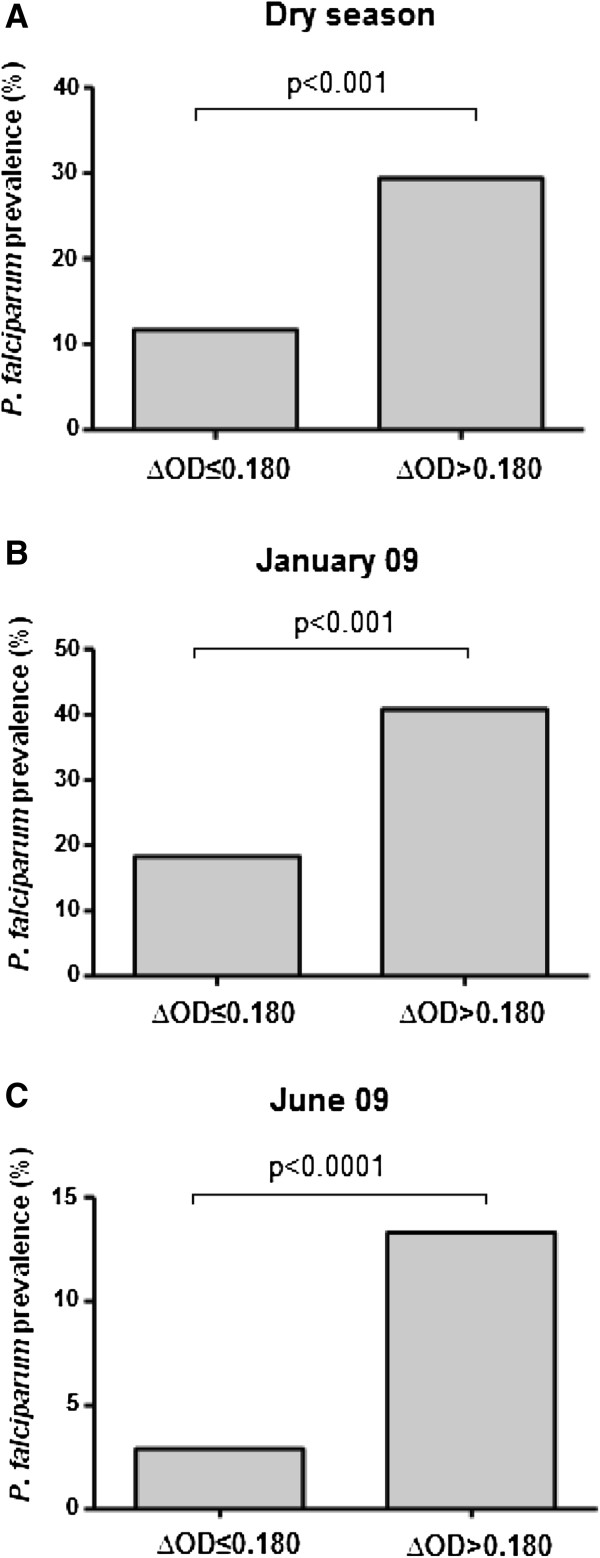
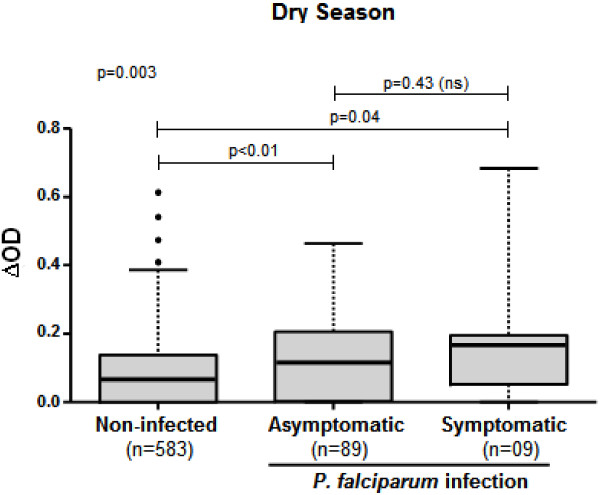
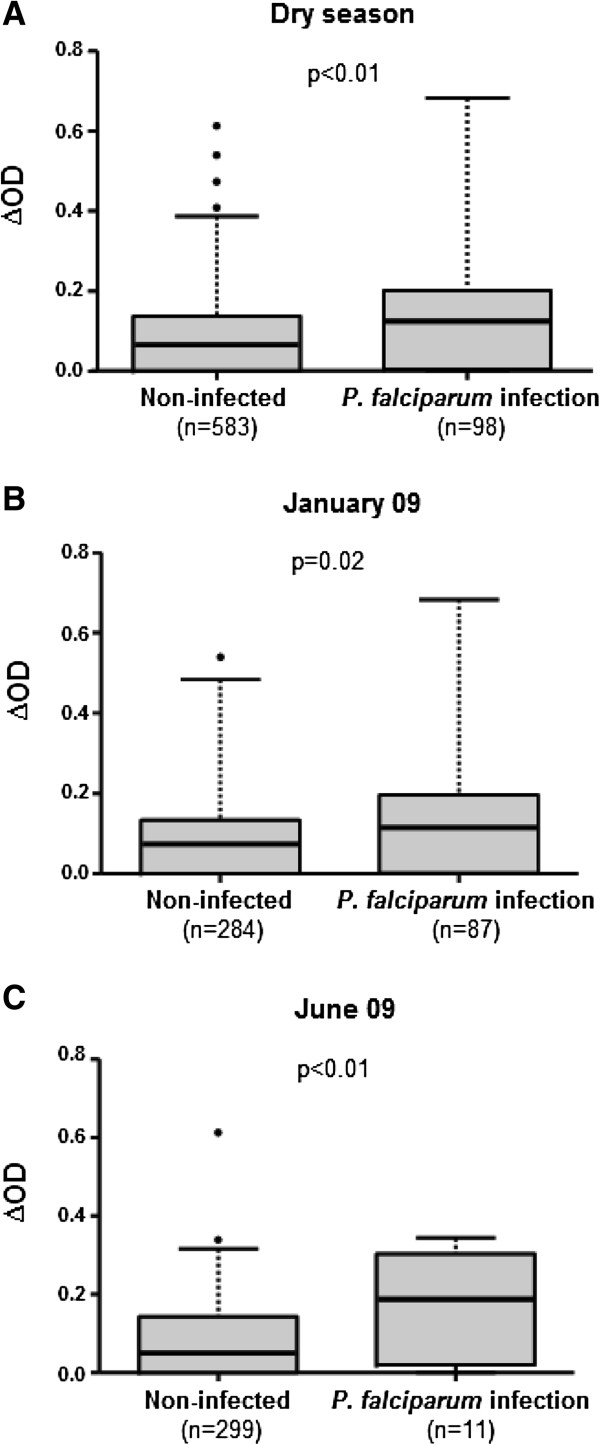
The prevalence of P. falciparum infection was very low to moderate according to the studied period and was higher in January (23.5%) compared to June (3.5%). Specific IgG response was also different between uninfected children and asymptomatic carriers of the parasite. Children with P. falciparum infection in the dry season showed higher IgG Ab levels to gSG6-P1 than uninfected children.

CONCLUSIONS

The results strengthen the hypothesis that malaria transmission is maintained during the dry season in an area of low and seasonal transmission. The measurement of IgG responses to gSG6-P1 salivary peptide could be a pertinent indicator of human malaria reservoir or infection risk in this particular epidemiological context. This promising immunological marker could be useful for the evaluation of the risk of P. falciparum exposure observed during dry season and, by consequences, could be used for the survey of potential pre-elimination situation.

摘要

背景

塞内加尔北部的疟疾传播水平较低且具有季节性。然而,在旱季仍有报道称出现了一些恶性疟原虫感染和疟疾临床病例。本研究旨在评估在塞内加尔河河谷地区,旱季期间 IgG 抗体(Ab)对 gSG6-P1 疟蚊唾液肽的反应与恶性疟原虫感染的流行率之间的关系。Ab 对 gSG6-P1 的阳性反应作为人类接触疟蚊叮咬的生物标志物,与恶性疟原虫感染的状态(未感染、无症状感染或有症状感染)呈正相关,这将使 gSG6-P1 成为评估旱季期间恶性疟原虫感染风险的潜在指标。

方法

分别在旱季开始(1 月)和结束(6 月)时对 371 名和 310 名儿童进行厚血涂片镜检,以评估恶性疟原虫感染的流行率。收集血清,通过 ELISA 评估 gSG6-P1 的 IgG 反应。在此期间,评估了寄生虫学和临床数据(无症状感染或有症状感染)与抗 gSG6-P1 IgG 水平之间的关系。

结果

根据研究期间,恶性疟原虫感染的流行率从低到中不等,1 月(23.5%)高于 6 月(3.5%)。在感染的无症状携带者和未感染者之间,gSG6-P1 的特异性 IgG 反应也不同。在旱季感染恶性疟原虫的儿童的 IgG Ab 水平高于未感染者。

结论

结果加强了旱季在低季节性传播地区维持疟疾传播的假说。gSG6-P1 唾液肽的 IgG 反应测量可能是评估特定流行病学背景下人类疟疾储存库或感染风险的一个有希望的免疫标志物。这种有前途的免疫标志物可能有助于评估旱季观察到的恶性疟原虫暴露风险,因此可用于调查潜在的消除前情况。
https://cdn.ncbi.nlm.nih.gov/pmc/blobs/33c2/3766161/4f24d8fe0cf6/1475-2875-12-301-3.jpg
https://cdn.ncbi.nlm.nih.gov/pmc/blobs/33c2/3766161/e966007e0352/1475-2875-12-301-1.jpg
https://cdn.ncbi.nlm.nih.gov/pmc/blobs/33c2/3766161/f35e285fb5df/1475-2875-12-301-2.jpg
https://cdn.ncbi.nlm.nih.gov/pmc/blobs/33c2/3766161/4f24d8fe0cf6/1475-2875-12-301-3.jpg
https://cdn.ncbi.nlm.nih.gov/pmc/blobs/33c2/3766161/e966007e0352/1475-2875-12-301-1.jpg
https://cdn.ncbi.nlm.nih.gov/pmc/blobs/33c2/3766161/f35e285fb5df/1475-2875-12-301-2.jpg
https://cdn.ncbi.nlm.nih.gov/pmc/blobs/33c2/3766161/4f24d8fe0cf6/1475-2875-12-301-3.jpg

相似文献

1
Plasmodium falciparum infection during dry season: IgG responses to Anopheles gambiae salivary gSG6-P1 peptide as sensitive biomarker for malaria risk in Northern Senegal.在旱季感染恶性疟原虫:针对冈比亚按蚊唾液 gSG6-P1 肽的 IgG 反应作为塞内加尔北部疟疾风险的敏感生物标志物。
Malar J. 2013 Aug 30;12:301. doi: 10.1186/1475-2875-12-301.
2
Utility of plasma anti-gSG6-P1 IgG levels in determining changes in Anopheles gambiae bite rates in a rural area of Cameroon.血浆抗-gSG6-P1 IgG 水平在判断喀麦隆农村地区冈比亚按蚊叮咬率变化中的作用。
Sci Rep. 2024 Jun 21;14(1):14294. doi: 10.1038/s41598-024-58337-8.
3
Exploring the heterogeneity of human exposure to malaria vectors in an urban setting, Bouaké, Côte d'Ivoire, using an immuno-epidemiological biomarker.在科特迪瓦布瓦凯的城市环境中,利用免疫流行病学生物标志物探索人类对疟疾媒介的异质性。
Malar J. 2019 Mar 11;18(1):68. doi: 10.1186/s12936-019-2696-z.
4
gSG6-P1 salivary biomarker discriminates micro-geographical heterogeneity of human exposure to Anopheles bites in low and seasonal malaria areas.gSG6-P1 唾液生物标志物可区分低疟区和季节性疟疾区人类接触疟蚊叮咬的微地域异质性。
Parasit Vectors. 2013 Mar 15;6:68. doi: 10.1186/1756-3305-6-68.
5
Preliminary validation of the use of IgG antibody response to Anopheles gSG6-p1 salivary peptide to assess human exposure to malaria vector bites in two endemic areas of Cameroon in Central Africa.初步验证 IgG 抗体对疟蚊唾液肽 Anopheles gSG6-p1 的反应在中非喀麦隆两个流行地区评估人类疟疾媒介叮咬的应用。
PLoS One. 2020 Dec 31;15(12):e0242510. doi: 10.1371/journal.pone.0242510. eCollection 2020.
6
Variation in exposure to Anopheles gambiae salivary gland peptide (gSG6-P1) across different malaria transmission settings in the western Kenya highlands.肯尼亚西部高原不同疟疾传播环境下冈比亚按蚊唾液腺肽(gSG6-P1)暴露情况的差异。
Malar J. 2012 Sep 10;11:318. doi: 10.1186/1475-2875-11-318.
7
Human IgG response to a salivary peptide, gSG6-P1, as a new immuno-epidemiological tool for evaluating low-level exposure to Anopheles bites.人类对唾液肽gSG6-P1的IgG反应,作为评估低水平按蚊叮咬暴露的一种新的免疫流行病学工具。
Malar J. 2009 Aug 13;8:198. doi: 10.1186/1475-2875-8-198.
8
Salivary Biomarker as a Proxy for Estimating Malaria Exposure on the Thailand-Myanmar Border.唾液生物标志物可作为估算泰缅边境地区疟疾暴露情况的替代指标。
Am J Trop Med Hyg. 2018 Aug;99(2):350-356. doi: 10.4269/ajtmh.18-0081. Epub 2018 May 31.
9
IgG antibody responses to Anopheles gambiae gSG6-P1 salivary peptide are induced in human populations exposed to secondary malaria vectors in forest areas in Cameroon.在喀麦隆森林地区接触次要疟疾传播媒介的人群中,可诱导产生针对冈比亚按蚊 gSG6-P1 唾液肽的 IgG 抗体反应。
PLoS One. 2022 Nov 10;17(11):e0276991. doi: 10.1371/journal.pone.0276991. eCollection 2022.
10
Use of anti-gSG6-P1 IgG as a serological biomarker to assess temporal exposure to Anopheles' mosquito bites in Lower Moshi.使用抗-gSG6-P1 IgG 作为血清生物标志物来评估在Lower Moshi 地区被疟蚊叮咬的时间暴露情况。
PLoS One. 2021 Oct 27;16(10):e0259131. doi: 10.1371/journal.pone.0259131. eCollection 2021.

引用本文的文献

1
Antibody responses to SG6, AgSAP, and SAMSP1 following Anopheline salivary exposure.按蚊唾液暴露后对SG6、AgSAP和SAMSP1的抗体反应。
medRxiv. 2025 Jul 16:2025.07.14.25331506. doi: 10.1101/2025.07.14.25331506.
2
Human IgG responses to Anopheles gambiae immunogenic salivary proteins in urban and rural populations of Burkina Faso: biomarkers of exposure to malaria vector bites.布基纳法索城乡人口对冈比亚按蚊免疫原性唾液蛋白的人免疫球蛋白G反应:接触疟疾媒介叮咬的生物标志物
Parasit Vectors. 2025 May 19;18(1):179. doi: 10.1186/s13071-025-06792-1.
3
Utility of plasma anti-gSG6-P1 IgG levels in determining changes in Anopheles gambiae bite rates in a rural area of Cameroon.

本文引用的文献

1
Evaluation of the effectiveness of malaria vector control measures in urban settings of Dakar by a specific anopheles salivary biomarker.评估达喀尔城市环境中疟疾媒介控制措施的有效性:一种特定的疟蚊唾液生物标志物。
PLoS One. 2013 Jun 20;8(6):e66354. doi: 10.1371/journal.pone.0066354. Print 2013.
2
gSG6-P1 salivary biomarker discriminates micro-geographical heterogeneity of human exposure to Anopheles bites in low and seasonal malaria areas.gSG6-P1 唾液生物标志物可区分低疟区和季节性疟疾区人类接触疟蚊叮咬的微地域异质性。
Parasit Vectors. 2013 Mar 15;6:68. doi: 10.1186/1756-3305-6-68.
3
Factors determining the occurrence of submicroscopic malaria infections and their relevance for control.
血浆抗-gSG6-P1 IgG 水平在判断喀麦隆农村地区冈比亚按蚊叮咬率变化中的作用。
Sci Rep. 2024 Jun 21;14(1):14294. doi: 10.1038/s41598-024-58337-8.
4
Immune responses to P falciparum antibodies in symptomatic malaria patients with variant hemoglobin genotypes in Ghana.加纳具有变异血红蛋白基因型的有症状疟疾病人中对 Pfalciparum 抗体的免疫反应。
BMC Immunol. 2024 Feb 9;25(1):14. doi: 10.1186/s12865-024-00607-1.
5
Implication of agricultural practices in the micro-geographic heterogeneity of malaria transmission in Bouna, Côte d'Ivoire.农业实践对布纳(科特迪瓦)疟疾传播微地域异质性的影响。
Malar J. 2023 Oct 17;22(1):313. doi: 10.1186/s12936-023-04748-3.
6
IgG antibody responses to Anopheles gambiae gSG6-P1 salivary peptide are induced in human populations exposed to secondary malaria vectors in forest areas in Cameroon.在喀麦隆森林地区接触次要疟疾传播媒介的人群中,可诱导产生针对冈比亚按蚊 gSG6-P1 唾液肽的 IgG 抗体反应。
PLoS One. 2022 Nov 10;17(11):e0276991. doi: 10.1371/journal.pone.0276991. eCollection 2022.
7
salivary antigens as serological biomarkers of vector exposure and malaria transmission: A systematic review with multilevel modelling.唾液抗原作为媒介暴露和疟疾传播的血清学生物标志物:一项采用多层次建模的系统评价。
Elife. 2021 Dec 23;10:e73080. doi: 10.7554/eLife.73080.
8
Anopheles arabiensis hotspots along intermittent rivers drive malaria dynamics in semi-arid areas of Central Ethiopia.沿间歇性河流的阿拉伯按蚊热点驱动埃塞俄比亚中部半干旱地区的疟疾动态。
Malar J. 2021 Mar 17;20(1):154. doi: 10.1186/s12936-021-03697-z.
9
Preliminary validation of the use of IgG antibody response to Anopheles gSG6-p1 salivary peptide to assess human exposure to malaria vector bites in two endemic areas of Cameroon in Central Africa.初步验证 IgG 抗体对疟蚊唾液肽 Anopheles gSG6-p1 的反应在中非喀麦隆两个流行地区评估人类疟疾媒介叮咬的应用。
PLoS One. 2020 Dec 31;15(12):e0242510. doi: 10.1371/journal.pone.0242510. eCollection 2020.
10
Targeting Malaria Hotspots to Reduce Transmission Incidence in Senegal.以疟疾热点地区为目标,降低塞内加尔的传播发病率。
Int J Environ Res Public Health. 2020 Dec 24;18(1):76. doi: 10.3390/ijerph18010076.
决定亚临床疟疾感染发生的因素及其对控制的意义。
Nat Commun. 2012;3:1237. doi: 10.1038/ncomms2241.
4
Seroprevalence of pertussis in Senegal: a prospective study.塞内加尔百日咳血清流行率:一项前瞻性研究。
PLoS One. 2012;7(10):e48684. doi: 10.1371/journal.pone.0048684. Epub 2012 Oct 31.
5
Variation in exposure to Anopheles gambiae salivary gland peptide (gSG6-P1) across different malaria transmission settings in the western Kenya highlands.肯尼亚西部高原不同疟疾传播环境下冈比亚按蚊唾液腺肽(gSG6-P1)暴露情况的差异。
Malar J. 2012 Sep 10;11:318. doi: 10.1186/1475-2875-11-318.
6
IgG responses to Anopheles gambiae salivary antigen gSG6 detect variation in exposure to malaria vectors and disease risk.对冈比亚按蚊唾液抗原 gSG6 的 IgG 反应可检测到疟疾媒介接触和疾病风险的变化。
PLoS One. 2012;7(6):e40170. doi: 10.1371/journal.pone.0040170. Epub 2012 Jun 29.
7
Effect of seasonality and ecological factors on the prevalence of the four malaria parasite species in northern mali.季节性和生态因素对马里北部四种疟原虫流行的影响。
J Trop Med. 2012;2012:367160. doi: 10.1155/2012/367160. Epub 2012 Mar 14.
8
IgG responses to the gSG6-P1 salivary peptide for evaluating human exposure to Anopheles bites in urban areas of Dakar region, Sénégal.评估塞内加尔达喀尔地区城市人群中人类被疟蚊叮咬的情况,用 gSG6-P1 唾液肽的 IgG 反应进行评估。
Malar J. 2012 Mar 16;11:72. doi: 10.1186/1475-2875-11-72.
9
Low and seasonal malaria transmission in the middle Senegal River basin: identification and characteristics of Anopheles vectors.塞内加尔河中流域低且季节性疟疾传播:疟蚊媒介的鉴定和特征。
Parasit Vectors. 2012 Jan 23;5:21. doi: 10.1186/1756-3305-5-21.
10
[Sanitary situation of the Senegal River Basin in 2010. Part II: vector-borne diseases and zoonoses].[2010年塞内加尔河流域的卫生状况。第二部分:媒介传播疾病和人畜共患病]
Med Trop (Mars). 2011 Jun;71(3):223-8.