Xu Xiaohui, Ha Sandie, Kan Haidong, Hu Hui, Curbow Barbara A, Lissaker Claudia T K
Department of Epidemiology, College of Public Health and Health Professions and College of Medicine, University of Florida, PO Box 100231, Gainesville, FL 32610, USA.
BMC Public Health. 2013 Sep 3;13:800. doi: 10.1186/1471-2458-13-800.
Air pollution has been extensively and consistently linked with mortality. However, no study has investigated the health effects of air pollution on length of survival among diagnosed respiratory cancer patients.
In this study, we conducted a population-based study to investigate if air pollution exposure has adverse effects on survival time of respiratory cancer cases in Los Angeles (LA), CA and Honolulu, HI. We selected all White respiratory cancer patients in the two study areas from the 1992-2008 Surveillance Epidemiology and End Results cancer data. Death from respiratory cancer and length of survival were the main outcomes.
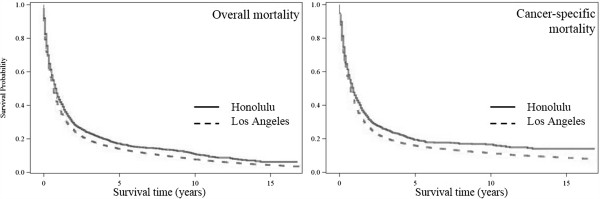
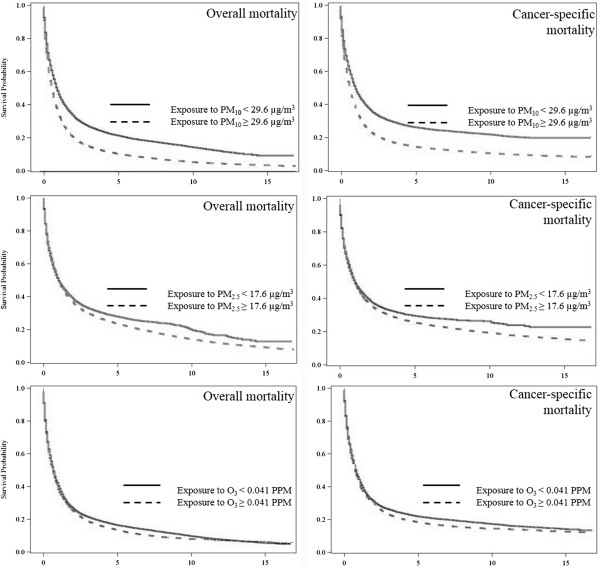
Kaplan-Meier survival analysis shows that all respiratory cancer cases exposed to high air pollution referring to the individuals from LA had a significantly shorter survival time than the low pollution exposure group referring to those from Honolulu without adjusting for other covariates (p <0.0001). Moreover, the results from the Cox Proportional-Hazards models suggest that exposure to particles less than 10 micrometers in diameter (PM10) was associated with an increased risk of cancer death (HR = 1.48, 95% CI: 1.44-1.52 per 10 μg/m3 increase in PM10) after adjusting for demographic factors and cancer characteristics. Similar results were observed for particles less than 2.5 micrometers in diameter and ozone.
Our study indicates that air pollution may have deleterious effects on the length of survival among White respiratory cancer patients. This study calls for attention to preventive effort from air pollution for this susceptible population in standard cancer patient care. The findings from this study warrant further investigation.
空气污染已被广泛且持续地与死亡率联系起来。然而,尚无研究调查空气污染对已确诊的呼吸道癌症患者生存时长的健康影响。
在本研究中,我们开展了一项基于人群的研究,以调查空气污染暴露是否会对加利福尼亚州洛杉矶市(LA)和夏威夷州檀香山市(HI)的呼吸道癌症病例的生存时间产生不利影响。我们从1992 - 2008年监测、流行病学和最终结果癌症数据中选取了这两个研究区域内所有的白人呼吸道癌症患者。呼吸道癌症死亡和生存时长是主要结局。
Kaplan - Meier生存分析表明,在未对其他协变量进行调整的情况下,所有暴露于高空气污染(指来自洛杉矶的个体)的呼吸道癌症病例的生存时间显著短于低污染暴露组(指来自檀香山市的个体)(p < 0.0001)。此外,Cox比例风险模型的结果表明,在调整了人口统计学因素和癌症特征后,暴露于直径小于10微米的颗粒物(PM10)与癌症死亡风险增加相关(每增加10μg/m³的PM10,风险比[HR] = 1.48,95%置信区间[CI]:1.44 - 1.52)。对于直径小于2.5微米的颗粒物和臭氧也观察到了类似结果。
我们的研究表明,空气污染可能对白人呼吸道癌症患者的生存时长产生有害影响。本研究呼吁在标准癌症患者护理中关注针对这一易感人群的空气污染预防措施。本研究的结果值得进一步调查。