Wiese David A, Thaiwong Tuddow, Yuzbasiyan-Gurkan Vilma, Kiupel Matti
Diagnostic Center for Population and Animal Health, Michigan State University, East Lansing, MI, USA.
BMC Cancer. 2013 Sep 3;13:403. doi: 10.1186/1471-2407-13-403.
Breast cancer is one of the leading causes of cancer deaths. Triple-negative breast cancer (TNBC), an immunophenotype defined by the absence of immunolabeling for estrogen receptor (ER), progesterone receptor (PR) and HER2 protein, has a highly aggressive behavior. A subpopulation of TNBCs exhibit a basal-like morphology with immunohistochemical positivity for cytokeratins 5/6 (CK5/6) and/or epidermal growth factor receptor (EGFR), and have a high incidence of BRCA (breast cancer susceptibility) mutations. Feline mammary adenocarcinomas (FMAs) are highly malignant and share a similar basal-like subtype. The purpose of this study was to classify FMAs according to the current human classification of breast cancer that includes evaluation of ER, PR and HER2 status and expression of basal CK 5/6 and EGFR. Furthermore, we selected triple negative, basal-like FMAs to screen for BRCA mutations similar to those described in human TNBC.
Twenty four FMAs were classified according to the current human histologic breast cancer classification including immunohistochemistry (IHC) for ER, PR HER2, CK5/6 and EGFR. Genetic alteration and loss of heterozygosity of BRCA1 and BRCA2 genes were analyzed in triple negative, basal-like FMAs.
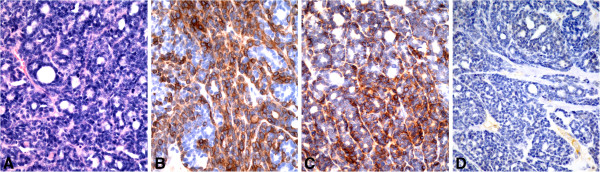
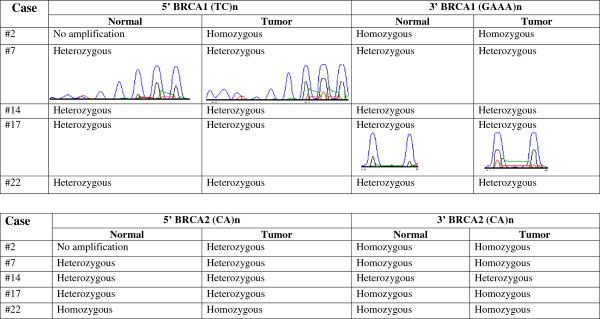
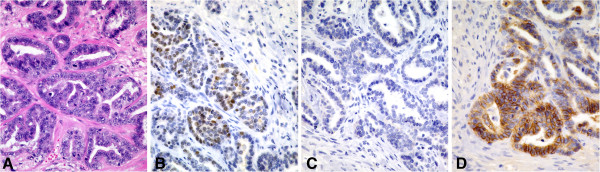
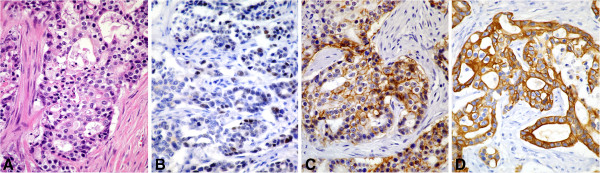
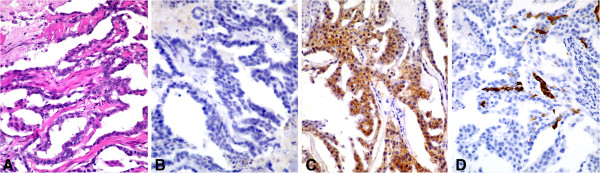
IHC for ER, PR and HER2 identified 14 of the 24 (58%) FMAs as a triple negative. Furthermore, 11 of these 14 (79%) triple negative FMAs had a basal-like subtype. However, no genetic abnormalities were detected in BRCA1 and BRCA2 by direct sequencing and loss of heterozygosity analysis.
FMAs are highly aggressive neoplasms that are commonly triple negative and exhibit a basal-like morphology. This is similar to human TNBC that are also commonly classified as a basal-like subtype. While sequencing of a select number of triple negative, basal-like FMAs and testing for loss of heterozygosity of BRCA1 and BRCA2 did not identify mutations similar to those described in human TNBC, further in-depth evaluation is required to elucidate a potential role of BRCA in the tumorigenesis of triple negative, basal-like FMAs. The strong similarities in clinical behavior, morphology and IHC phenotype suggest that triple negative, basal-like FMAs may be a suitable spontaneous animal model for studying novel therapeutic approaches against human basal-like TNBC.
乳腺癌是癌症死亡的主要原因之一。三阴性乳腺癌(TNBC)是一种免疫表型,其特征为雌激素受体(ER)、孕激素受体(PR)和HER2蛋白免疫标记缺失,具有高度侵袭性。一部分TNBC表现出基底样形态,细胞角蛋白5/6(CK5/6)和/或表皮生长因子受体(EGFR)免疫组化呈阳性,且BRCA(乳腺癌易感基因)突变发生率高。猫乳腺腺癌(FMA)具有高度恶性,且有相似的基底样亚型。本研究的目的是根据当前人类乳腺癌分类方法对FMA进行分类,包括评估ER、PR和HER2状态以及基底CK 5/6和EGFR的表达。此外,我们选择三阴性、基底样FMA来筛查与人类TNBC中描述的相似的BRCA突变。
根据当前人类组织学乳腺癌分类方法,包括对ER、PR、HER2、CK5/6和EGFR进行免疫组织化学(IHC)检测,对24例FMA进行分类。对三阴性、基底样FMA分析BRCA1和BRCA2基因的基因改变和杂合性缺失情况。
ER、PR和HER2的IHC检测确定24例FMA中有14例(58%)为三阴性。此外,这14例三阴性FMA中有11例(79%)为基底样亚型。然而,通过直接测序和杂合性缺失分析,未在BRCA1和BRCA2中检测到基因异常。
FMA是高度侵袭性肿瘤,通常为三阴性,表现出基底样形态。这与人类TNBC相似,后者也通常被分类为基底样亚型。虽然对一些三阴性、基底样FMA进行测序以及检测BRCA1和BRCA2的杂合性缺失未发现与人类TNBC中描述的相似突变,但需要进一步深入评估以阐明BRCA在三阴性、基底样FMA肿瘤发生中的潜在作用。临床行为、形态和IHC表型的高度相似性表明,三阴性、基底样FMA可能是研究针对人类基底样TNBC新治疗方法的合适自发动物模型。