Ono Koji, Hiraoka Toru, Ono Asami, Komatsu Eiji, Shigenaga Takehiko, Takaki Hajime, Maeda Toru, Ogusu Hiroyuki, Yoshida Shintaro, Fukushima Kiyoyasu, Kai Michiaki
Faculty of Nursing at Higashigaoka, Tokyo Healthcare University, 2-5-1, Higashigaoka, Meguro, Tokyo, Japan.
Springerplus. 2013 Aug 21;2:393. doi: 10.1186/2193-1801-2-393. eCollection 2013.
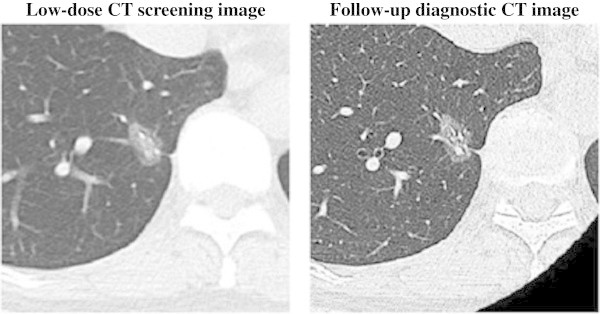
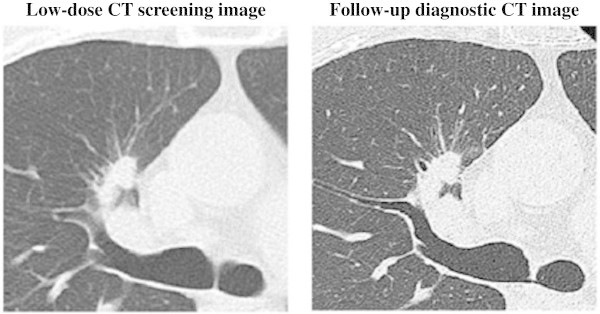
This study aim to compare image quality and radiation doses between low-dose CT and follow-up standard diagnostic CT for lung cancer screening.
In a single medical institution, 19 subjects who had been screened for lung cancer by low-dose CT before going through follow-up standard diagnostic CT were randomly selected. Both CT image sets for all subjects were independently evaluated by five specialized physicians.
There were no significant differences between low-dose CT screening and follow-up standard diagnostic CT for lung cancer screening in all 11 criteria. The concordance rate for the diagnoses was approximately 80% (p < 0.001) for all categories. Agreement of the evaluation of all categories in the final diagnosis exceeded 94% (p < 0.001). Five physicians detecting and characterizing the pulmonary nodules did not recognized the difference between low-dose CT screening and follow-up standard diagnostic CT. With low-dose CT, the effective dose ranged between 1.3 and 3.4 mSv, whereas in the follow-up diagnostic CT, the effective dose ranged between 8.5 and 14.0 mSv.
This study suggests that low-dose CT can be effectively used as a follow-up standard diagnostic CT in place of standard-dose CT in order to reduce the radiation dose.
本研究旨在比较低剂量CT与后续标准诊断CT在肺癌筛查中的图像质量和辐射剂量。
在一家医疗机构中,随机选择19名在进行后续标准诊断CT之前已通过低剂量CT进行肺癌筛查的受试者。所有受试者的两组CT图像均由五名专业医生独立评估。
在所有11项标准中,低剂量CT筛查与后续标准诊断CT在肺癌筛查方面均无显著差异。所有类别的诊断符合率约为80%(p < 0.001)。最终诊断中所有类别的评估一致性超过94%(p < 0.001)。五名检测和描述肺结节的医生未识别出低剂量CT筛查与后续标准诊断CT之间的差异。使用低剂量CT时,有效剂量范围为1.3至3.4 mSv,而在后续诊断CT中,有效剂量范围为8.5至14.0 mSv。
本研究表明,为了降低辐射剂量,低剂量CT可以有效地替代标准剂量CT用作后续标准诊断CT。