Oloomi Kaveh, Saberi Eshaghali, Mokhtari Hadi, Mokhtari Zonouzi Hamid Reza, Nosrat Ali, Nekoofar Mohammad Hossein, Dummer Paul Michael Howell
Department of Endodontics, Tehran University of Medical Sciences School of Dentistry, Tehran, Iran.
Restor Dent Endod. 2013 Aug;38(3):128-33. doi: 10.5395/rde.2013.38.3.128. Epub 2013 Aug 23.
This study was performed to evaluate the effect of blood contamination on the compressive strength (CS) of Root MTA (RMTA) modified with Calcium chloride (CaCl2) and Disodium hydrogen phosphate (Na2HPO4) as setting accelerators over time.
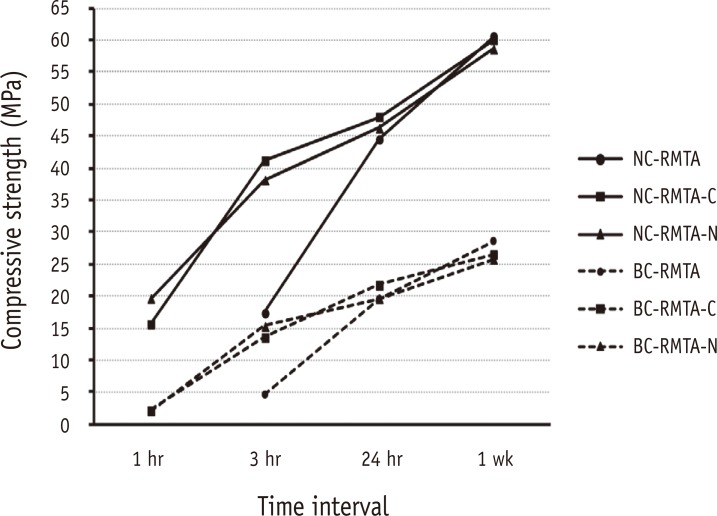
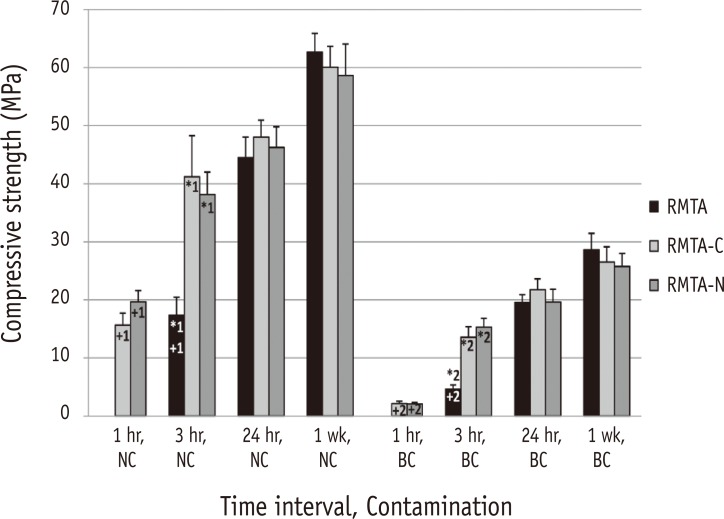
A total of 110 cylindrical specimens of RMTA were divided into 6 experimental groups as follows: Group1, RMTA; Group 2, RMTA modified with CaCl2 (RMTA-C); Group 3, RMTA modified with Na2HPO4 (RMTA-N); Group 4, RMTA contaminated with blood; Group 5, RMTA-C contaminated with blood; Group 6, RMTA-N contaminated with blood. The CS of specimens in all groups was evaluated after 3 hr, 24 hr, and 1 wk. In the modified groups (groups 2, 3, 5, and 6) the CS of five specimens per group was also evaluated after 1 hr.
Blood contamination significantly reduced the CS of all materials at all time intervals (p < 0.05). After 3 hr, the CS of specimens in the RMTA groups (with and without blood contamination) was significantly lower than those in the RMTA-C and RMTA-N groups (p < 0.05). The CS values were not significantly different at the other time intervals. In all groups, the CS of specimens significantly increased over time (p < 0.05).
Blood contamination decreased the CS of both original and accelerated RMTA.
本研究旨在评估血液污染对添加氯化钙(CaCl2)和磷酸氢二钠(Na2HPO4)作为促凝剂的根管封闭剂MTA(RMTA)抗压强度(CS)随时间的影响。
共制备110个RMTA圆柱形试件,分为6个试验组,如下:第1组,RMTA;第2组,添加CaCl2的RMTA(RMTA-C);第3组,添加Na2HPO4的RMTA(RMTA-N);第4组,受血液污染的RMTA;第5组,受血液污染的RMTA-C;第6组,受血液污染的RMTA-N。在3小时、24小时和1周后评估所有组试件的抗压强度。在改性组(第2、3、5和6组)中,每组五个试件在1小时后也进行了抗压强度评估。
在所有时间间隔内,血液污染均显著降低了所有材料的抗压强度(p<0.05)。3小时后,RMTA组(有和无血液污染)试件的抗压强度显著低于RMTA-C组和RMTA-N组(p<0.05)。在其他时间间隔,抗压强度值无显著差异。在所有组中,试件的抗压强度随时间显著增加(p<0.05)。
血液污染降低了原始RMTA和加速RMTA的抗压强度。