Institute of Nursing and Health Research/School of Nursing, University of Ulster, Shore Road, Newtownabbey, BT37 0QB, Antrim, Co, Northern Ireland.
Implement Sci. 2013 Sep 8;8:107. doi: 10.1186/1748-5908-8-107.
Change agency in its various forms is one intervention aimed at improving the effectiveness of the uptake of evidence. Facilitators, knowledge brokers and opinion leaders are examples of change agency strategies used to promote knowledge utilization. This review adopts a realist approach and addresses the following question: What change agency characteristics work, for whom do they work, in what circumstances and why?
The literature reviewed spanned the period 1997-2007. Change agency was operationalized as roles that are aimed at effecting successful change in individuals and organizations. A theoretical framework, developed through stakeholder consultation formed the basis for a search for relevant literature. Team members, working in sub groups, independently themed the data and developed chains of inference to form a series of hypotheses regarding change agency and the role of change agency in knowledge use.
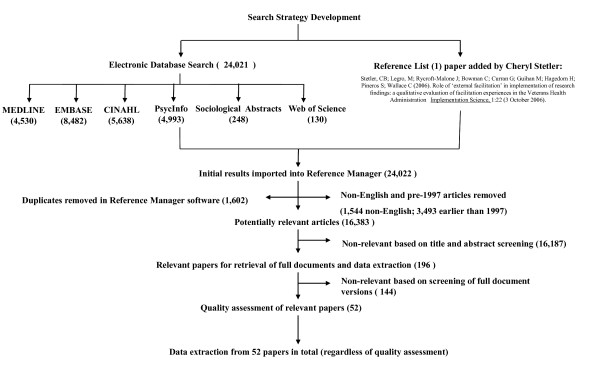
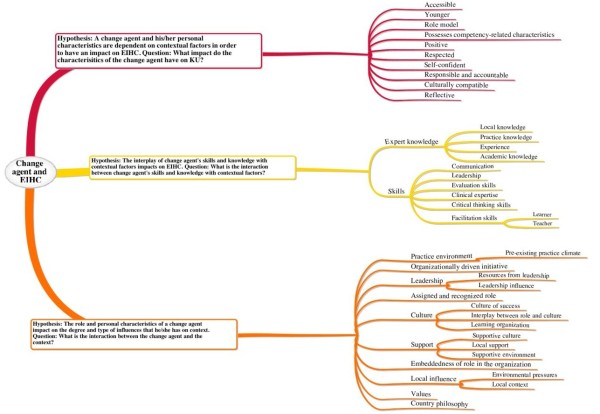
24, 478 electronic references were initially returned from search strategies. Preliminary screening of the article titles reduced the list of potentially relevant papers to 196. A review of full document versions of potentially relevant papers resulted in a final list of 52 papers. The findings add to the knowledge of change agency as they raise issues pertaining to how change agents' function, how individual change agent characteristics effect evidence-informed health care, the influence of interaction between the change agent and the setting and the overall effect of change agency on knowledge utilization. Particular issues are raised such as how accessibility of the change agent, their cultural compatibility and their attitude mediate overall effectiveness. Findings also indicate the importance of promoting reflection on practice and role modeling. The findings of this study are limited by the complexity and diversity of the change agency literature, poor indexing of literature and a lack of theory-driven approaches.
This is the first realist review of change agency. Though effectiveness evidence is weak, change agent roles are evolving, as is the literature, which requires more detailed description of interventions, outcomes measures, the context, intensity, and levels at which interventions are implemented in order to understand how change agent interventions effect evidence-informed health care.
变革代理以各种形式存在,是一种旨在提高证据采用效果的干预措施。促进者、知识经纪人、意见领袖都是用于促进知识利用的变革代理策略的例子。本研究采用现实主义方法,旨在回答以下问题:哪些变革代理特征有效?对谁有效?在什么情况下有效?为什么有效?
文献综述涵盖了 1997 年至 2007 年的时间段。变革代理被操作化为旨在影响个人和组织成功变革的角色。通过利益相关者协商制定的理论框架是搜索相关文献的基础。团队成员分组独立对数据进行主题分析,并形成一系列关于变革代理以及变革代理在知识利用中的作用的推理链,从而形成一系列假设。
从搜索策略中最初返回了 24478 条电子参考文献。通过初步筛选文章标题,将潜在相关文章的列表减少到 196 篇。对潜在相关论文全文版本的审查最终确定了 52 篇论文的清单。研究结果增加了对变革代理的认识,因为它们提出了一些与变革代理如何运作、变革代理的个人特征如何影响循证医疗、变革代理与环境之间的相互作用的影响以及变革代理对知识利用的整体影响等问题。特别提出了变革代理的可及性、文化兼容性和态度如何调解整体效果等问题。研究结果还表明,促进对实践的反思和角色扮演的重要性。本研究的结果受到变革代理文献的复杂性和多样性、文献索引不良以及缺乏理论驱动方法的限制。
这是对变革代理的首次现实主义综述。虽然效果证据薄弱,但变革代理角色正在演变,文献也在演变,这需要更详细地描述干预措施、结果衡量标准、背景、干预实施的强度和层次,以便了解变革代理干预措施如何影响循证医疗。