Faculty of Nursing, University of Alberta, Level 3, Edmonton Clinic Health Academy, Edmonton, AB, Canada.
Implement Sci. 2012 Jul 25;7:70. doi: 10.1186/1748-5908-7-70.
Knowledge translation (KT) aims to close the research-practice gap in order to realize and maximize the benefits of research within the practice setting. Previous studies have investigated KT strategies in nursing and medicine; however, the present study is the first systematic review of the effectiveness of a variety of KT interventions in five allied health disciplines: dietetics, occupational therapy, pharmacy, physiotherapy, and speech-language pathology.
A health research librarian developed and implemented search strategies in eight electronic databases (MEDLINE, CINAHL, ERIC, PASCAL, EMBASE, IPA, Scopus, CENTRAL) using language (English) and date restrictions (1985 to March 2010). Other relevant sources were manually searched. Two reviewers independently screened the titles and abstracts, reviewed full-text articles, performed data extraction, and performed quality assessment. Within each profession, evidence tables were created, grouping and analyzing data by research design, KT strategy, targeted behaviour, and primary outcome. The published descriptions of the KT interventions were compared to the Workgroup for Intervention Development and Evaluation Research (WIDER) Recommendations to Improve the Reporting of the Content of Behaviour Change Interventions.
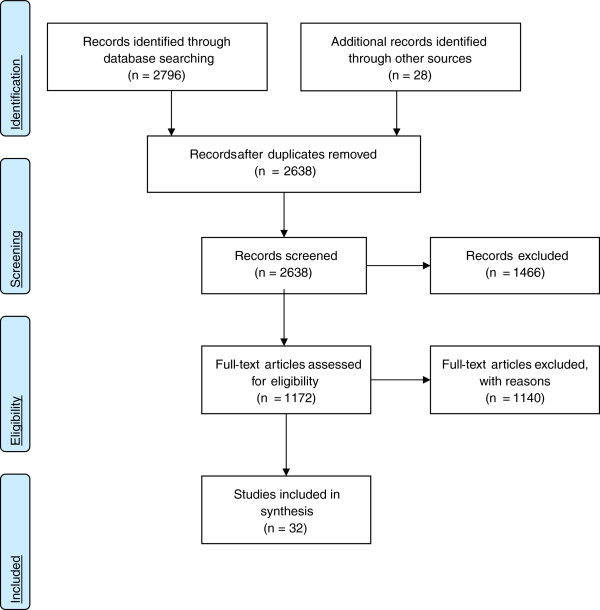
A total of 2,638 articles were located and the titles and abstracts were screened. Of those, 1,172 full-text articles were reviewed and subsequently 32 studies were included in the systematic review. A variety of single (n = 15) and multiple (n = 17) KT interventions were identified, with educational meetings being the predominant KT strategy (n = 11). The majority of primary outcomes were identified as professional/process outcomes (n = 25); however, patient outcomes (n = 4), economic outcomes (n = 2), and multiple primary outcomes (n = 1) were also represented. Generally, the studies were of low methodological quality. Outcome reporting bias was common and precluded clear determination of intervention effectiveness. In the majority of studies, the interventions demonstrated mixed effects on primary outcomes, and only four studies demonstrated statistically significant, positive effects on primary outcomes. None of the studies satisfied the four WIDER Recommendations.
Across five allied health professions, equivocal results, low methodological quality, and outcome reporting bias limited our ability to recommend one KT strategy over another. Further research employing the WIDER Recommendations is needed to inform the development and implementation of effective KT interventions in allied health.
知识转化(KT)旨在缩小研究与实践之间的差距,以便在实践环境中实现和最大化研究的效益。先前的研究已经调查了护理和医学领域的 KT 策略;然而,本研究是首次对五个相关健康学科(营养学、职业治疗、药学、物理治疗和言语-语言病理学)的各种 KT 干预措施的有效性进行系统审查。
一位健康研究图书馆员在八个电子数据库(MEDLINE、CINAHL、ERIC、PASCAL、EMBASE、IPA、Scopus、CENTRAL)中使用语言(英语)和日期限制(1985 年至 2010 年 3 月)制定并实施了搜索策略。其他相关来源通过手动搜索进行了搜索。两位审稿人独立筛选标题和摘要、审查全文文章、进行数据提取和质量评估。在每个专业中,创建了证据表,按研究设计、KT 策略、目标行为和主要结果对数据进行分组和分析。将发表的 KT 干预措施描述与改善行为干预内容报告工作组(WIDER)建议进行了比较。
共定位了 2638 篇文章,并对标题和摘要进行了筛选。其中,有 1172 篇全文文章进行了审查,随后有 32 项研究纳入了系统评价。确定了各种单一(n = 15)和多种(n = 17)KT 干预措施,其中教育会议是主要的 KT 策略(n = 11)。大多数主要结果被确定为专业/过程结果(n = 25);然而,也有患者结果(n = 4)、经济结果(n = 2)和多个主要结果(n = 1)。一般来说,这些研究的方法学质量较低。结果报告偏倚很常见,无法明确确定干预措施的有效性。在大多数研究中,干预措施对主要结果的影响是混合的,只有四项研究对主要结果显示出统计学上的积极影响。没有一项研究符合四个 WIDER 建议。
在五个相关健康专业中,结果不确定、方法学质量低和结果报告偏倚限制了我们推荐一种 KT 策略而不是另一种策略的能力。需要进一步研究采用 WIDER 建议,为相关健康领域有效的 KT 干预措施的制定和实施提供信息。