Department Aquatic Ecotoxicology, Faculty of Biological Sciences, Goethe University Frankfurt, Frankfurt am Main, Germany.
PLoS One. 2013 Aug 28;8(8):e72472. doi: 10.1371/journal.pone.0072472. eCollection 2013.
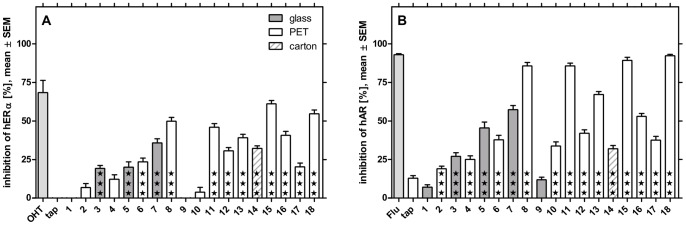
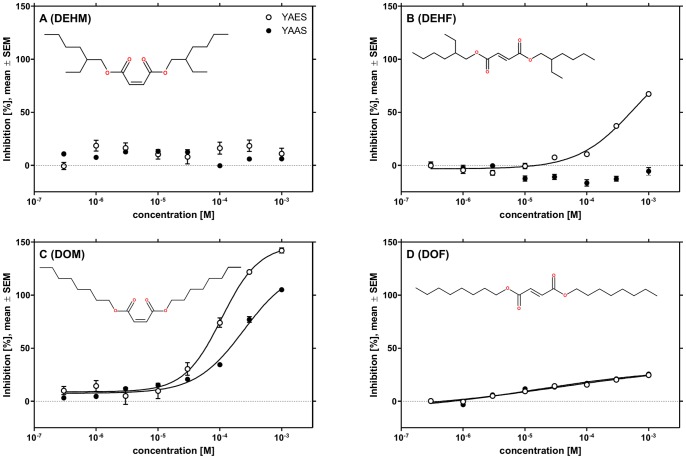
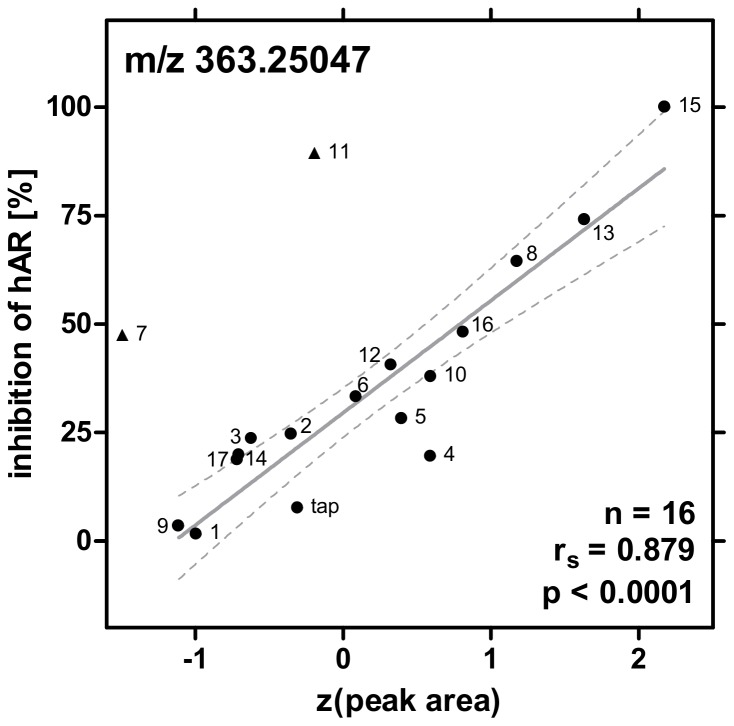
Endocrine disrupting chemicals (EDCs) are man-made compounds interfering with hormone signaling and thereby adversely affecting human health. Recent reports provide evidence for the presence of EDCs in commercially available bottled water, including steroid receptor agonists and antagonists. However, since these findings are based on biological data the causative chemicals remain unidentified and, therefore, inaccessible for toxicological evaluation. Thus, the aim of this study is to assess the antiestrogenic and antiandrogenic activity of bottled water and to identify the causative steroid receptor antagonists. We evaluated the antiestrogenic and antiandrogenic activity of 18 bottled water products in reporter gene assays for human estrogen receptor alpha and androgen receptor. Using nontarget high-resolution mass spectrometry (LTQ-Orbitrap Velos), we acquired corresponding analytical data. We combined the biological and chemical information to determine the exact mass of the tentative steroid receptor antagonist. Further MS(n) experiments elucidated the molecule's structure and enabled its identification. We detected significant antiestrogenicity in 13 of 18 products. 16 samples were antiandrogenic inhibiting the androgen receptor by up to 90%. Nontarget chemical analysis revealed that out of 24520 candidates present in bottled water one was consistently correlated with the antagonistic activity. By combining experimental and in silico MS(n) data we identified this compound as di(2-ethylhexyl) fumarate (DEHF). We confirmed the identity and biological activity of DEHF and additional isomers of dioctyl fumarate and maleate using authentic standards. Since DEHF is antiestrogenic but not antiandrogenic we conclude that additional, yet unidentified EDCs must contribute to the antagonistic effect of bottled water. Applying a novel approach to combine biological and chemical analysis this is the first study to identify so far unknown EDCs in bottled water. Notably, dioctyl fumarates and maleates have been overlooked by science and regulation to date. This illustrates the need to identify novel toxicologically relevant compounds to establish a more holistic picture of the human exposome.
内分泌干扰化学物质(EDCs)是人为合成的化合物,会干扰激素信号传递,从而对人类健康产生不利影响。最近的报告提供了证据,证明商业销售的瓶装水中存在 EDC,包括甾体激素受体激动剂和拮抗剂。然而,由于这些发现基于生物学数据,导致化学物质仍未被确定,因此无法进行毒理学评估。因此,本研究的目的是评估瓶装水中的抗雌激素和抗雄激素活性,并确定潜在的甾体激素受体拮抗剂。我们在人雌激素受体 α 和雄激素受体的报告基因检测中评估了 18 种瓶装水产品的抗雌激素和抗雄激素活性。使用非靶向高分辨率质谱(LTQ-Orbitrap Velos),我们获取了相应的分析数据。我们将生物学和化学信息结合起来,确定了暂定的甾体激素受体拮抗剂的精确质量。进一步的 MS(n)实验阐明了分子的结构,并能够对其进行鉴定。我们发现 18 种产品中有 13 种具有显著的抗雌激素活性。16 个样本具有抗雄激素活性,可抑制雄激素受体达 90%。非靶向化学分析表明,在瓶装水中存在的 24520 种候选物中,有 1 种物质与拮抗活性始终相关。通过结合实验和计算 MS(n)数据,我们将这种化合物鉴定为邻苯二甲酸二(2-乙基己基)酯(DEHF)。我们使用真实标准物证实了 DEHF 的身份和生物活性,以及其他二辛基富马酸酯和马来酸酯的同分异构体。由于 DEHF 具有抗雌激素活性,但没有抗雄激素活性,我们得出结论,还必须有其他未知的 EDC 对瓶装水的拮抗作用做出贡献。本研究应用了一种新方法,将生物学和化学分析相结合,这是首次在瓶装水中鉴定出目前未知的 EDC。值得注意的是,二辛基富马酸酯和马来酸酯迄今为止一直被科学界和监管机构忽视。这说明了需要识别新的具有毒理学相关性的化合物,以建立更全面的人类暴露组学图像。