• 文献检索
  • 文档翻译
  • 深度研究
  • 学术资讯
  • Suppr Zotero 插件Zotero 插件
  • 邀请有礼
  • 套餐&价格
  • 历史记录
应用&插件
Suppr Zotero 插件Zotero 插件浏览器插件Mac 客户端Windows 客户端微信小程序
定价
高级版会员购买积分包购买API积分包
服务
文献检索文档翻译深度研究API 文档MCP 服务
关于我们
关于 Suppr公司介绍联系我们用户协议隐私条款
关注我们

Suppr 超能文献

核心技术专利:CN118964589B侵权必究
粤ICP备2023148730 号-1Suppr @ 2026

文献检索

告别复杂PubMed语法,用中文像聊天一样搜索,搜遍4000万医学文献。AI智能推荐,让科研检索更轻松。

立即免费搜索

文件翻译

保留排版,准确专业,支持PDF/Word/PPT等文件格式,支持 12+语言互译。

免费翻译文档

深度研究

AI帮你快速写综述,25分钟生成高质量综述,智能提取关键信息,辅助科研写作。

立即免费体验

人类在地面行走时步幅变异性的两个独立贡献。

Two independent contributions to step variability during over-ground human walking.

机构信息

Department of Mechanical Engineering and Robotics Institute, Carnegie Mellon University, Pittsburgh, Pennsylvania, United States of America.

出版信息

PLoS One. 2013 Aug 28;8(8):e73597. doi: 10.1371/journal.pone.0073597. eCollection 2013.

DOI:10.1371/journal.pone.0073597
PMID:24015308
原文链接:https://pmc.ncbi.nlm.nih.gov/articles/PMC3756042/
Abstract

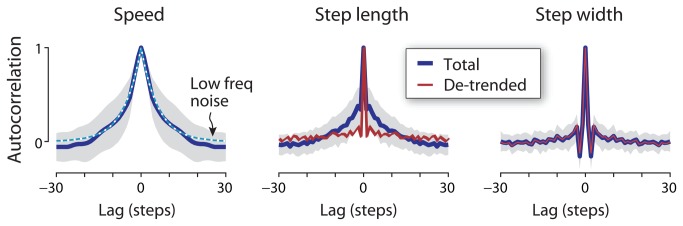
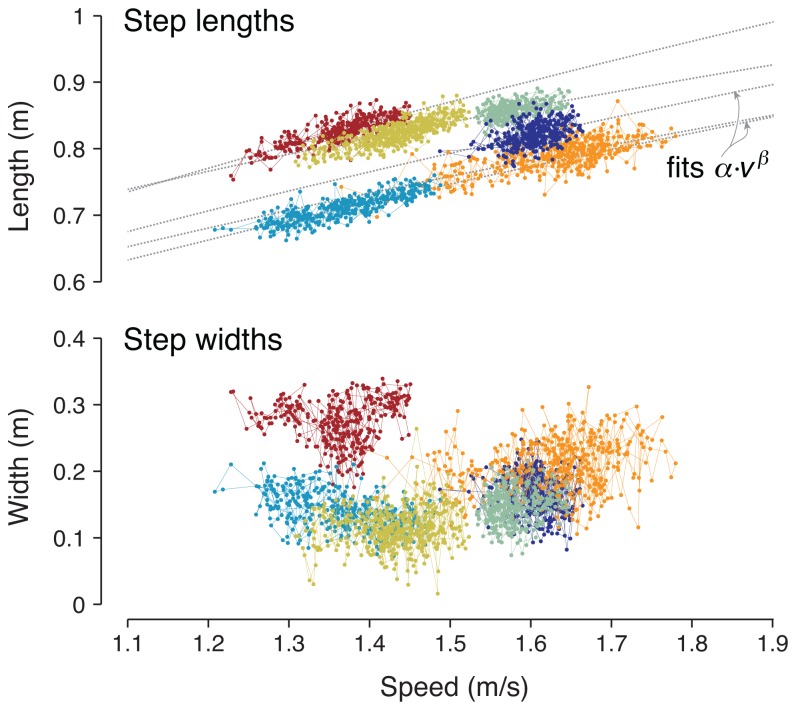
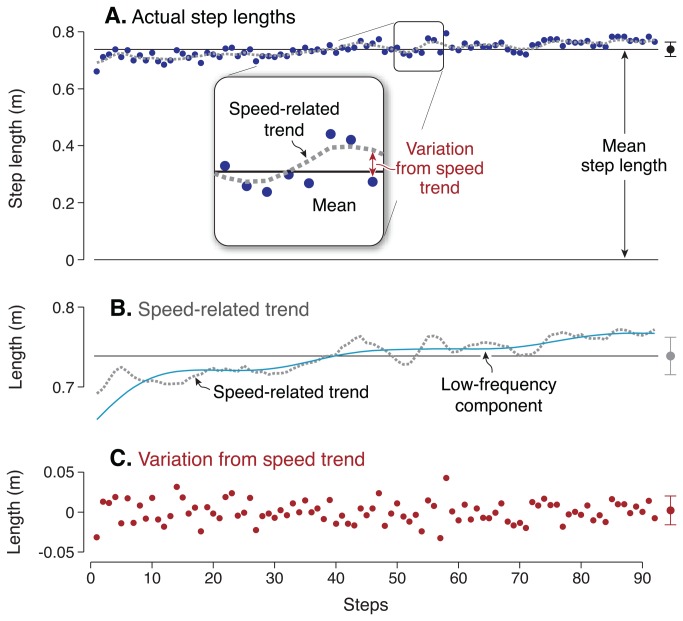
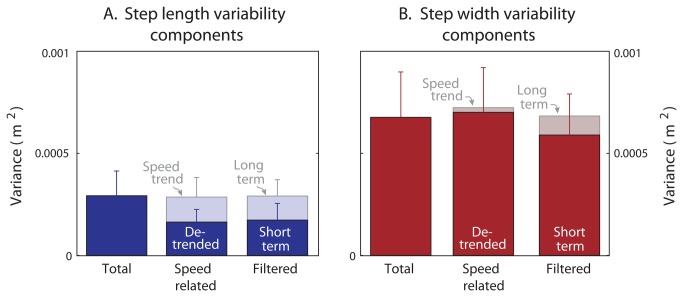
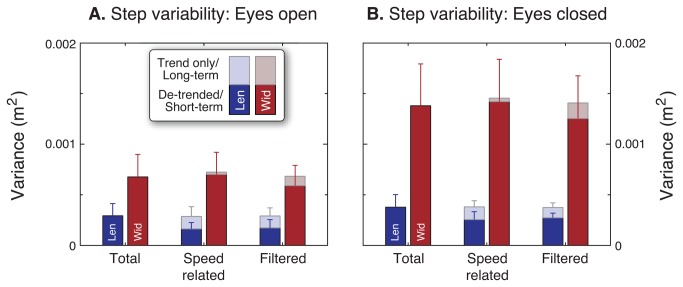
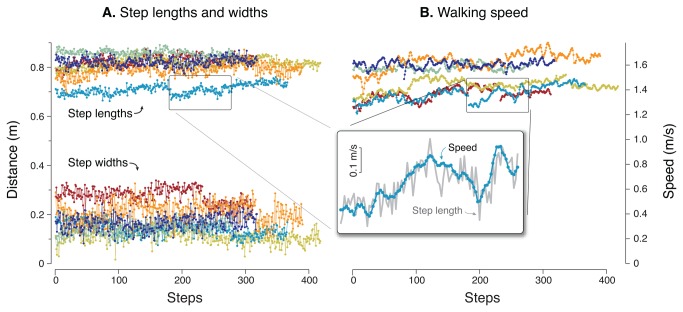
Human walking exhibits small variations in both step length and step width, some of which may be related to active balance control. Lateral balance is thought to require integrative sensorimotor control through adjustment of step width rather than length, contributing to greater variability in step width. Here we propose that step length variations are largely explained by the typical human preference for step length to increase with walking speed, which itself normally exhibits some slow and spontaneous fluctuation. In contrast, step width variations should have little relation to speed if they are produced more for lateral balance. As a test, we examined hundreds of overground walking steps by healthy young adults (N = 14, age < 40 yrs.). We found that slow fluctuations in self-selected walking speed (2.3% coefficient of variation) could explain most of the variance in step length (59%, P < 0.01). The residual variability not explained by speed was small (1.5% coefficient of variation), suggesting that step length is actually quite precise if not for the slow speed fluctuations. Step width varied over faster time scales and was independent of speed fluctuations, with variance 4.3 times greater than that for step length (P < 0.01) after accounting for the speed effect. That difference was further magnified by walking with eyes closed, which appears detrimental to control of lateral balance. Humans appear to modulate fore-aft foot placement in precise accordance with slow fluctuations in walking speed, whereas the variability of lateral foot placement appears more closely related to balance. Step variability is separable in both direction and time scale into balance- and speed-related components. The separation of factors not related to balance may reveal which aspects of walking are most critical for the nervous system to control.

摘要

人类行走时步长和步宽都会有小的变化,其中一些可能与主动平衡控制有关。人们认为,横向平衡需要通过调整步宽而不是步长来进行综合的感觉运动控制,这导致了步宽的更大变化。在这里,我们提出步长的变化在很大程度上可以解释为人类通常倾向于随着步行速度的增加而增加步长,而步行速度本身通常会有一些缓慢的自发波动。相比之下,如果步宽的变化更多是为了横向平衡,那么它们与速度的关系应该不大。作为一个测试,我们检查了数百名健康年轻成年人(N=14,年龄<40 岁)在地面上行走的步伐。我们发现,自我选择的步行速度的缓慢波动(2.3%的变异系数)可以解释步长变化的大部分(59%,P<0.01)。速度无法解释的剩余可变性很小(1.5%的变异系数),这表明如果没有缓慢的速度波动,步长实际上是相当精确的。步宽的变化发生在更快的时间尺度上,与速度波动无关,在考虑速度影响后,其方差是步长方差的 4.3 倍(P<0.01)。这种差异在闭眼行走时进一步放大,这似乎对横向平衡的控制不利。人类似乎以精确的方式根据步行速度的缓慢波动来调节前后脚的位置,而横向脚位置的变化似乎与平衡更密切相关。步长的可变性可以在方向和时间尺度上分为与平衡和速度相关的两个组成部分。将与平衡无关的因素分开,可能会揭示出哪些方面的行走对神经系统的控制最为关键。
https://cdn.ncbi.nlm.nih.gov/pmc/blobs/e688/3756042/f0d741a631ab/pone.0073597.g006.jpg
https://cdn.ncbi.nlm.nih.gov/pmc/blobs/e688/3756042/a8b334e42657/pone.0073597.g001.jpg
https://cdn.ncbi.nlm.nih.gov/pmc/blobs/e688/3756042/0a7b29530228/pone.0073597.g002.jpg
https://cdn.ncbi.nlm.nih.gov/pmc/blobs/e688/3756042/4ba992277cd2/pone.0073597.g003.jpg
https://cdn.ncbi.nlm.nih.gov/pmc/blobs/e688/3756042/351aae253442/pone.0073597.g004.jpg
https://cdn.ncbi.nlm.nih.gov/pmc/blobs/e688/3756042/a10105fb8520/pone.0073597.g005.jpg
https://cdn.ncbi.nlm.nih.gov/pmc/blobs/e688/3756042/f0d741a631ab/pone.0073597.g006.jpg
https://cdn.ncbi.nlm.nih.gov/pmc/blobs/e688/3756042/a8b334e42657/pone.0073597.g001.jpg
https://cdn.ncbi.nlm.nih.gov/pmc/blobs/e688/3756042/0a7b29530228/pone.0073597.g002.jpg
https://cdn.ncbi.nlm.nih.gov/pmc/blobs/e688/3756042/4ba992277cd2/pone.0073597.g003.jpg
https://cdn.ncbi.nlm.nih.gov/pmc/blobs/e688/3756042/351aae253442/pone.0073597.g004.jpg
https://cdn.ncbi.nlm.nih.gov/pmc/blobs/e688/3756042/a10105fb8520/pone.0073597.g005.jpg
https://cdn.ncbi.nlm.nih.gov/pmc/blobs/e688/3756042/f0d741a631ab/pone.0073597.g006.jpg

相似文献

1
Two independent contributions to step variability during over-ground human walking.人类在地面行走时步幅变异性的两个独立贡献。
PLoS One. 2013 Aug 28;8(8):e73597. doi: 10.1371/journal.pone.0073597. eCollection 2013.
2
Direction-dependent control of balance during walking and standing.行走和站立过程中平衡的方向依赖性控制。
J Neurophysiol. 2009 Sep;102(3):1411-9. doi: 10.1152/jn.00131.2009. Epub 2009 Jun 24.
3
Active control of lateral balance in human walking.人体行走中对侧向平衡的主动控制。
J Biomech. 2000 Nov;33(11):1433-40. doi: 10.1016/s0021-9290(00)00101-9.
4
Motor-equivalent covariation stabilizes step parameters and center of mass position during treadmill walking.在跑步机上行走时,运动等效协变稳定了步幅参数和质心位置。
Exp Brain Res. 2010 Nov;207(1-2):13-26. doi: 10.1007/s00221-010-2424-y. Epub 2010 Sep 23.
5
Interaction between step-to-step variability and metabolic cost of transport during human walking.人类行走时步幅变异性与运动代谢成本之间的相互作用。
J Exp Biol. 2018 Nov 12;221(Pt 22):jeb181834. doi: 10.1242/jeb.181834.
6
Energetic cost of walking with increased step variability.步幅变异性增加时行走的能量消耗。
Gait Posture. 2012 May;36(1):102-7. doi: 10.1016/j.gaitpost.2012.01.014. Epub 2012 Mar 28.
7
Effects of visual deprivation on stability among young and older adults during treadmill walking.视觉剥夺对年轻人和老年人在跑步机行走时稳定性的影响。
Gait Posture. 2017 May;54:106-111. doi: 10.1016/j.gaitpost.2017.03.001. Epub 2017 Mar 6.
8
The effect of lateral stabilization on walking in young and old adults.侧向稳定对年轻人和老年人行走的影响。
IEEE Trans Biomed Eng. 2007 Nov;54(11):1919-26. doi: 10.1109/TBME.2007.901031.
9
The influence of altered foot placement and cognitive load on balance control during walking in healthy young adults.改变足部位置和认知负荷对健康年轻成年人行走时平衡控制的影响。
Gait Posture. 2023 Jun;103:37-43. doi: 10.1016/j.gaitpost.2023.04.007. Epub 2023 Apr 6.
10
The stabilizing properties of foot yaw in human walking.人类行走中足部偏航的稳定特性。
J Biomech. 2017 Feb 28;53:1-8. doi: 10.1016/j.jbiomech.2016.11.059. Epub 2016 Dec 1.

引用本文的文献

1
Probing gait adaptations: The impact of aging on dynamic stability and reflex control mechanisms under varied weight-bearing conditions.探究步态适应性:衰老对不同负重条件下动态稳定性和反射控制机制的影响。
Eur J Appl Physiol. 2025 Jul 1. doi: 10.1007/s00421-025-05884-1.
2
Natural variability increases human walking metabolic costs and its implications to simulation-based metabolic estimation.自然变异性增加人类行走的代谢成本及其对基于模拟的代谢估计的影响。
bioRxiv. 2025 Mar 15:2025.03.13.643096. doi: 10.1101/2025.03.13.643096.
3
Walking with increased step length variability increases the metabolic cost of walking in young adults.

本文引用的文献

1
Distinct fast and slow processes contribute to the selection of preferred step frequency during human walking.不同的快、慢过程有助于人类行走时选择最优的步频。
J Appl Physiol (1985). 2011 Jun;110(6):1682-90. doi: 10.1152/japplphysiol.00536.2010. Epub 2011 Mar 10.
2
Do humans optimally exploit redundancy to control step variability in walking?人类是否能最优地利用冗余来控制行走时的步长变异性?
PLoS Comput Biol. 2010 Jul 15;6(7):e1000856. doi: 10.1371/journal.pcbi.1000856.
3
Balance responses to lateral perturbations in human treadmill walking.
步长变异性增加时行走会增加年轻人行走的代谢成本。
J Exp Biol. 2025 Apr 15;228(8). doi: 10.1242/jeb.250126. Epub 2025 Apr 24.
4
Gait Variability as a Potential Motor Marker of Cerebellar Disease-Relationship between Variability of Stride, Arm Swing and Trunk Movements, and Walking Speed.步态可变性作为小脑疾病的潜在运动标志物-步幅、手臂摆动和躯干运动的可变性与行走速度的关系。
Sensors (Basel). 2024 May 28;24(11):3476. doi: 10.3390/s24113476.
5
Walking with increased step length variability increases the metabolic cost of walking.步长变异性增加时行走会增加行走的代谢成本。
bioRxiv. 2024 Jun 2:2024.05.28.596299. doi: 10.1101/2024.05.28.596299.
6
Effects of sedentary behaviour and long-term regular Tai Chi exercise on dynamic stability control during gait initiation in older women.久坐行为和长期规律太极拳锻炼对老年女性步态起始时动态稳定性控制的影响。
Front Bioeng Biotechnol. 2024 May 9;12:1353270. doi: 10.3389/fbioe.2024.1353270. eCollection 2024.
7
Regional differences in the biological variability of plantar pressure as a basis for refining diagnostic gait analysis.足底压力生物变异性的区域差异作为优化诊断性步态分析的基础。
Sci Rep. 2024 Mar 11;14(1):5911. doi: 10.1038/s41598-024-53787-6.
8
Optimizing exoskeleton assistance to improve walking speed and energy economy for older adults.优化外骨骼辅助以提高老年人的行走速度和能量效率。
J Neuroeng Rehabil. 2024 Jan 2;21(1):1. doi: 10.1186/s12984-023-01287-5.
9
Does the effect of walking balance perturbations generalize across contexts?行走平衡扰动的效果是否能在不同情境中普遍适用?
Hum Mov Sci. 2024 Feb;93:103158. doi: 10.1016/j.humov.2023.103158. Epub 2023 Nov 28.
10
The effect of image fractal properties and its interaction with visual discomfort on gait kinematics.图像分形属性及其与视觉不适的相互作用对步态运动学的影响。
Sci Rep. 2023 Oct 3;13(1):16581. doi: 10.1038/s41598-023-42114-0.
人类在跑步机上行走时对侧向扰动的平衡反应。
J Exp Biol. 2010 Aug 1;213(Pt 15):2655-64. doi: 10.1242/jeb.042572.
4
Walking variability during continuous pseudo-random oscillations of the support surface and visual field.支撑面和视野连续伪随机摆动时的行走变异性。
J Biomech. 2010 May 28;43(8):1470-5. doi: 10.1016/j.jbiomech.2010.02.003. Epub 2010 Mar 26.
5
Dynamic principles of gait and their clinical implications.步态的动力学原理及其临床意义。
Phys Ther. 2010 Feb;90(2):157-74. doi: 10.2522/ptj.20090125. Epub 2009 Dec 18.
6
Gait adaptations to simultaneous cognitive and mechanical constraints.步态对同时存在的认知和机械约束的适应性。
Exp Brain Res. 2009 Oct;199(1):39-48. doi: 10.1007/s00221-009-1968-1. Epub 2009 Aug 12.
7
Direction-dependent control of balance during walking and standing.行走和站立过程中平衡的方向依赖性控制。
J Neurophysiol. 2009 Sep;102(3):1411-9. doi: 10.1152/jn.00131.2009. Epub 2009 Jun 24.
8
The effect of lateral stabilization on walking in young and old adults.侧向稳定对年轻人和老年人行走的影响。
IEEE Trans Biomed Eng. 2007 Nov;54(11):1919-26. doi: 10.1109/TBME.2007.901031.
9
Stance time and step width variability have unique contributing impairments in older persons.站立时间和步幅变异性在老年人中具有独特的促成损伤因素。
Gait Posture. 2008 Apr;27(3):431-9. doi: 10.1016/j.gaitpost.2007.05.016. Epub 2007 Jul 13.
10
Dominance of gait cycle duration in casual walking.日常行走中步态周期时长的主导因素
Hum Mov Sci. 2006 Jun;25(3):383-92. doi: 10.1016/j.humov.2006.01.001. Epub 2006 Mar 24.