Department of Health Services Research - Focusing on Chronic Care and Ageing, CAPHRI School for Public Health and Primary Care, Maastricht University, P O Box 616, 6200 MD Maastricht, Netherlands.
BMJ. 2013 Sep 10;347:f5264. doi: 10.1136/bmj.f5264.
To evaluate whether an interdisciplinary primary care approach for community dwelling frail older people is more effective than usual care in reducing disability and preventing (further) functional decline.
Cluster randomised controlled trial.
12 general practices in the south of the Netherlands
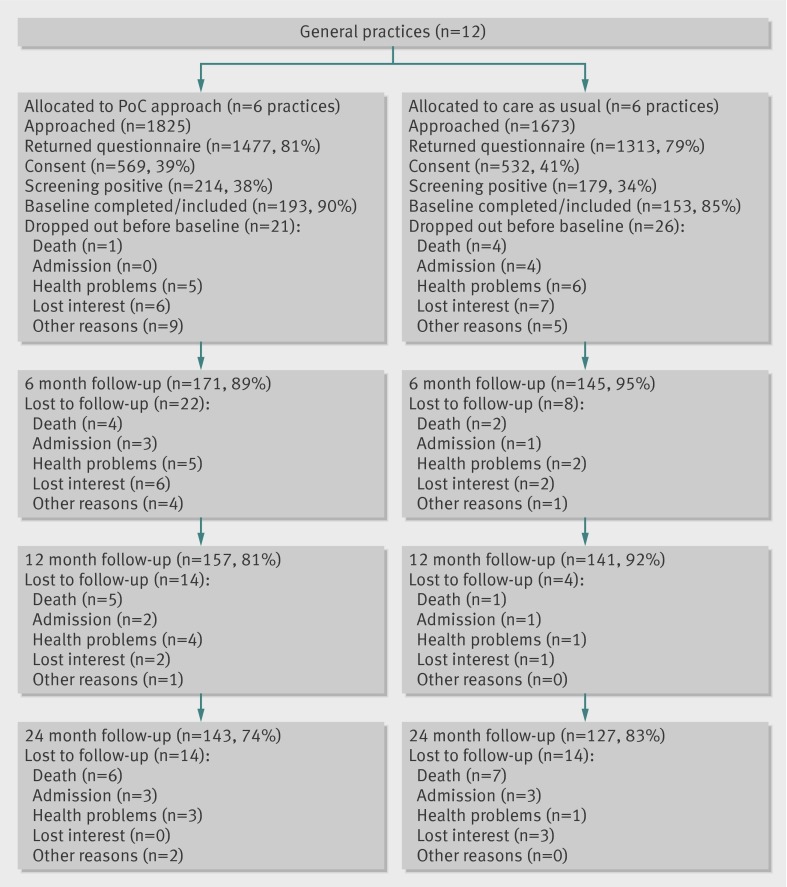
346 frail older people (score ≥ 5 on Groningen Frailty Indicator) were included; 270 (78%) completed the study.
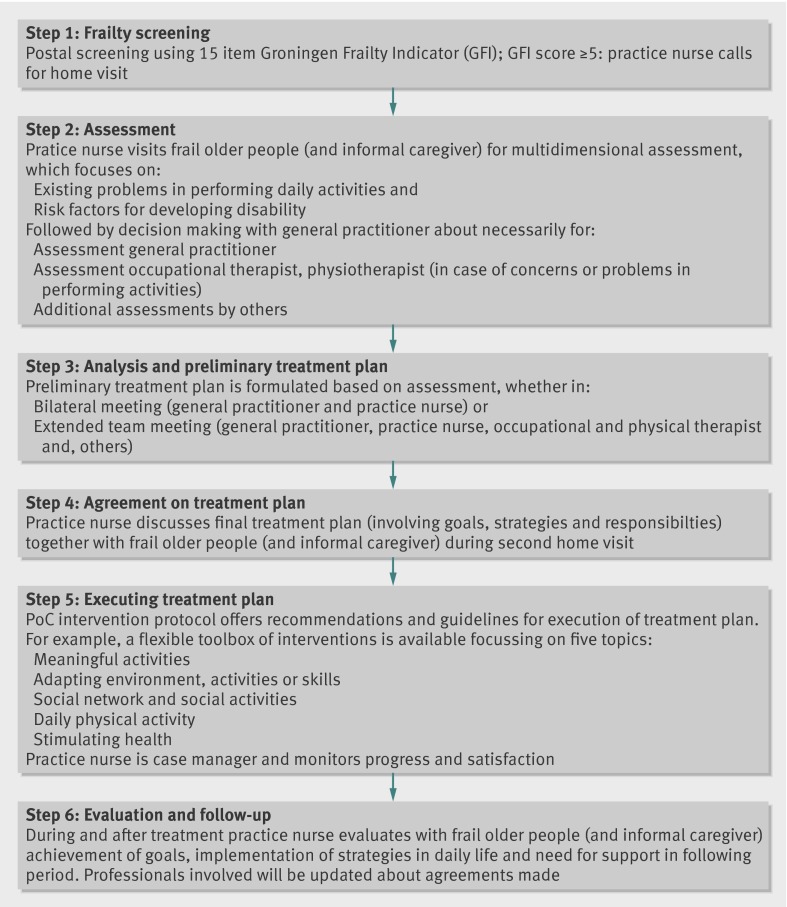
General practices were randomised to the intervention or control group. Practices in the control group delivered care as usual. Practices in the intervention group implemented the "Prevention of Care" (PoC) approach, in which frail older people received a multidimensional assessment and interdisciplinary care based on a tailor made treatment plan and regular evaluation and follow-up.
The primary outcome was disability, assessed at 24 months by means of the Groningen Activity Restriction Scale. Secondary outcomes were depressive symptomatology, social support interactions, fear of falling, and social participation. Outcomes were measured at baseline and at 6, 12, and 24 months' follow-up.
193 older people in the intervention group (six practices) received the PoC approach; 153 older people in the control group (six practices) received care as usual. Follow-up rates for patients were 91% (n=316) at six months, 86% (n=298) at 12 months, and 78% (n=270) at 24 months. Mixed model multilevel analyses showed no significant differences between the two groups with regard to disability (primary outcome) and secondary outcomes. Pre-planned subgroup analyses confirmed these results.
This study found no evidence for the effectiveness of the PoC approach. The study contributes to the emerging body of evidence that community based care in frail older people is a challenging task. More research in this field is needed.
Current Controlled Trials ISRCTN31954692.
评估针对社区居住的虚弱老年人的跨学科初级保健方法是否比常规护理更能有效减少残疾和预防(进一步)功能下降。
整群随机对照试验。
荷兰南部的 12 家全科诊所。
纳入 346 名虚弱老年人(Groningen 虚弱指标得分≥5);270 名(78%)完成了研究。
全科诊所被随机分配到干预组或对照组。对照组的诊所提供常规护理。干预组实施了“预防护理”(PoC)方法,在此方法中,虚弱的老年人接受了多维评估和跨学科护理,基于量身定制的治疗计划以及定期评估和随访。
主要结局是残疾,通过 Groningen 活动限制量表在 24 个月时评估。次要结局是抑郁症状、社会支持互动、跌倒恐惧和社会参与。在基线以及 6、12 和 24 个月随访时测量结局。
193 名接受 PoC 方法的干预组老年人(6 家诊所);153 名接受常规护理的对照组老年人(6 家诊所)。患者的随访率为 6 个月时 91%(n=316),12 个月时 86%(n=298),24 个月时 78%(n=270)。混合模型多水平分析显示,两组在残疾(主要结局)和次要结局方面无显著差异。预先计划的亚组分析证实了这些结果。
本研究未发现 PoC 方法有效的证据。该研究为在虚弱老年人中开展基于社区的护理这一具有挑战性的任务提供了新的证据。该领域需要更多的研究。
当前对照试验 ISRCTN31954692。