Key Lab of Intelligent Perception and Image Understanding of Ministry of Education, Xidian University, Xi'an, Shaanxi,China.
PLoS One. 2013 Sep 4;8(9):e72696. doi: 10.1371/journal.pone.0072696. eCollection 2013.
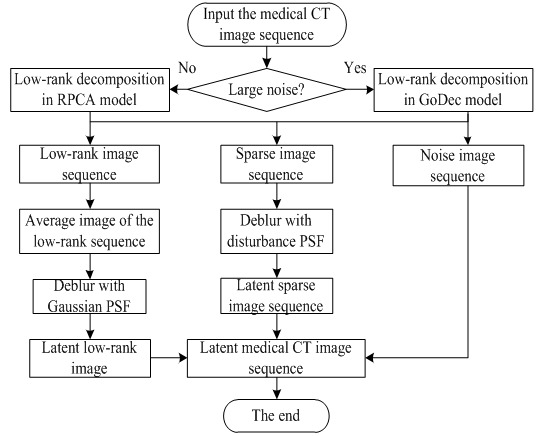
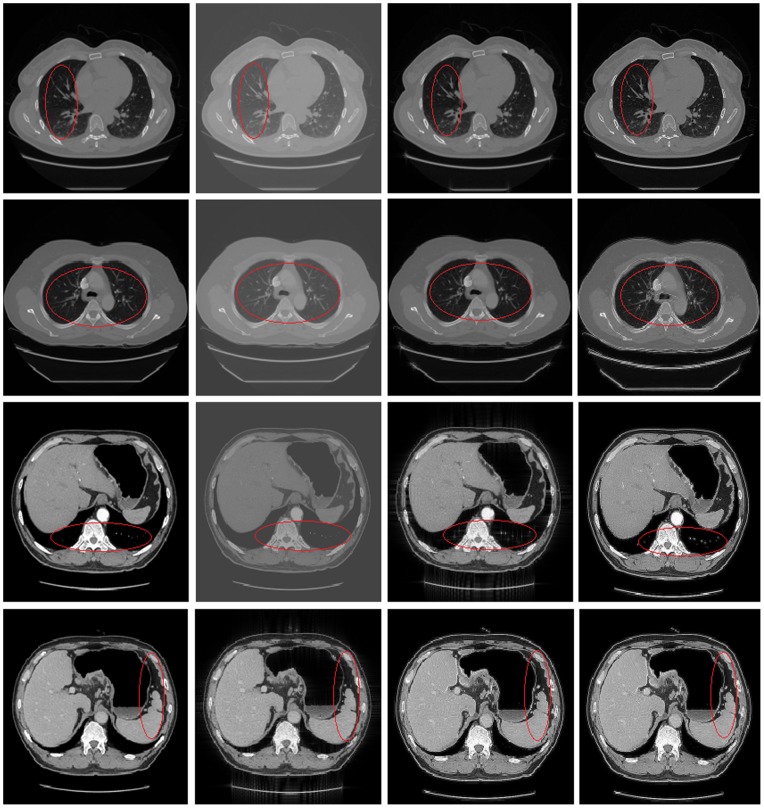
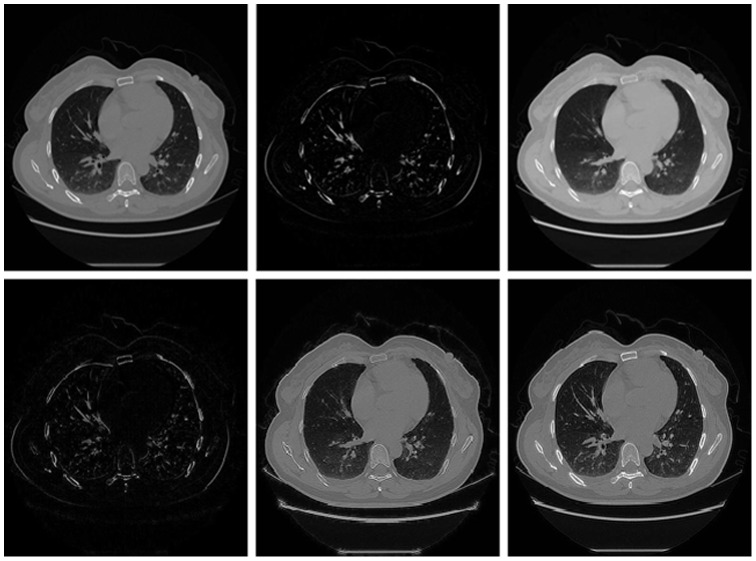
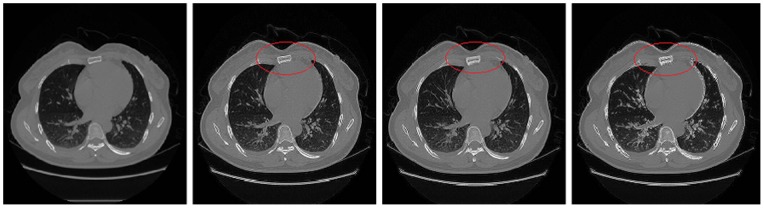
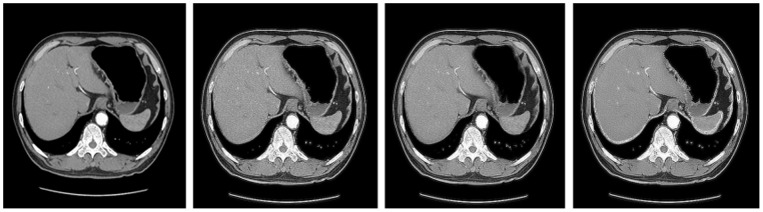
Blurry organ boundaries and soft tissue structures present a major challenge in biomedical image restoration. In this paper, we propose a low-rank decomposition-based method for computed tomography (CT) image sequence restoration, where the CT image sequence is decomposed into a sparse component and a low-rank component. A new point spread function of Weiner filter is employed to efficiently remove blur in the sparse component; a wiener filtering with the Gaussian PSF is used to recover the average image of the low-rank component. And then we get the recovered CT image sequence by combining the recovery low-rank image with all recovery sparse image sequence. Our method achieves restoration results with higher contrast, sharper organ boundaries and richer soft tissue structure information, compared with existing CT image restoration methods. The robustness of our method was assessed with numerical experiments using three different low-rank models: Robust Principle Component Analysis (RPCA), Linearized Alternating Direction Method with Adaptive Penalty (LADMAP) and Go Decomposition (GoDec). Experimental results demonstrated that the RPCA model was the most suitable for the small noise CT images whereas the GoDec model was the best for the large noisy CT images.
模糊的器官边界和软组织结构是生物医学图像恢复中的一个主要挑战。在本文中,我们提出了一种基于低秩分解的 CT 图像序列恢复方法,其中 CT 图像序列被分解为稀疏分量和低秩分量。我们采用了一种新的维纳滤波器点扩散函数来有效地去除稀疏分量中的模糊;使用具有高斯 PSF 的维纳滤波来恢复低秩分量的平均图像。然后,我们通过将恢复的低秩图像与所有恢复的稀疏图像序列相结合,得到恢复的 CT 图像序列。与现有的 CT 图像恢复方法相比,我们的方法在对比度更高、器官边界更清晰、软组织结构信息更丰富的方面实现了恢复效果。我们的方法的鲁棒性通过使用三种不同的低秩模型(鲁棒主成分分析(RPCA)、带有自适应惩罚的线性交替方向法(LADMAP)和 Go 分解(GoDec))的数值实验进行了评估。实验结果表明,RPCA 模型最适合小噪声 CT 图像,而 GoDec 模型最适合大噪声 CT 图像。