Department of Biology, University of Nevada Reno, 1664 N. Virginia Street, Reno, NV, 89557, USA.
Department of Biology, San Diego State University, 5500 Campanile Drive, San Diego, CA, 92182, USA.
BMC Ecol. 2020 Apr 3;20(1):18. doi: 10.1186/s12898-020-00286-7.
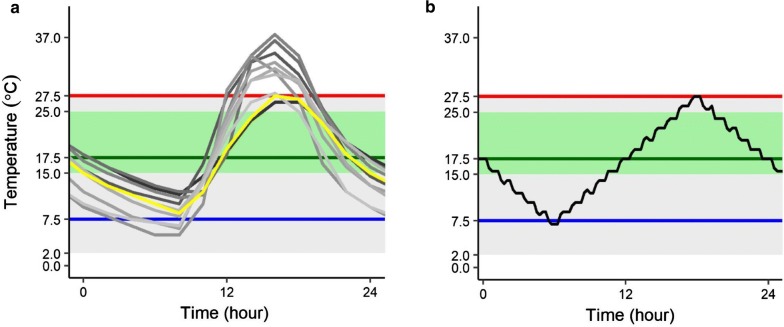
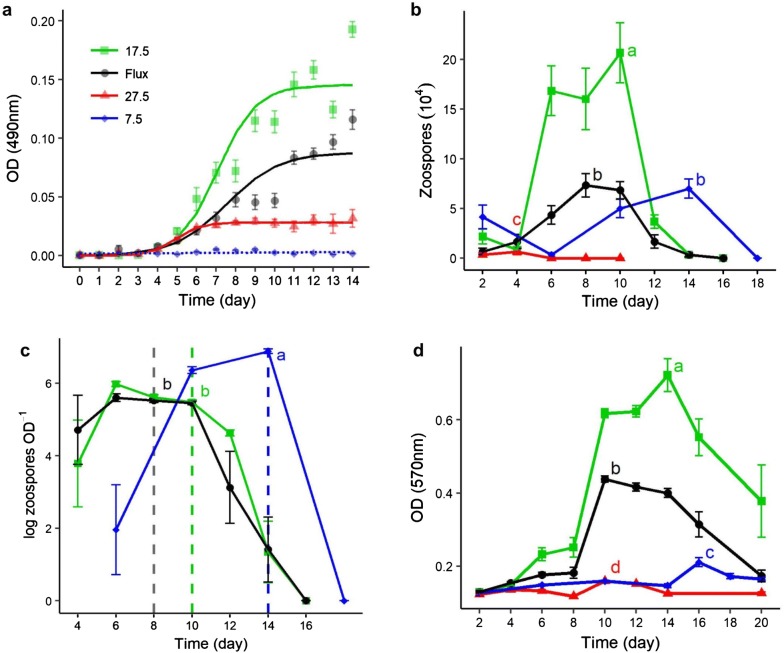
Emerging infectious diseases (EIDs) are contributing to species die-offs worldwide. We can better understand EIDs by using ecological approaches to study pathogen biology. For example, pathogens are exposed to variable temperatures across daily, seasonal, and annual scales. Exposure to temperature fluctuations may reduce pathogen growth and reproduction, which could affect pathogen virulence, transmission, and environmental persistence with implications for disease. We examined the effect of a variable thermal environment on reproductive life history traits of the fungal pathogen Batrachochytrium dendrobatidis (Bd). Bd causes chytridiomycosis, an emerging infectious disease of amphibians. As a pathogen of ectothermic hosts, Bd can be exposed to large temperature fluctuations in nature. To determine the effect of fluctuating temperatures on Bd growth and reproduction, we collected temperature data from breeding pools of the Yosemite toad (Anaxyrus canorus), a federally threatened species that is susceptible to chytridiomycosis. We cultured Bd under a daily fluctuating temperature regime that simulated Yosemite toad breeding pool temperatures and measured Bd growth, reproduction, fecundity, and viability.
We observed decreased Bd growth and reproduction in a diurnally fluctuating thermal environment as compared to cultures grown at constant temperatures within the optimal Bd thermal range. We also found that Bd exhibits temperature-induced trade-offs under constant low and constant high temperature conditions.
Our results provide novel insights on variable responses of Bd to dynamic thermal conditions and highlight the importance of incorporating realistic temperature fluctuations into investigations of pathogen ecology and EIDs.
新发传染病(EIDs)正在导致全球物种灭绝。我们可以通过使用生态方法研究病原体生物学来更好地了解 EIDs。例如,病原体在日常、季节性和年度范围内都会受到温度变化的影响。暴露于温度波动可能会降低病原体的生长和繁殖能力,从而影响病原体的毒力、传播和环境持久性,对疾病产生影响。我们研究了可变热环境对真菌病原体蛙壶菌(Batrachochytrium dendrobatidis,Bd)生殖生活史特征的影响。Bd 引起蛙壶菌病,这是一种新兴的两栖动物传染病。作为一种外温宿主的病原体,Bd 在自然界中可能会受到很大的温度波动。为了确定波动温度对 Bd 生长和繁殖的影响,我们从约塞米蒂蟾蜍(Anaxyrus canorus)的繁殖池中收集了温度数据,约塞米蒂蟾蜍是一种易受蛙壶菌病影响的联邦受威胁物种。我们在模拟约塞米蒂蟾蜍繁殖池温度的每日波动温度条件下培养 Bd,并测量了 Bd 的生长、繁殖、繁殖力和活力。
与在最适 Bd 温度范围内生长于恒温条件下的培养物相比,我们观察到 Bd 在昼夜波动的热环境中生长和繁殖减少。我们还发现,Bd 在恒低温和恒高温条件下表现出温度诱导的权衡。
我们的结果为 Bd 对动态热条件的可变反应提供了新的见解,并强调了将实际温度波动纳入病原体生态学和 EIDs 研究的重要性。