Hickok Jason R, Vasudevan Divya, Jablonski Kate, Thomas Douglas D
Departments of Medicinal Chemistry & Pharmacognosy, University of Illinois at Chicago, Chicago, IL 60612-7231, United States.
Redox Biol. 2013 Jan 14;1(1):203-9. doi: 10.1016/j.redox.2012.11.002. eCollection 2013.
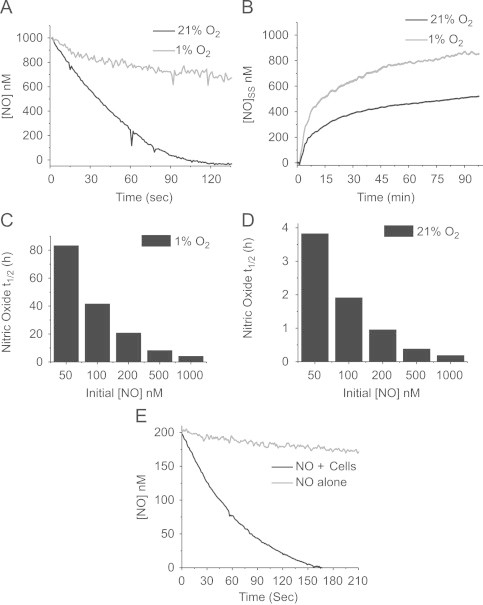
Nitric oxide (•NO) is a biologically important short-lived free radical signaling molecule. Both the enzymatic synthesis and the predominant forms of cellular metabolism of •NO are oxygen-dependent. For these reasons, changes in local oxygen concentrations can have a profound influence on steady-state •NO concentrations. Many proteins are regulated by •NO in a concentration-dependent manner, but their responses are elicited at different thresholds. Using soluble guanylyl cyclase (sGC) and p53 as model •NO-sensitive proteins, we demonstrate that their concentration-dependent responses to •NO are a function of the O2 concentration. p53 requires relatively high steady-state •NO concentrations (>600 nM) to induce its phosphorylation (P-ser-15), whereas sGC responds to low •NO concentrations (<100 nM). At a constant rate of •NO production (liberation from •NO-donors), decreasing the O2 concentration (1%) lowers the rate of •NO metabolism. This raises steady-state •NO concentrations and allows p53 activation at lower doses of the •NO donor. Enzymatic •NO production, however, requires O2 as a substrate such that decreasing the O2 concentration below the K m for O2 for nitric oxide synthase (NOS) will decrease the production of •NO. We demonstrate that the amount of •NO produced by RAW 264.7 macrophages is a function of the O2 concentration. Differences in rates of •NO production and •NO metabolism result in differential sGC activation that is not linear with respect to O2. There is an optimal O2 concentration (≈5-8%) where a balance between the synthesis and metabolism of •NO is established such that both the •NO concentration and sGC activation are maximal.
一氧化氮(•NO)是一种具有重要生物学意义的短寿命自由基信号分子。•NO的酶促合成及其细胞代谢的主要形式均依赖于氧气。由于这些原因,局部氧浓度的变化会对稳态•NO浓度产生深远影响。许多蛋白质受•NO浓度依赖性调节,但其反应在不同阈值下引发。以可溶性鸟苷酸环化酶(sGC)和p53作为•NO敏感蛋白模型,我们证明它们对•NO的浓度依赖性反应是O2浓度的函数。p53需要相对较高的稳态•NO浓度(>600 nM)来诱导其磷酸化(P-丝氨酸-15),而sGC对低•NO浓度(<100 nM)有反应。在•NO产生(从•NO供体释放)速率恒定的情况下,降低O2浓度(1%)会降低•NO代谢速率。这会提高稳态•NO浓度,并使较低剂量的•NO供体就能激活p53。然而,酶促•NO产生需要O2作为底物,因此将O2浓度降低至低于一氧化氮合酶(NOS)对O2的Km值会减少•NO的产生。我们证明RAW 264.7巨噬细胞产生的•NO量是O2浓度的函数。•NO产生速率和•NO代谢速率的差异导致sGC激活存在差异,且这种差异与O2并非呈线性关系。存在一个最佳O2浓度(≈5-8%),此时•NO的合成与代谢达到平衡,使得•NO浓度和sGC激活均达到最大值。