• 文献检索
  • 文档翻译
  • 深度研究
  • 学术资讯
  • Suppr Zotero 插件Zotero 插件
  • 邀请有礼
  • 套餐&价格
  • 历史记录
应用&插件
Suppr Zotero 插件Zotero 插件浏览器插件Mac 客户端Windows 客户端微信小程序
定价
高级版会员购买积分包购买API积分包
服务
文献检索文档翻译深度研究API 文档MCP 服务
关于我们
关于 Suppr公司介绍联系我们用户协议隐私条款
关注我们

Suppr 超能文献

核心技术专利:CN118964589B侵权必究
粤ICP备2023148730 号-1Suppr @ 2026

文献检索

告别复杂PubMed语法,用中文像聊天一样搜索,搜遍4000万医学文献。AI智能推荐,让科研检索更轻松。

立即免费搜索

文件翻译

保留排版,准确专业,支持PDF/Word/PPT等文件格式,支持 12+语言互译。

免费翻译文档

深度研究

AI帮你快速写综述,25分钟生成高质量综述,智能提取关键信息,辅助科研写作。

立即免费体验

一项针对乳腺癌患者化疗所致脱发的全基因组关联研究。

A genome-wide association study of chemotherapy-induced alopecia in breast cancer patients.

作者信息

Chung Suyoun, Low Siew-Kee, Zembutsu Hitoshi, Takahashi Atsushi, Kubo Michiaki, Sasa Mitsunori, Nakamura Yusuke

出版信息

Breast Cancer Res. 2013;15(5):R81. doi: 10.1186/bcr3475.

DOI:10.1186/bcr3475
PMID:24025145
原文链接:https://pmc.ncbi.nlm.nih.gov/articles/PMC3978764/
Abstract

INTRODUCTION

Chemotherapy-induced alopecia is one of the most common adverse events caused by conventional cytotoxic chemotherapy, yet there has been very little progress in the prevention or treatment of this side effect. Although this is not a life-threatening event, alopecia is very psychologically difficult for many women to manage. In order to improve the quality of life for these women, it is important to elucidate the molecular mechanisms of chemotherapy-induced alopecia and develop ways to effectively prevent and/or treat it. To identify the genetic risk factors associated with chemotherapy-induced alopecia, we conducted a genome-wide association study (GWAS) using DNA samples from breast cancer patients who were treated with chemotherapy.

METHODS

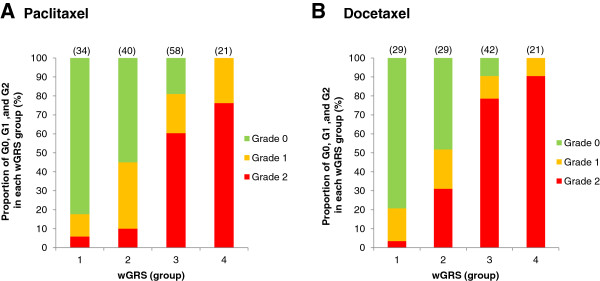
We performed a case-control association study of 303 individuals who developed grade 2 alopecia, and compared them with 880 breast cancer patients who did not show hair loss after being treated with conventional chemotherapy. In addition, we separately analyzed a subset of patients who received specific combination therapies by GWASs and applied the weighted genetic risk scoring (wGRS) system to investigate the cumulative effects of the associated SNPs.

RESULTS

We identified an SNP significantly associated with drug-induced grade 2 alopecia (rs3820706 in CACNB4 (calcium channel voltage-dependent subunit beta 4) on 2q23, P = 8.13 × 10(-9), OR = 3.71) and detected several SNPs that showed some suggestive associations by subgroup analyses. We also classified patients into four groups on the basis of wGRS analysis and found that patients who classified in the highest risk group showed 443 times higher risk of antimicrotubule agents-induced alopecia than the lowest risk group.

CONCLUSIONS

Our study suggests several associated genes and should shed some light on the molecular mechanism of alopecia in chemotherapy-treated breast cancer patients and hopefully will contribute to development of interventions that will improve the quality of life (QOL) of cancer patients.

摘要

引言

化疗引起的脱发是传统细胞毒性化疗最常见的不良事件之一,但在预防或治疗这种副作用方面进展甚微。虽然这并非危及生命的事件,但脱发对许多女性来说在心理上很难应对。为了提高这些女性的生活质量,阐明化疗引起脱发的分子机制并开发有效预防和/或治疗方法很重要。为了确定与化疗引起脱发相关的遗传风险因素,我们使用接受化疗的乳腺癌患者的DNA样本进行了全基因组关联研究(GWAS)。

方法

我们对303例出现2级脱发的个体进行了病例对照关联研究,并将他们与880例接受传统化疗后未出现脱发的乳腺癌患者进行比较。此外,我们通过GWAS分别分析了接受特定联合治疗的患者亚组,并应用加权遗传风险评分(wGRS)系统来研究相关单核苷酸多态性(SNP)的累积效应。

结果

我们鉴定出一个与药物引起的2级脱发显著相关的SNP(位于2q23的CACNB4(钙通道电压依赖性亚基β4)中的rs3820706,P = 8.13×10⁻⁹,比值比(OR) = 3.71),并通过亚组分析检测到几个显示出一些提示性关联的SNP。我们还根据wGRS分析将患者分为四组,发现分类为最高风险组的患者发生抗微管药物引起脱发的风险比最低风险组高443倍。

结论

我们的研究提示了几个相关基因,应该有助于阐明化疗治疗的乳腺癌患者脱发的分子机制,有望为改善癌症患者生活质量(QOL)的干预措施的开发做出贡献。
https://cdn.ncbi.nlm.nih.gov/pmc/blobs/53d8/3978764/4745ebc0a3b2/bcr3475-1.jpg

相似文献

1
A genome-wide association study of chemotherapy-induced alopecia in breast cancer patients.一项针对乳腺癌患者化疗所致脱发的全基因组关联研究。
Breast Cancer Res. 2013;15(5):R81. doi: 10.1186/bcr3475.
2
Association Between ABCB1 Genetic Variants and Persistent Chemotherapy-Induced Alopecia in Women With Breast Cancer.ABCB1 基因变异与乳腺癌女性持续化疗性脱发的关联。
JAMA Dermatol. 2020 Sep 1;156(9):987-991. doi: 10.1001/jamadermatol.2020.1867.
3
Effect of a Scalp Cooling Device on Alopecia in Women Undergoing Chemotherapy for Breast Cancer: The SCALP Randomized Clinical Trial.头皮冷却装置对乳腺癌化疗女性脱发的影响:SCALP 随机临床试验。
JAMA. 2017 Feb 14;317(6):596-605. doi: 10.1001/jama.2016.20939.
4
Association Between Use of a Scalp Cooling Device and Alopecia After Chemotherapy for Breast Cancer.头皮冷却装置的使用与乳腺癌化疗后脱发之间的关联。
JAMA. 2017 Feb 14;317(6):606-614. doi: 10.1001/jama.2016.21038.
5
Impact of chemotherapy-induced alopecia distress on body image, psychosocial well-being, and depression in breast cancer patients.化疗所致脱发困扰对乳腺癌患者身体形象、心理社会幸福感及抑郁的影响。
Psychooncology. 2014 Oct;23(10):1103-10. doi: 10.1002/pon.3531. Epub 2014 Mar 24.
6
Development and validation of Chemotherapy-induced Alopecia Distress Scale (CADS) for breast cancer patients.化疗所致脱发困扰量表(CADS)的制订与验证:适用于乳腺癌患者。
Ann Oncol. 2014 Feb;25(2):346-51. doi: 10.1093/annonc/mdt476. Epub 2013 Dec 29.
7
Permanent hair loss associated with taxane chemotherapy use in breast cancer: A retrospective survey at two tertiary UK cancer centres.与乳腺癌紫杉烷化疗相关的永久性脱发:英国两家癌症中心的回顾性调查。
Eur J Cancer Care (Engl). 2021 May;30(3):e13395. doi: 10.1111/ecc.13395. Epub 2020 Dec 22.
8
Assessment of Quality of Life and Treatment Outcomes of Patients With Persistent Postchemotherapy Alopecia.评估持续性化疗后脱发患者的生活质量和治疗结果。
JAMA Dermatol. 2019 Jun 1;155(6):724-728. doi: 10.1001/jamadermatol.2018.5071.
9
Efficacy of the DigniCap System in preventing chemotherapy-induced alopecia in breast cancer patients is not related to patient characteristics or side effects of the device.DigniCap 系统预防乳腺癌患者化疗所致脱发的疗效与患者特征或器械副作用无关。
Int J Nurs Pract. 2021 Jun;27(3):e12888. doi: 10.1111/ijn.12888. Epub 2020 Sep 22.
10
The utility of DHL-HisZnNa, a novel antioxidant, against anticancer agent-induced alopecia in breast cancer patients: a multicenter phase II clinical trial.新型抗氧化剂 DHL-HisZnNa 防治乳腺癌患者化疗所致脱发的疗效:一项多中心 II 期临床试验。
Breast Cancer Res Treat. 2019 Aug;176(3):625-630. doi: 10.1007/s10549-019-05164-5. Epub 2019 Feb 26.

引用本文的文献

1
Parallel Toxicities: A Comparative Analysis of Chemotherapy-Induced Neutropenia and Alopecia.平行毒性:化疗引起的中性粒细胞减少症和脱发的比较分析
Cancers (Basel). 2025 Mar 30;17(7):1163. doi: 10.3390/cancers17071163.
2
Cancer-Related Alopecia: From Etiologies to Global Management.癌症相关脱发:从病因到全球管理
Cancers (Basel). 2021 Nov 5;13(21):5556. doi: 10.3390/cancers13215556.
3
Association Between ABCB1 Genetic Variants and Persistent Chemotherapy-Induced Alopecia in Women With Breast Cancer.ABCB1 基因变异与乳腺癌女性持续化疗性脱发的关联。

本文引用的文献

1
Pathobiology of chemotherapy-induced hair loss.化疗引起的脱发的病理生物学。
Lancet Oncol. 2013 Feb;14(2):e50-9. doi: 10.1016/S1470-2045(12)70553-3.
2
P-cadherin regulates human hair growth and cycling via canonical Wnt signaling and transforming growth factor-β2.P-钙黏蛋白通过经典 Wnt 信号通路和转化生长因子-β2 调节人类毛发的生长和循环。
J Invest Dermatol. 2012 Oct;132(10):2332-2341. doi: 10.1038/jid.2012.171. Epub 2012 Jun 14.
3
Chemotherapy-induced alopecia.化疗引起的脱发。
JAMA Dermatol. 2020 Sep 1;156(9):987-991. doi: 10.1001/jamadermatol.2020.1867.
4
CDK4/6 inhibition mitigates stem cell damage in a novel model for taxane-induced alopecia.CDK4/6 抑制减轻了新型紫杉醇诱导脱发模型中的干细胞损伤。
EMBO Mol Med. 2019 Oct;11(10):e11031. doi: 10.15252/emmm.201911031. Epub 2019 Sep 12.
5
Use of big data in drug development for precision medicine: an update.大数据在精准医学药物研发中的应用:最新进展
Expert Rev Precis Med Drug Dev. 2019;4(3):189-200. doi: 10.1080/23808993.2019.1617632. Epub 2019 May 20.
6
A Pharmacogenetic Prediction Model of Progression-Free Survival in Breast Cancer using Genome-Wide Genotyping Data from CALGB 40502 (Alliance).基于 CALGB 40502(Alliance)全基因组基因分型数据的乳腺癌无进展生存的遗传预测模型。
Clin Pharmacol Ther. 2019 Mar;105(3):738-745. doi: 10.1002/cpt.1241. Epub 2018 Nov 1.
7
Breast cancer: The translation of big genomic data to cancer precision medicine.乳腺癌:大型基因组数据向癌症精准医学的转化。
Cancer Sci. 2018 Mar;109(3):497-506. doi: 10.1111/cas.13463. Epub 2017 Dec 30.
8
Prediction for Intravenous Immunoglobulin Resistance by Using Weighted Genetic Risk Score Identified From Genome-Wide Association Study in Kawasaki Disease.利用从川崎病全基因组关联研究中确定的加权遗传风险评分预测静脉注射免疫球蛋白耐药性。
Circ Cardiovasc Genet. 2017 Oct;10(5):e001625. doi: 10.1161/CIRCGENETICS.116.001625.
9
Improving the detection of pathways in genome-wide association studies by combined effects of SNPs from Linkage Disequilibrium blocks.通过连锁不平衡块中 SNP 的联合效应提高全基因组关联研究中通路的检测。
Sci Rep. 2017 Jun 14;7(1):3512. doi: 10.1038/s41598-017-03826-2.
10
Familiarity, opinions, experiences and knowledge about scalp cooling: a Dutch survey among breast cancer patients and oncological professionals.关于头皮冷却的熟悉程度、看法、经历和知识:一项针对荷兰乳腺癌患者和肿瘤学专业人员的调查
Asia Pac J Oncol Nurs. 2015 Jan-Mar;2(1):35-41. doi: 10.4103/2347-5625.152404.
J Am Acad Dermatol. 2012 Jul;67(1):e37-47. doi: 10.1016/j.jaad.2011.02.026. Epub 2011 Dec 16.
4
Functional ion channels in stem cells.干细胞中的功能离子通道。
World J Stem Cells. 2011 Mar 26;3(3):19-24. doi: 10.4252/wjsc.v3.i3.19.
5
Genome-wide association study in alopecia areata implicates both innate and adaptive immunity.斑秃的全基因组关联研究提示固有免疫和适应性免疫均参与其中。
Nature. 2010 Jul 1;466(7302):113-7. doi: 10.1038/nature09114.
6
Triple-negative breast cancer: molecular features, pathogenesis, treatment and current lines of research.三阴性乳腺癌:分子特征、发病机制、治疗和当前研究方向。
Cancer Treat Rev. 2010 May;36(3):206-15. doi: 10.1016/j.ctrv.2009.12.002. Epub 2010 Jan 8.
7
Integration of genetic risk factors into a clinical algorithm for multiple sclerosis susceptibility: a weighted genetic risk score.将遗传风险因素整合到多发性硬化易感性临床算法中:加权遗传风险评分
Lancet Neurol. 2009 Dec;8(12):1111-9. doi: 10.1016/S1474-4422(09)70275-3. Epub 2009 Oct 29.
8
Association of three-gene interaction among MTHFR, ALOX5AP and NOTCH3 with thrombotic stroke: a multicenter case-control study.亚甲基四氢叶酸还原酶(MTHFR)、5-脂氧合酶激活蛋白(ALOX5AP)和Notch3三基因相互作用与血栓性中风的关联:一项多中心病例对照研究
Hum Genet. 2009 Jun;125(5-6):649-56. doi: 10.1007/s00439-009-0659-0. Epub 2009 Apr 17.
9
Chemotherapy-induced alopecia.化疗引起的脱发
Semin Cutan Med Surg. 2009 Mar;28(1):11-4. doi: 10.1016/j.sder.2008.12.001.
10
Gene-expression signatures in breast cancer.乳腺癌中的基因表达特征
N Engl J Med. 2009 Feb 19;360(8):790-800. doi: 10.1056/NEJMra0801289.