Division of Pharmacology and Therapeutics, Graduate School of Pharmaceutical Sciences, Kumamoto University, Kumamoto, Japan.
Cardiovasc Diabetol. 2013 Sep 13;12:132. doi: 10.1186/1475-2840-12-132.
Mitochondrial aldehyde dehydrogenase 2 (ALDH2) detoxifies reactive aldehydes in the micro- and macrovasculature. These substrates, including methylglyoxal and 4-hydroxynonenal formed from glucose and lipids, cause protein carbonylation and mitochondrial dysfunction, forming advanced glycation end products (AGEs). The present study aimed to confirm the association between the inactive ALDH2*2 allele and diabetic retinopathy (DR).
A retrospective longitudinal analysis was conducted, among 234 Japanese patients with type 2 diabetes mellitus (DM) (156 males and 78 females) who had no DR signs at baseline and were treated for more than half a year. The ALDH2*1/*2 alleles were determined using a real-time TaqMan allelic discrimination assay. Multivariate-adjusted hazard ratios (HRs) and 95% confidential intervals (CIs) for the cumulative incidence of the development of DR were examined using a Cox proportional hazard model, taking drinking habits and the serum γ-glutamyltransferase (GGT) level into consideration.
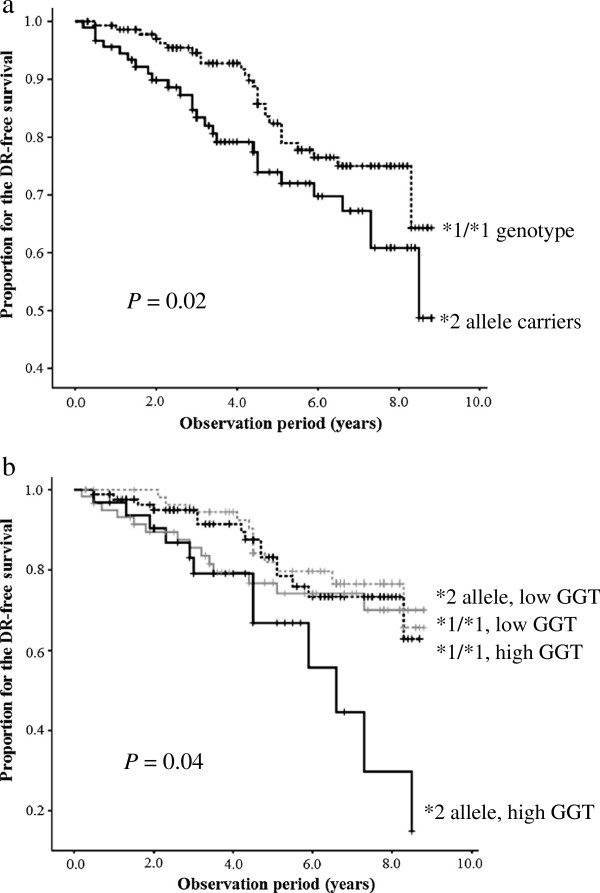
The frequency of the ALDH22 allele was 22.3%. Fifty-two subjects cumulatively developed DR during the follow-up period of 5.5 ± 2.5 years. The ALDH22 allele carriers had a significantly higher incidence of DR than the non-carriers (HR: 1.92; P = 0.02). The incidence of DR was significantly higher in the drinkers with the ALDH22 allele than in those with the ALDH21/1 genotype (HR: 2.61; P = 0.03), while the incidence of DR in the non-drinkers did not differ significantly between the ALDH2 genotype groups (P > 0.05). The incidence of DR was significantly higher in the ALDH22 allele carriers with a high GGT level than in the non-carriers with a high or low GGT level (HR: 2.45; P = 0.03; and HR: 2.63; P = 0.03, respectively).
To the best of our knowledge, this is the first report of a significant association between the ALDH2*2 allele and the incidence of DR. These findings provide additional evidence that ALDH2 protects both microvasculature and macrovasculature against reactive aldehydes generated under conditions of sustained oxidative stress, although further investigations in larger cohorts are needed to verify the results.
线粒体乙醛脱氢酶 2(ALDH2)可清除微血管和大血管中的活性醛。这些底物包括糖和脂质产生的甲基乙二醛和 4-羟基壬烯醛,会导致蛋白质羰基化和线粒体功能障碍,形成晚期糖基化终产物(AGEs)。本研究旨在证实无活性 ALDH2*2 等位基因与糖尿病视网膜病变(DR)之间的关联。
对 234 名基线时无 DR 迹象且接受了半年以上治疗的日本 2 型糖尿病(DM)患者(男性 156 名,女性 78 名)进行了回顾性纵向分析。使用实时 TaqMan 等位基因鉴别检测法确定 ALDH2*1/*2 等位基因。使用 Cox 比例风险模型检查累积 DR 发展发生率的多变量调整后的风险比(HR)和 95%置信区间(CI),同时考虑饮酒习惯和血清γ-谷氨酰转移酶(GGT)水平。
ALDH22 等位基因的频率为 22.3%。在 5.5±2.5 年的随访期间,52 名患者累积发生了 DR。ALDH22 等位基因携带者的 DR 发生率明显高于非携带者(HR:1.92;P=0.02)。携带 ALDH22 等位基因的饮酒者的 DR 发生率明显高于 ALDH21/1 基因型的饮酒者(HR:2.61;P=0.03),而不饮酒者的 ALDH2 基因型组之间的 DR 发生率无显著差异(P>0.05)。在 GGT 水平较高的 ALDH22 等位基因携带者中,DR 的发生率明显高于 GGT 水平较高或较低的非携带者(HR:2.45;P=0.03;和 HR:2.63;P=0.03)。
据我们所知,这是首次报道 ALDH2*2 等位基因与 DR 发生率之间存在显著关联。这些发现提供了额外的证据,表明 ALDH2 可保护微血管和大血管免受持续氧化应激下产生的活性醛的侵害,尽管需要在更大的队列中进行进一步研究来验证这些结果。