CareFlight Ltd, Westmead, NSW, Australia.
Scand J Trauma Resusc Emerg Med. 2013 Sep 14;21:69. doi: 10.1186/1757-7241-21-69.
The utility of advanced prehospital interventions for severe blunt traumatic brain injury (BTI) remains controversial. Of all trauma patient subgroups it has been anticipated that this patient group would most benefit from advanced prehospital interventions as hypoxia and hypotension have been demonstrated to be associated with poor outcomes and these factors may be amenable to prehospital intervention. Supporting evidence is largely lacking however. In particular the efficacy of early anaesthesia/muscle relaxant assisted intubation has proved difficult to substantiate.
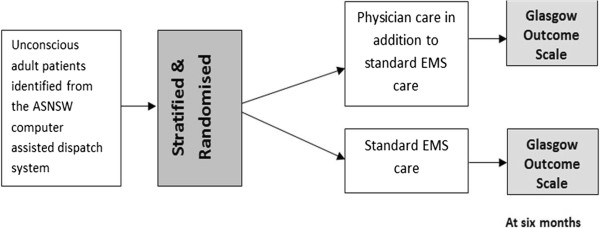
This article describes the design and protocol of the Head Injury Retrieval Trial (HIRT) which is a randomised controlled single centre trial of physician prehospital care (delivering advanced interventions such as rapid sequence intubation and blood transfusion) in addition to paramedic care for severe blunt TBI compared with paramedic care alone.
Primary endpoint is Glasgow Outcome Scale score at six months post injury. Issues with trial integrity resulting from drop ins from standard care to the treatment arm as the result of policy changes by the local ambulance system are discussed.
This randomised controlled trial will contribute to the evaluation of the efficacy of advance prehospital interventions in severe blunt TBI.
ClinicalTrials.gov: NCT00112398.
高级院前干预在严重钝性颅脑损伤(BTI)中的作用仍存在争议。在所有创伤患者亚组中,预计该患者组将从高级院前干预中获益最多,因为已经证明缺氧和低血压与不良预后相关,并且这些因素可能适合院前干预。然而,支持证据主要缺乏。特别是早期麻醉/肌肉松弛剂辅助插管的疗效难以证实。
本文描述了头部损伤检索试验(HIRT)的设计和方案,这是一项随机对照单中心试验,比较了医师院前护理(提供高级干预,如快速序列插管和输血)与单独的护理人员护理对严重钝性 TBI 的效果。
主要终点是损伤后 6 个月的格拉斯哥结局量表评分。由于当地救护系统的政策变化,标准护理向治疗组的插补导致试验完整性出现问题。
这项随机对照试验将有助于评估高级院前干预在严重钝性 TBI 中的疗效。
ClinicalTrials.gov:NCT00112398。