Dakwar Elias, Levin Frances, Foltin Richard W, Nunes Edward V, Hart Carl L
New York State Psychiatric Institute/Columbia University College of Physicians and Surgeons, New York, New York.
New York State Psychiatric Institute/Columbia University College of Physicians and Surgeons, New York, New York.
Biol Psychiatry. 2014 Jul 1;76(1):40-6. doi: 10.1016/j.biopsych.2013.08.009. Epub 2013 Sep 12.
Cocaine dependence involves problematic neuroadaptations that might be responsive to modulation of glutamatergic circuits. This investigation examined the effects of subanesthetic ketamine infusions on motivation for quitting cocaine and on cue-induced craving in cocaine-dependent participants, 24 hours postinfusion.
Eight volunteers with active DSM-IV cocaine dependence not seeking treatment or abstinence were entered into this crossover, double-blind trial. Three 52-min intravenous infusions were administered: ketamine (.41 mg/kg or .71 mg/kg) or lorazepam 2 mg, counterbalanced into three orderings in which ketamine .41 mg/kg always preceded the .71 mg/kg dose. Infusions were separated by 48 hours, and assessments occurred at baseline and at 24 hours postinfusion. Outcomes were change between postinfusion and preinfusion values for: 1) motivation to quit cocaine scores with the University of Rhode Island Change Assessment; and 2) sums of visual analogue scale craving ratings administered during cue exposure.
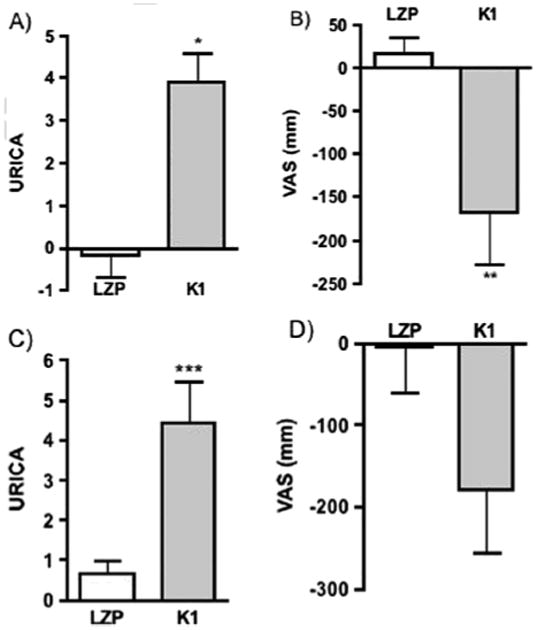
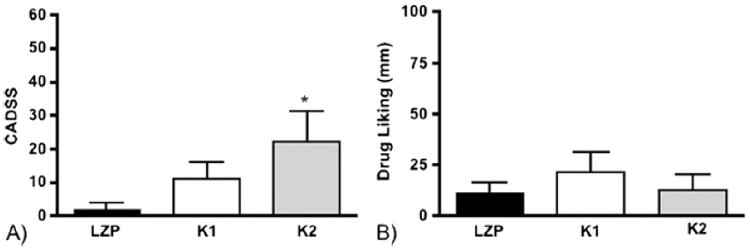
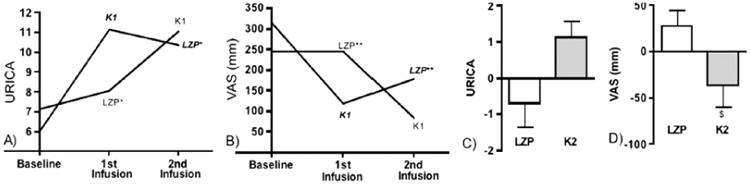
Compared with the active control lorazepam, a single ketamine infusion (.41 mg/kg) led to a mean 3.9-point gain in University of Rhode Island Change Assessment (p = .012), which corresponds to an approximately 60% increase over preceding values. There was a reduction of comparable magnitude in cue-induced craving (p = .012). A subsequent ketamine infusion (.71 mg/kg) led to further reductions in cue-induced craving compared with the control. Infusions were well-tolerated.
Subanesthetic ketamine demonstrated promising effects on motivation to quit cocaine and on cue-induced craving, 24 hours postinfusion. Research is needed to expand on these preliminary results and to evaluate the efficacy of this intervention in clinical settings.
可卡因成瘾涉及有问题的神经适应性变化,这些变化可能对谷氨酸能回路的调节有反应。本研究调查了亚麻醉剂量氯胺酮输注对可卡因依赖参与者在输注后24小时戒除可卡因的动机以及线索诱导的渴望的影响。
八名患有活跃的DSM-IV可卡因成瘾且未寻求治疗或戒断的志愿者进入了这项交叉、双盲试验。进行了三次52分钟的静脉输注:氯胺酮(0.41毫克/千克或0.71毫克/千克)或2毫克劳拉西泮,分为三种顺序,其中0.41毫克/千克的氯胺酮总是先于0.71毫克/千克的剂量。输注间隔48小时,在基线和输注后24小时进行评估。结果包括输注后与输注前相比的变化:1)使用罗德岛大学变化评估量表的戒除可卡因动机得分;2)线索暴露期间视觉模拟量表渴望评分的总和。
与活性对照劳拉西泮相比,单次氯胺酮输注(0.41毫克/千克)使罗德岛大学变化评估量表的平均得分提高了3.9分(p = 0.012),比之前的值增加了约60%。线索诱导的渴望也有类似程度的降低(p = 0.012)。随后的氯胺酮输注(0.71毫克/千克)与对照组相比,线索诱导的渴望进一步降低。输注耐受性良好。
亚麻醉剂量氯胺酮在输注后24小时对戒除可卡因的动机和线索诱导的渴望显示出有前景的效果。需要开展研究以扩展这些初步结果,并评估这种干预措施在临床环境中的疗效。