Max Planck Institute of Molecular Cell Biology and Genetics, Pfotenhauerstrasse 108, 01307 Dresden, Germany.
Curr Biol. 2013 Oct 7;23(19):1844-52. doi: 10.1016/j.cub.2013.07.084. Epub 2013 Sep 12.
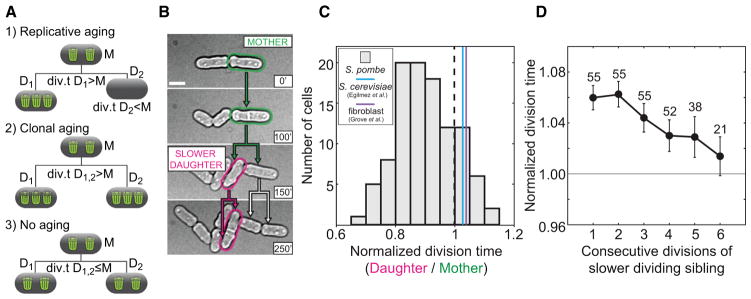
Many unicellular organisms age: as time passes, they divide more slowly and ultimately die. In budding yeast, asymmetric segregation of cellular damage results in aging mother cells and rejuvenated daughters. We hypothesize that the organisms in which this asymmetry is lacking, or can be modulated, may not undergo aging.
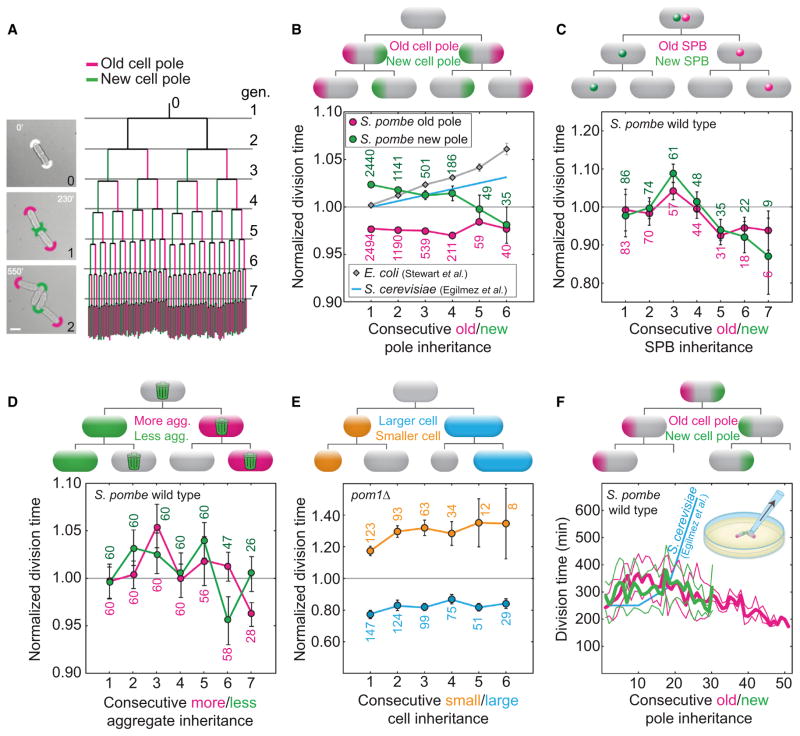
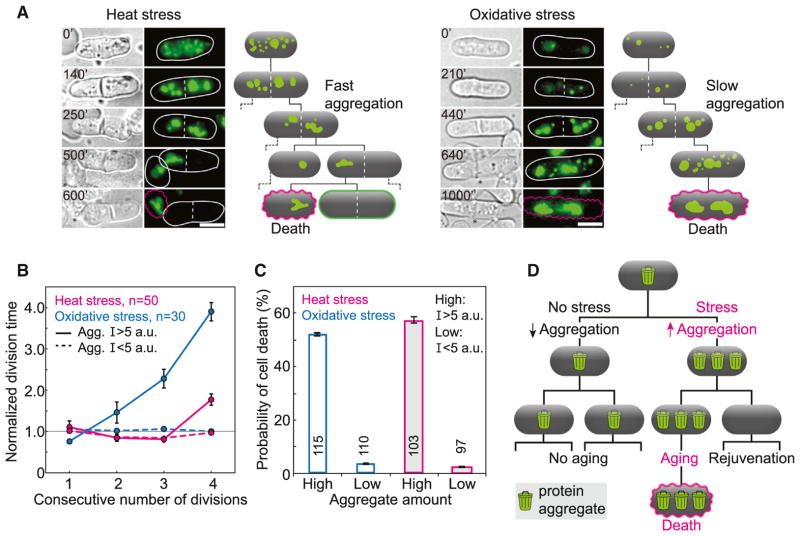
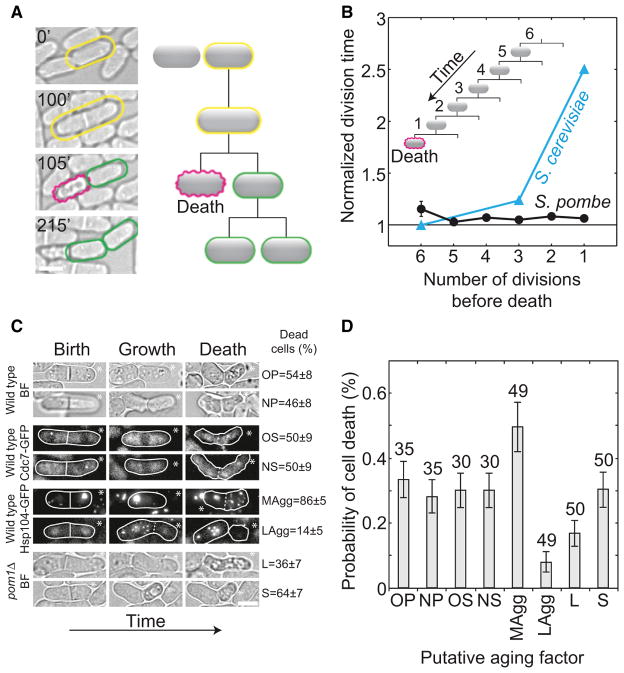
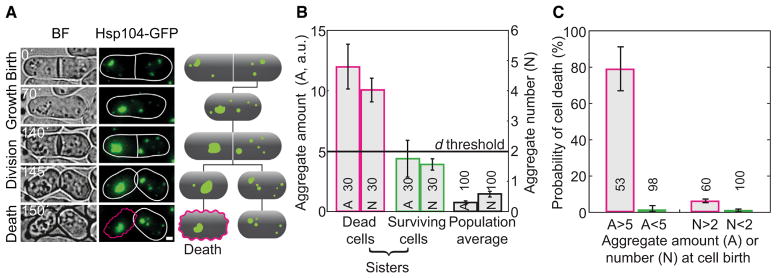
We performed a complete pedigree analysis of microcolonies of the fission yeast Schizosaccharomyces pombe growing from a single cell. When cells were grown under favorable conditions, none of the lineages exhibited aging, which is defined as a consecutive increase in division time and increased death probability. Under favorable conditions, few cells died, and their death was random and sudden rather than following a gradual increase in division time. Cell death correlated with the inheritance of Hsp104-associated protein aggregates. After stress, the cells that inherited large aggregates aged, showing a consecutive increase in division time and an increased death probability. Their sisters, who inherited little or no aggregates, did not age.
We conclude that S. pombe does not age under favorable growth conditions, but does so under stress. This transition appears to be passive rather than active and results from the formation of a single large aggregate, which segregates asymmetrically at the subsequent cell division. We argue that this damage-induced asymmetric segregation has evolved to sacrifice some cells so that others may survive unscathed after severe environmental stresses.
许多单细胞生物会衰老:随着时间的推移,它们的分裂速度会变慢,最终死亡。在出芽酵母中,细胞损伤的不对称分配导致衰老的母细胞和恢复活力的子细胞。我们假设,那些缺乏这种不对称性或可以调节这种不对称性的生物可能不会经历衰老。
我们对来自单个细胞的裂殖酵母 Schizosaccharomyces pombe 的微菌落进行了完整的系谱分析。当细胞在有利条件下生长时,没有任何谱系表现出衰老,衰老定义为连续增加分裂时间和增加死亡概率。在有利条件下,很少有细胞死亡,而且它们的死亡是随机和突然的,而不是随着分裂时间的逐渐增加。细胞死亡与 Hsp104 相关蛋白聚集体的遗传有关。在应激后,继承大聚集体的细胞衰老,表现为连续增加的分裂时间和增加的死亡概率。它们继承了少量或没有聚集体的姐妹细胞则不会衰老。
我们得出结论,裂殖酵母在有利的生长条件下不会衰老,但在应激条件下会衰老。这种转变似乎是被动的,而不是主动的,是由一个大的聚集体形成的,这个聚集体在随后的细胞分裂中不对称地分配。我们认为,这种由损伤诱导的不对称分配已经进化到牺牲一些细胞,以便在严重的环境压力后,其他细胞可以毫发无损地存活。