Laboratory of Cancer Genomics and Individualized Medicine, Beijing Institute of Genomics, Chinese Academy of Sciences, Beijing 100101, China, State Key Laboratory of Biomembrane and Membrane Biotechnology, Institute of Zoology, Chinese Academy of Sciences, Beijing 100101, China and Department of Pathology, University of Texas Southwestern Medical Center, Dallas, TX 75390, USA.
Nucleic Acids Res. 2013 Dec;41(22):10312-22. doi: 10.1093/nar/gkt793. Epub 2013 Sep 12.
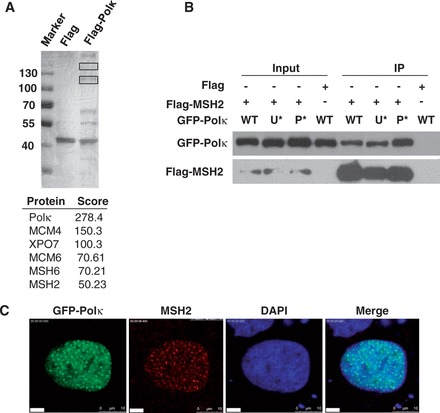
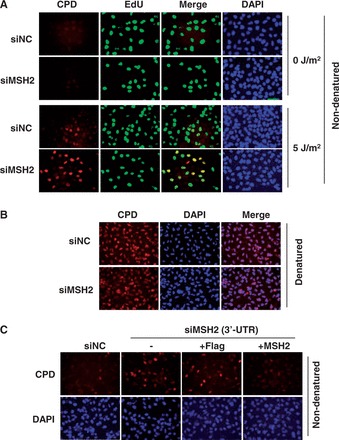
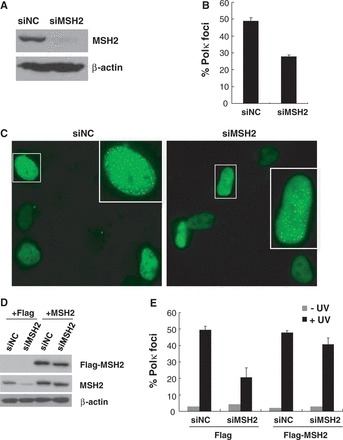
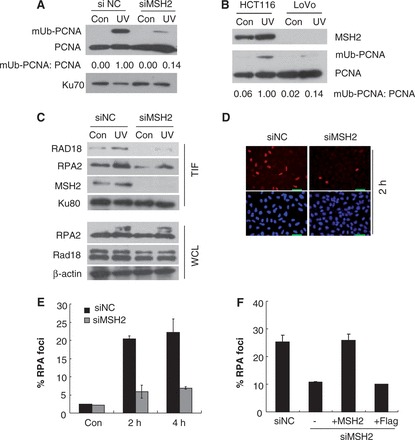
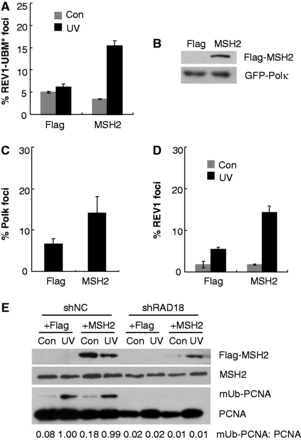
Translesion DNA synthesis (TLS) can use specialized DNA polymerases to insert and/or extend nucleotides across lesions, thereby limiting stalled replication fork collapse and the potential for cell death. Recent studies have shown that monoubiquitinated proliferating cell nuclear antigen (PCNA) plays an important role in recruitment of Y-family TLS polymerases to stalled replication forks after DNA damage treatment. To explore the possible roles of other factors that regulate the ultraviolet (UV)-induced assembly of specialized DNA polymerases at arrested replication forks, we performed immunoprecipitation experiments combined with mass spectrometry and established that DNA polymerase kappa (Polκ) can partner with MSH2, an important mismatch repair protein associated with hereditary non-polyposis colorectal cancer. We found that depletion of MSH2 impairs PCNA monoubiquitination and the formation of foci containing Polκ and other TLS polymerases after UV irradiation of cells. Interestingly, expression of MSH2 in Rad18-deficient cells increased UV-induced Polκ and REV1 focus formation without detectable changes in PCNA monoubiquitination, indicating that MSH2 can regulate post-UV focus formation by specialized DNA polymerases in both PCNA monoubiquitination-dependent and -independent fashions. Moreover, we observed that MSH2 can facilitate TLS across cyclobutane pyrimidine dimers photoproducts in living cells, presenting a novel role of MSH2 in post-UV cellular responses.
跨损伤 DNA 合成(TLS)可以利用专门的 DNA 聚合酶将核苷酸插入和/或延伸到损伤部位,从而限制复制叉停滞的崩溃和细胞死亡的可能性。最近的研究表明,单泛素化增殖细胞核抗原(PCNA)在 DNA 损伤处理后,募集 Y 家族 TLS 聚合酶到停滞的复制叉中,起着重要的作用。为了探索调节特殊 DNA 聚合酶在停滞复制叉中紫外线(UV)诱导组装的其他因素的可能作用,我们进行了免疫沉淀实验,结合质谱分析,确定 DNA 聚合酶 kappa(Polκ)可以与 MSH2 结合,MSH2 是一种与遗传性非息肉病结直肠癌相关的重要错配修复蛋白。我们发现,MSH2 的耗竭会损害 PCNA 的单泛素化以及 Polκ和其他 TLS 聚合酶在细胞受到 UV 照射后的焦点形成。有趣的是,在 Rad18 缺陷细胞中表达 MSH2 会增加 UV 诱导的 Polκ和 REV1 焦点形成,而 PCNA 单泛素化没有明显变化,表明 MSH2 可以通过 PCNA 单泛素化依赖和非依赖的方式调节特殊 DNA 聚合酶的 UV 后焦点形成。此外,我们观察到 MSH2 可以促进活细胞中环丁烷嘧啶二聚体光产物的 TLS,这是 MSH2 在 UV 后细胞反应中的一个新作用。