Institute of Hygiene and Environmental Medicine, Charité University Medicine Berlin, Berlin, Germany ; German National Reference Center for the Surveillance of Nosocomial Infections, Berlin, Germany.
PLoS One. 2013 Sep 11;8(9):e74323. doi: 10.1371/journal.pone.0074323. eCollection 2013.
The number of extended-spectrum beta-lactamase (ESBL) positive (+) Escherichia coli is increasing worldwide. In contrast with many other multidrug-resistant bacteria, it is suspected that they predominantly spread within the community. The objective of this study was to assess factors associated with community-acquired colonization of ESBL (+) E. coli.
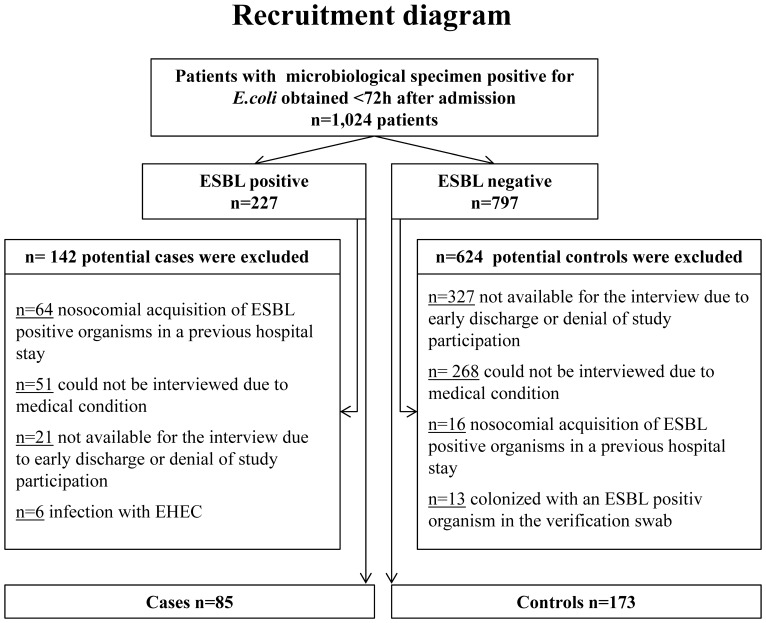
We performed a matched case-control study at the Charité University Hospital Berlin between May 2011 and January 2012. Cases were defined as patients colonized with community-acquired ESBL (+) E. coli identified <72 h after hospital admission. Controls were patients that carried no ESBL-positive bacteria but an ESBL-negative E.coli identified <72 h after hospital admission. Two controls per case were chosen from potential controls according to admission date. Case and control patients completed a questionnaire assessing nutritional habits, travel habits, household situation and language most commonly spoken at home (mother tongue). An additional rectal swab was obtained together with the questionnaire to verify colonization status. Genotypes of ESBL (+) E. coli strains were determined by PCR and sequencing. Risk factors associated with ESBL (+) E. coli colonization were analyzed by a multivariable conditional logistic regression analysis.
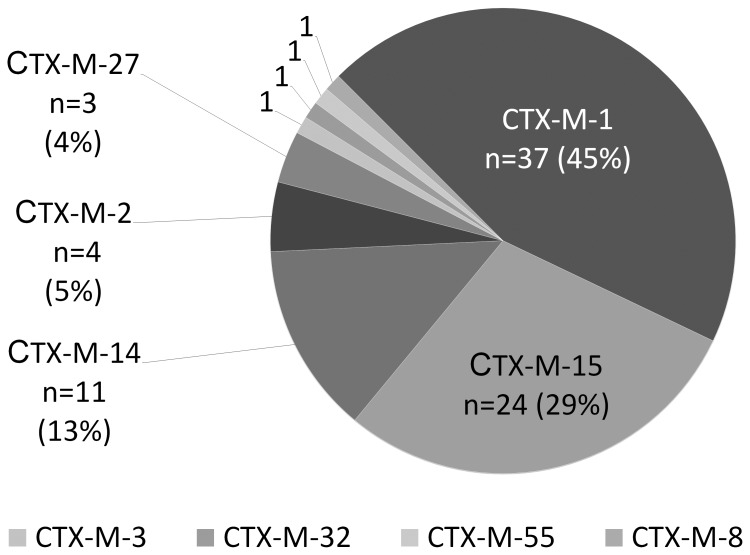
We analyzed 85 cases and 170 controls, respectively. In the multivariable analysis, speaking an Asian language most commonly at home (OR = 13.4, CI 95% 3.3-53.8; p<0.001) and frequently eating pork (≥ 3 meals per week) showed to be independently associated with ESBL colonization (OR = 3.5, CI 95% 1.8-6.6; p<0.001). The most common ESBL genotypes were CTX-M-1 with 44% (n = 37), CTX-M-15 with 28% (n = 24) and CTX-M-14 with 13% (n = 11).
An Asian mother tongue and frequently consuming certain types of meat like pork can be independently associated with the colonization of ESBL-positive bacteria. We found neither frequent consumption of poultry nor previous use of antibiotics to be associated with ESBL colonization.
全球范围内,产超广谱β-内酰胺酶(ESBL)阳性(+)大肠杆菌的数量正在增加。与许多其他多药耐药菌不同,人们怀疑它们主要在社区内传播。本研究的目的是评估与社区获得性 ESBL(+)大肠杆菌定植相关的因素。
我们在 2011 年 5 月至 2012 年 1 月期间在柏林 Charité 大学医院进行了一项匹配病例对照研究。病例定义为入院后 72 小时内发现定植有社区获得性 ESBL(+)大肠杆菌的患者。对照组为入院后 72 小时内未携带 ESBL 阳性细菌但携带 ESBL 阴性大肠杆菌的患者。根据入院日期,从潜在对照中选择了每个病例的两名对照。病例和对照患者完成了一份调查问卷,评估饮食习惯、旅行习惯、家庭情况以及家中最常用的语言(母语)。在完成调查问卷的同时还采集了直肠拭子以验证定植状态。通过 PCR 和测序确定 ESBL(+)大肠杆菌菌株的基因型。通过多变量条件逻辑回归分析来分析与 ESBL(+)大肠杆菌定植相关的危险因素。
我们分别分析了 85 例病例和 170 例对照。在多变量分析中,在家中最常说亚洲语言(OR = 13.4,95%CI 3.3-53.8;p<0.001)和经常食用猪肉(每周≥3 餐)与 ESBL 定植独立相关(OR = 3.5,95%CI 1.8-6.6;p<0.001)。最常见的 ESBL 基因型是 CTX-M-1,占 44%(n = 37),CTX-M-15 占 28%(n = 24),CTX-M-14 占 13%(n = 11)。
亚洲母语和经常食用某些类型的肉类(如猪肉)可与 ESBL 阳性细菌定植独立相关。我们发现频繁食用家禽或以前使用抗生素与 ESBL 定植无关。