Institute for Biology, Leipzig University, Leipzig, Germany.
PLoS One. 2013 Sep 6;8(9):e74965. doi: 10.1371/journal.pone.0074965. eCollection 2013.
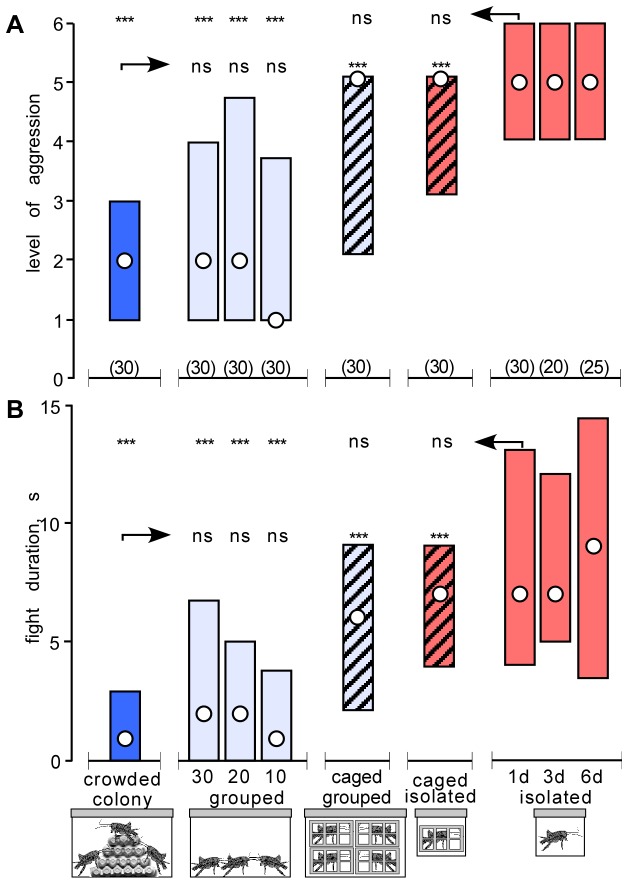
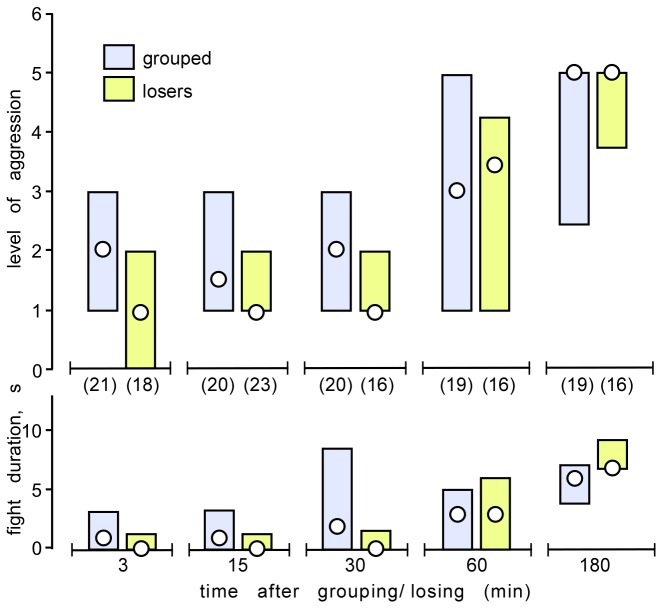
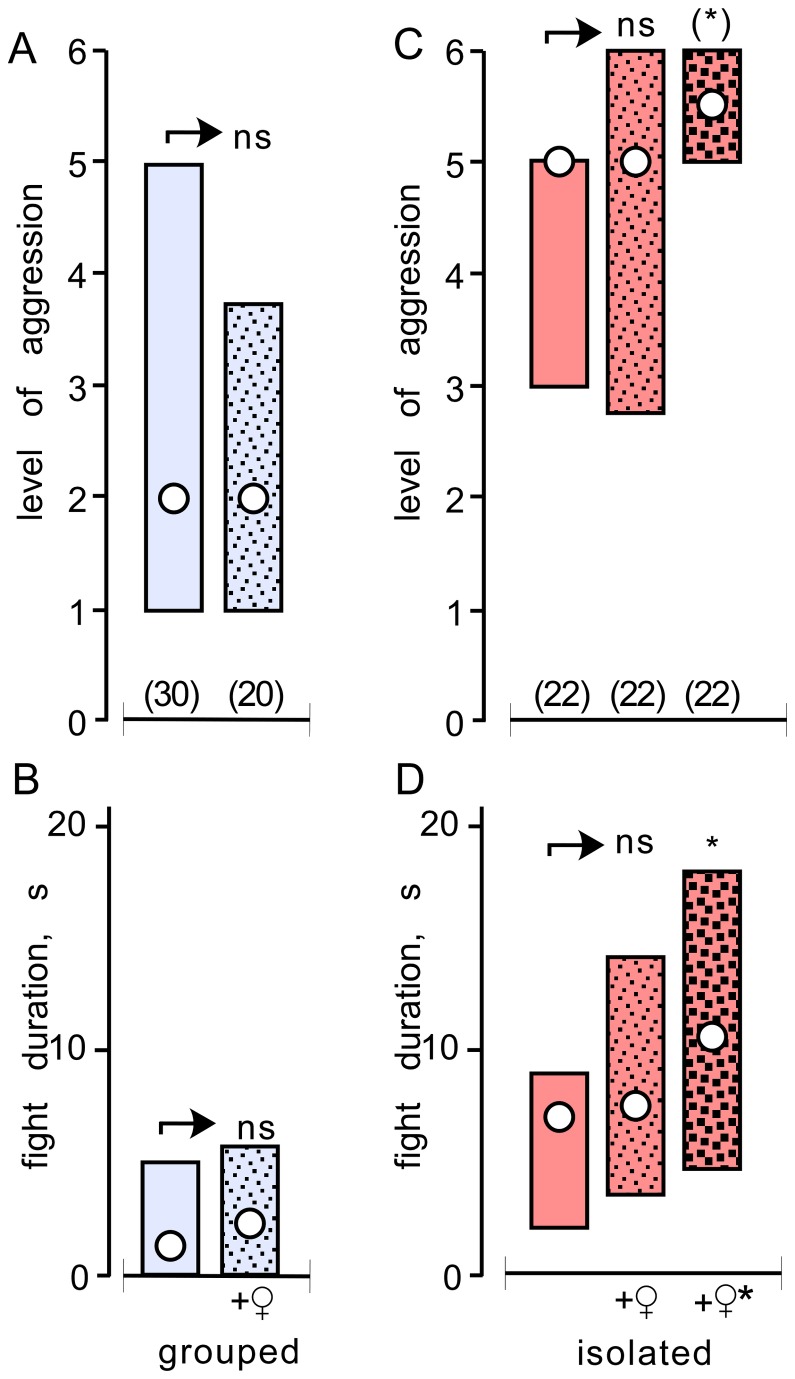
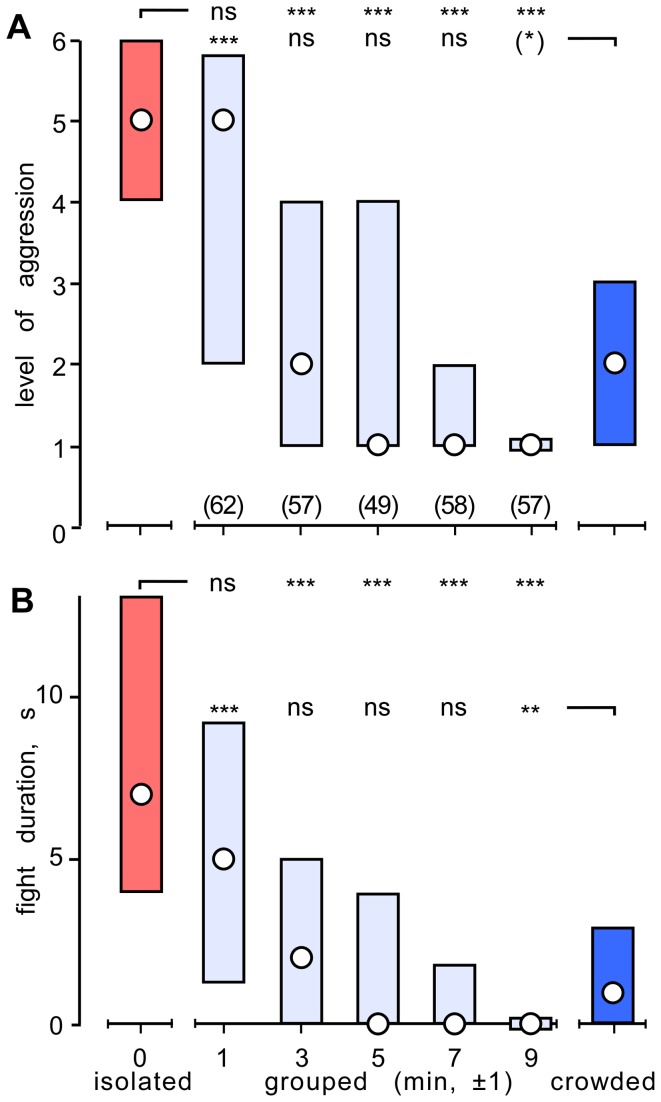
Population density has profound influences on the physiology and behaviour of many animal species. Social isolation is generally reported to lead to increased aggressiveness, while grouping lowers it. We evaluated the effects of varying degrees of isolation and grouping on aggression in a territorial insect, the Mediterranean field cricket, Gryllus bimaculatus. Substantiating early observations, we show that dyadic contests between weight-matched, adult male crickets taken from groups rarely escalate beyond threat displays, whereas interactions between pairs of previously isolated crickets typically escalate to physical fights lasting several seconds. No significant differences were found between 1, 2 and 6-day isolates, or between individuals grouped for a few hours or lifelong. Unexpectedly, crickets grouped in immediate proximity within individual mesh cages that precluded fighting while permitting visual, olfactory and mechanical, antennal contact, were as aggressive as free isolates. This suggests that reduced aggression of grouped animals may be an acquired result of fighting. Supporting this notion, isolated crickets initially engage in vigorous fights when first grouped, but fighting intensity and duration rapidly decline to the level of life-long grouped crickets within only 10 min. Furthermore, grouped crickets become as aggressive as life-long isolates after only 3 hours of isolation, and on the same time course required for crickets to regain their aggressiveness after social defeat. We conclude that the reduced aggressiveness of grouped crickets is a manifestation of the loser effect resulting from social subjugation, while isolation allows recovery to a state of heightened aggressiveness, which in crickets can be considered as the default condition. Given the widespread occurrence of the loser effect in the Animal Kingdom, many effects generally attributed to social isolation are likely to be a consequence of recovery from social subjugation.
人口密度对许多动物物种的生理和行为有深远的影响。一般来说,社会隔离会导致攻击性增加,而群体则会降低攻击性。我们评估了不同程度的隔离和分组对领地昆虫,地中海蟋蟀(Gryllus bimaculatus)攻击性的影响。证实了早期的观察结果,我们表明,从群体中取出的体重匹配的成年雄性蟋蟀之间的二元竞争很少升级为威胁展示,而之前隔离的蟋蟀对之间的相互作用通常会升级为持续数秒的身体战斗。在 1、2 和 6 天的隔离个体之间,或者在几小时或终生分组的个体之间,没有发现显著差异。出乎意料的是,在个体网笼内被分组在一起的蟋蟀,尽管禁止战斗,但允许视觉、嗅觉和机械的触角接触,其攻击性与自由隔离的蟋蟀一样。这表明,群居动物的攻击性降低可能是战斗的结果。支持这一观点,孤立的蟋蟀在最初分组时会进行激烈的战斗,但战斗强度和持续时间会在短短 10 分钟内迅速下降到终生分组蟋蟀的水平。此外,孤立的蟋蟀在隔离仅 3 小时后就变得像终生隔离的蟋蟀一样具有攻击性,并且在蟋蟀从社会挫败中恢复攻击性所需的相同时间范围内。我们得出结论,群居蟋蟀的攻击性降低是社会屈服导致的失败者效应的表现,而隔离则允许其恢复到高度攻击性的状态,在蟋蟀中,这种状态可以被视为默认状态。鉴于失败者效应在动物王国中的广泛存在,许多通常归因于社会隔离的影响可能是社会屈服恢复的结果。