Malherbe Delphine C, Sanders Rogier W, van Gils Marit J, Park Byung, Gomes Michelle M, Schuitemaker Hanneke, Barnett Susan, Haigwood Nancy L
Oregon National Primate Research Center, Oregon Health and Science University, Beaverton, Oregon, United States of America.
PLoS One. 2013 Sep 9;8(9):e75277. doi: 10.1371/journal.pone.0075277. eCollection 2013.
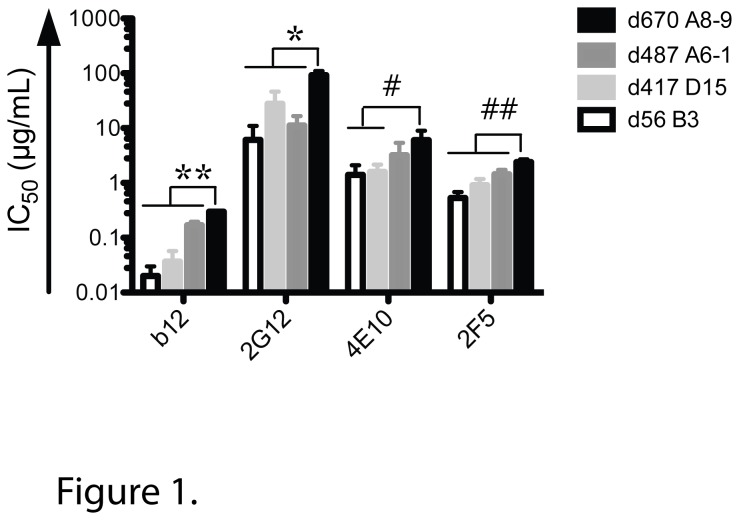
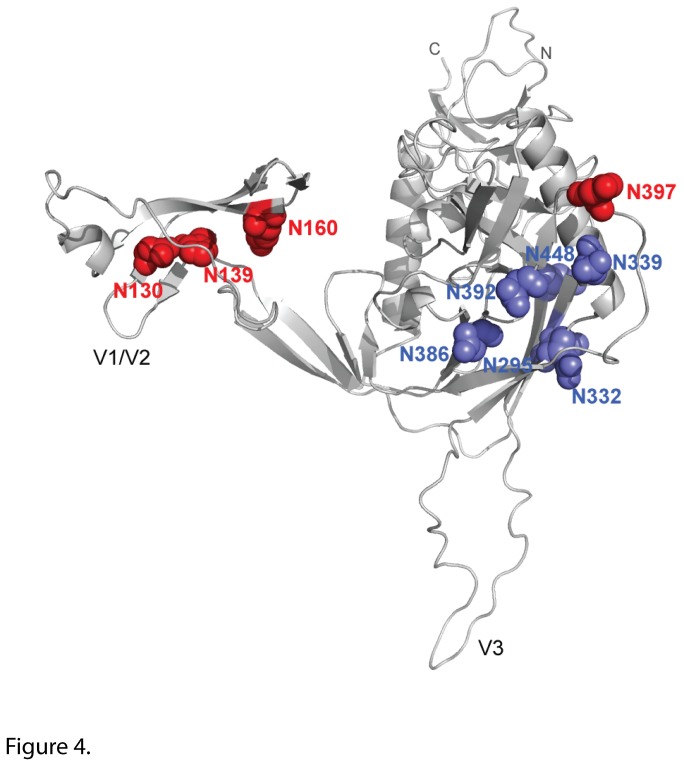
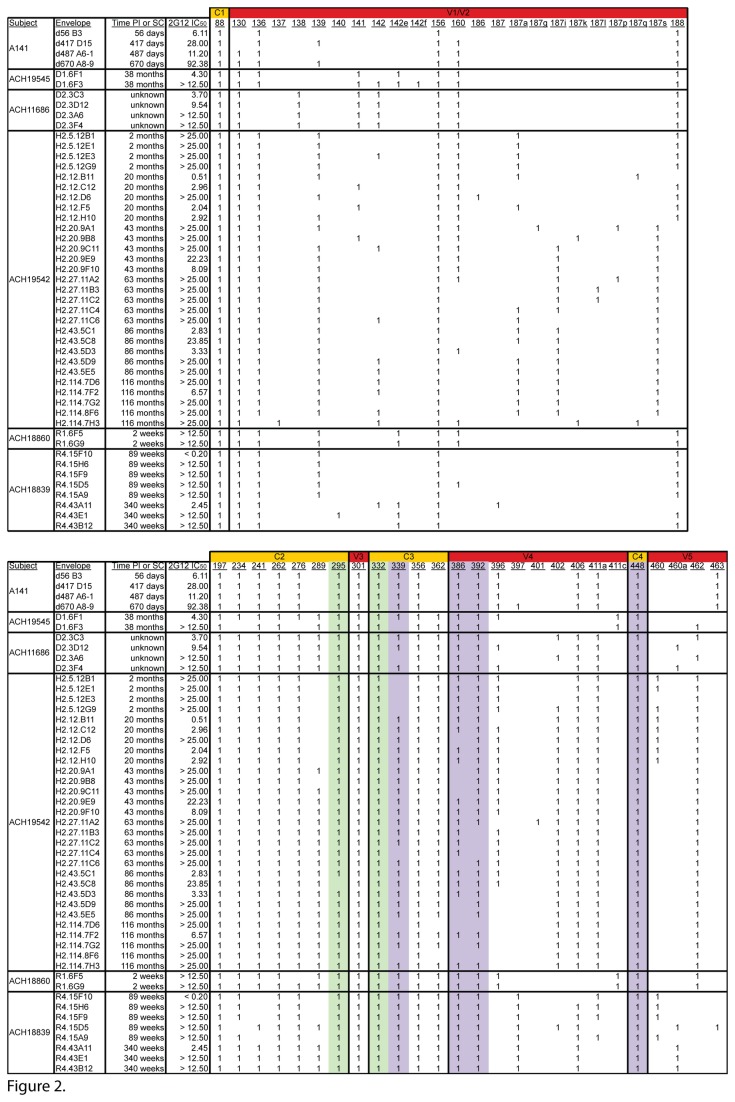
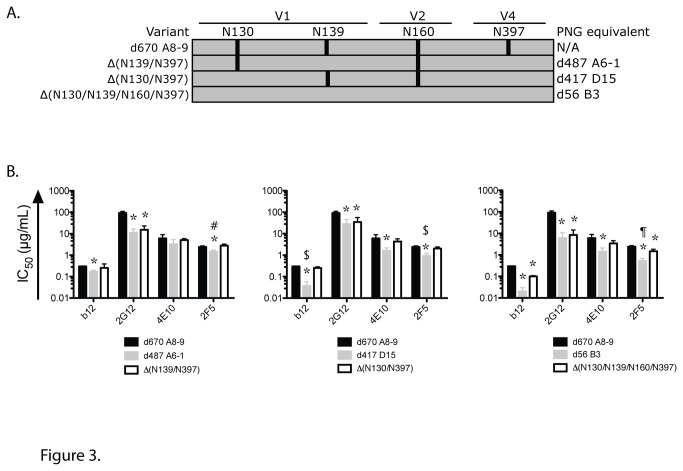
HIV-1 Envelope (Env) protein is the sole target of neutralizing antibodies (NAbs) that arise during infection to neutralize autologous variants. Under this immune pressure, HIV escape variants are continuously selected and over the course of infection Env becomes more neutralization resistant. Many common alterations are known to affect sensitivity to NAbs, including residues encoding potential N-linked glycosylation sites (PNGS). Knowledge of Env motifs associated with neutralization resistance is valuable for the design of an effective Env-based vaccine so we characterized Envs isolated longitudinally from a SHIV(SF162P4) infected macaque for sensitivity to neutralizing monoclonal antibodies (MAbs) B12, 2G12, 4E10 and 2F5. The early Env, isolated from plasma at day 56 after infection, was the most sensitive and the late Env, from day 670, was the most resistant to MAbs. We identified four PNGS in these Envs that accumulated over time at positions 130, 139, 160 and 397. We determined that removal of these PNGS significantly increased neutralization sensitivity to 2G12, and conversely, we identified mutations by in silico analyses that contributed resistance to 2G12 neutralization. In order to expand our understanding of these PNGS, we analyzed Envs from clade B HIV-infected human subjects and identified additional glycan and amino acid changes that could affect neutralization by 2G12 in a context-dependent manner. Taken together, these in vitro and in silico analyses of clade B Envs revealed that 2G12 resistance is achieved by previously unrecognized PNGS substitutions in a context-dependent manner and by subject-specific pathways.
HIV-1包膜(Env)蛋白是感染期间产生的中和抗体(NAbs)中和自体变体的唯一靶点。在这种免疫压力下,HIV逃逸变体不断被选择,在感染过程中Env对中和作用的抗性增强。已知许多常见改变会影响对NAbs的敏感性,包括编码潜在N-糖基化位点(PNGS)的残基。了解与中和抗性相关的Env基序对于设计有效的基于Env的疫苗很有价值,因此我们对从感染SHIV(SF162P4)的猕猴中纵向分离的Env进行了表征,以检测其对中和单克隆抗体(MAbs)B12、2G12、4E10和2F5的敏感性。感染后第56天从血浆中分离的早期Env对MAbs最敏感,而第670天的晚期Env对MAbs最具抗性。我们在这些Env中鉴定出四个随时间在第130、139、160和397位积累的PNGS。我们确定去除这些PNGS会显著增加对2G12的中和敏感性,相反,我们通过计算机分析鉴定出导致对2G12中和产生抗性的突变。为了扩展我们对这些PNGS的理解,我们分析了B亚型HIV感染人类受试者的Env,并确定了其他可能以依赖上下文的方式影响2G12中和作用的聚糖和氨基酸变化。综上所述,这些对B亚型Env的体外和计算机分析表明,2G12抗性是通过以前未被认识的PNGS以依赖上下文的方式取代以及通过个体特异性途径实现的。