Department of Thoracic Surgery, Provincial Hospital Affiliated to Shandong University, 250021, Shandong, China.
J Transl Med. 2013 Sep 16;11:212. doi: 10.1186/1479-5876-11-212.
Gastric cancer is highly aggressive disease. Despite advances in diagnosis and therapy, the prognosis is still poor. Various genetic and molecular alterations are found in gastric cancer that underlies the malignant transformation of gastric mucosa during the multistep process of gastric cancer pathogenesis. The detailed mechanism of the gastric cancer development remains uncertain. In present study we investigated the potential role of stathmin1 gene in gastric cancer tumorigenesis and examined the usefulness of RNA interference (RNAi) targeting stathmin1 as a form of gastric cancer treatment.
A lentiviral vector encoding a short hairpin RNA (shRNA) targeted against stathmin1 was constructed and transfected into the packaging cells HEK 293 T and the viral supernatant was collected to transfect MKN-45 cells. The transwell chemotaxis assay and the CCK-8 assay were used to measure migration and proliferation of tumor cells, respectively. Quantitative real-time PCR and western blotting were used to detect the expression levels of stathmin1.
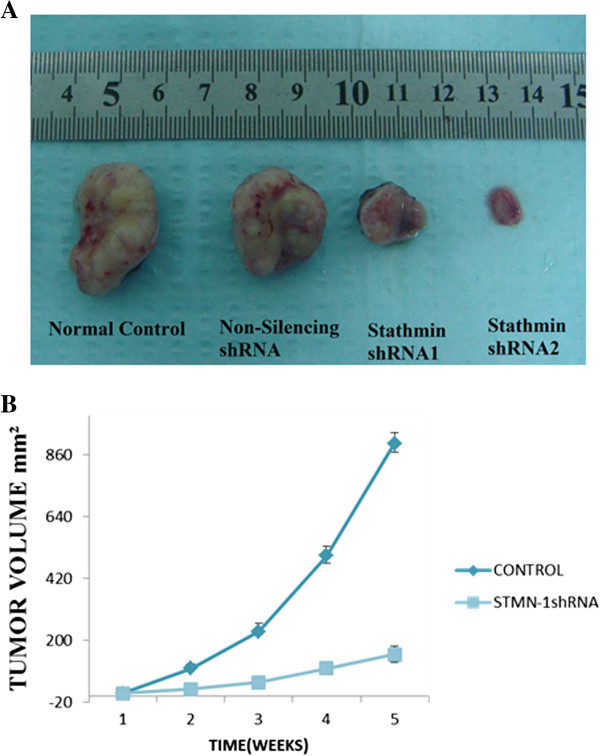
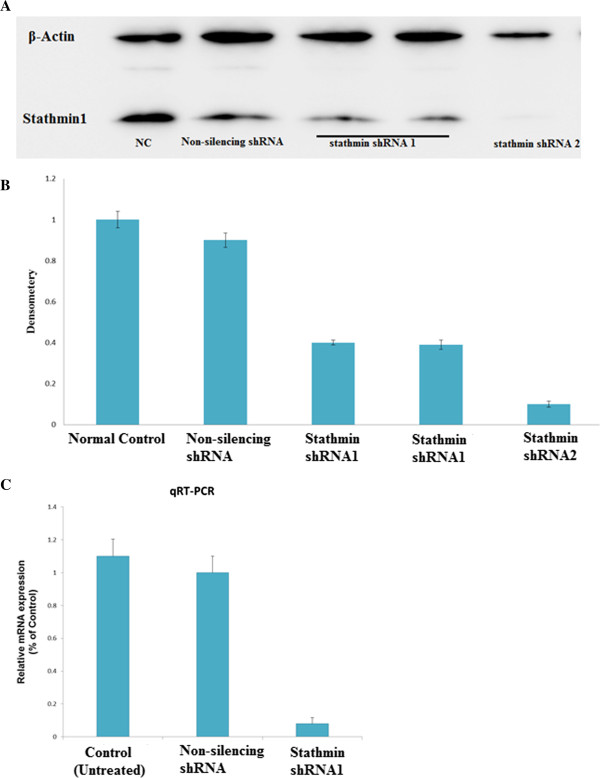
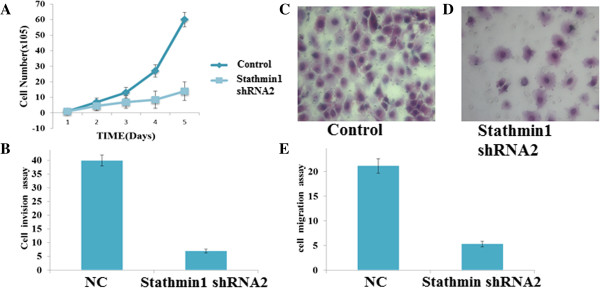
Lentivirus mediated RNAi effectively reduced stathmin1 expression in gastric cells. Significant decreases in stathmin1 mRNA and protein expression were detected in gastric cells carrying lentiviral stathmin-shRNA vector and also significantly inhibited the proliferation, migration in gastric cancer cells and tumorigenicity in Xenograft Animal Models.
Our findings suggest that stathmin1 overexpression is common in gastric cancer and may play a role in its pathogenesis. Lentivirus mediated RNAi effectively reduced stathmin1 expression in gastric cells. In summary, shRNA targeting of stathmin1 can effectively inhibits human gastric cancer cell growth in vivo and may be a potential therapeutic strategy for gastric cancer.
胃癌是一种高度侵袭性的疾病。尽管在诊断和治疗方面取得了进展,但预后仍然很差。在胃癌中发现了各种遗传和分子改变,这些改变是胃癌发病机制多步过程中胃黏膜恶性转化的基础。胃癌发展的详细机制仍不确定。在本研究中,我们研究了 stathmin1 基因在胃癌发生中的潜在作用,并研究了针对 stathmin1 的 RNA 干扰(RNAi)作为胃癌治疗形式的有用性。
构建了靶向 stathmin1 的短发夹 RNA(shRNA)的慢病毒载体,并将其转染到包装细胞 HEK 293 T 中,并收集病毒上清液转染 MKN-45 细胞。使用 Transwell 趋化实验和 CCK-8 测定分别测量肿瘤细胞的迁移和增殖。使用定量实时 PCR 和 Western blot 检测 stathmin1 的表达水平。
慢病毒介导的 RNAi 可有效降低胃癌细胞中的 stathmin1 表达。携带慢病毒 stathmin-shRNA 载体的胃癌细胞中 stathmin1 mRNA 和蛋白表达水平显著降低,并且还显著抑制了胃癌细胞的增殖、迁移和异种移植动物模型中的肿瘤生成。
我们的研究结果表明,stathmin1 在胃癌中过度表达较为常见,可能在其发病机制中起作用。慢病毒介导的 RNAi 可有效降低胃癌细胞中的 stathmin1 表达。综上所述,靶向 stathmin1 的 shRNA 可有效抑制体内人胃癌细胞的生长,可能是胃癌的潜在治疗策略。