Mamudu Hadii M, John Rijo M, Veeranki Sreenivas P, Ouma Ahmed E Ogwell
Department of Health Services Management and Policy, College of Public Health, East Tennessee State University, Johnson City, TN, USA.
BMC Public Health. 2013 Sep 17;13:856. doi: 10.1186/1471-2458-13-856.
The tobacco industry has globalized and tobacco use continues to increase in low- and middle-income countries. Yet, the data and research to inform policy initiatives for addressing this phenomenon is sparse. This study aims to estimate the prevalence of adult tobacco use in 17 Sub-Saharan Africa (SSA) countries, and to identify key factors associated with adult tobacco consumption choices (smoked, smokeless tobacco and dual use) in Madagascar.
We used Demographic Health Survey for estimating tobacco use prevalence among adults in SSA. A multinomial logistic regression model was used to identify key determinants of adult tobacco consumption choices in Madagascar.
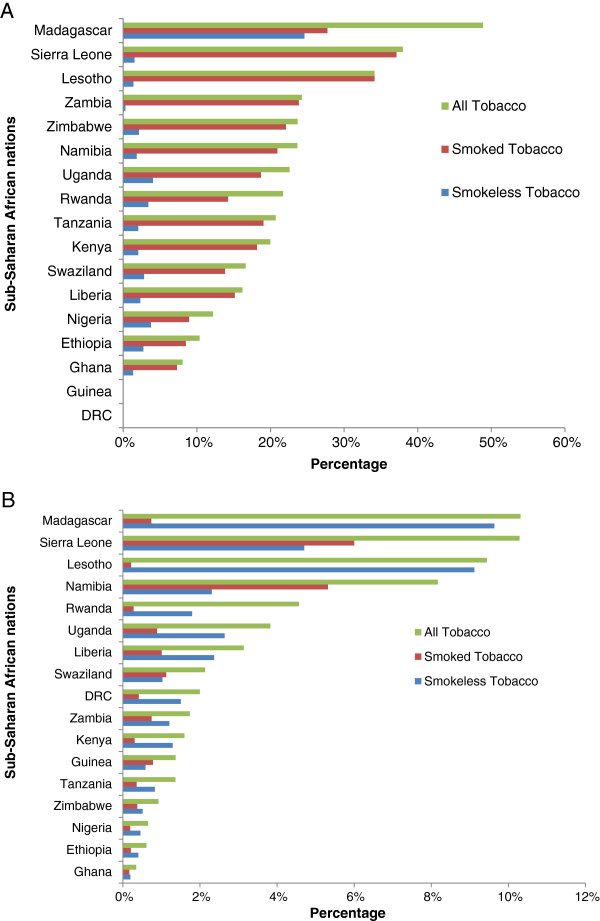
While differences in tobacco use exist in SSA, Madagascar has exceptionally higher prevalence rates (48.9% of males; 10.3% of females). The regression analyses showed complexity of tobacco use in Madagascar and identified age, education, wealth, employment, marriage, religion and place of residence as factors significantly associated with the choice of tobacco use among males, while age, wealth, and employment were significantly associated with that of females. The effects, however, differ across the three choices of tobacco use compared to non-use.
Tobacco use in Madagascar was higher than the other 16 SSA countries. Although the government continues to enact policies to address the problem, there is a need for effective implementation and enforcement. There is also the need for health education to modify social norms and denormalize tobacco use.
烟草行业已全球化,且低收入和中等收入国家的烟草使用持续增加。然而,用于为应对这一现象的政策举措提供信息的数据和研究却很匮乏。本研究旨在估计撒哈拉以南非洲(SSA)17个国家的成人烟草使用 prevalence,并确定马达加斯加与成人烟草消费选择(吸烟、无烟烟草和双重使用)相关的关键因素。
我们使用人口与健康调查来估计SSA地区成年人的烟草使用 prevalence。采用多项逻辑回归模型来确定马达加斯加成人烟草消费选择的关键决定因素。
虽然SSA地区存在烟草使用差异,但马达加斯加的患病率异常高(男性为48.9%;女性为10.3%)。回归分析显示了马达加斯加烟草使用的复杂性,并确定年龄、教育程度、财富、就业、婚姻、宗教和居住地点是与男性烟草使用选择显著相关的因素,而年龄、财富和就业与女性的烟草使用选择显著相关。然而,与不使用烟草相比,这三种烟草使用选择的影响有所不同。
马达加斯加的烟草使用率高于其他16个SSA国家。尽管政府继续制定政策来解决这一问题,但仍需要有效实施和执行。还需要开展健康教育,以改变社会规范并使烟草使用失去常态化。