Department of Infectious Disease Epidemiology, Imperial College London School of Public Health, London, UK.
AIDS. 2013 Jun 19;27(10):1657-66. doi: 10.1097/QAD.0b013e3283601b90.
To investigate whether community engagement (participation in grassroots organizations) contributed to increases in HIV testing in Zimbabwe.
Prospective data on membership of local community organizations (e.g. women's groups and burial societies) and uptake of HIV testing and counselling (HTC) and prevention-of-mother-to-child transmission (PMTCT) services were collected from 5260 adults interviewed in two consecutive rounds of a general-population cohort survey in eastern Zimbabwe between 2003 and 2008. The effects of community engagement on uptake of services during the follow-up period were measured using logistic regression to adjust for observed confounding factors.
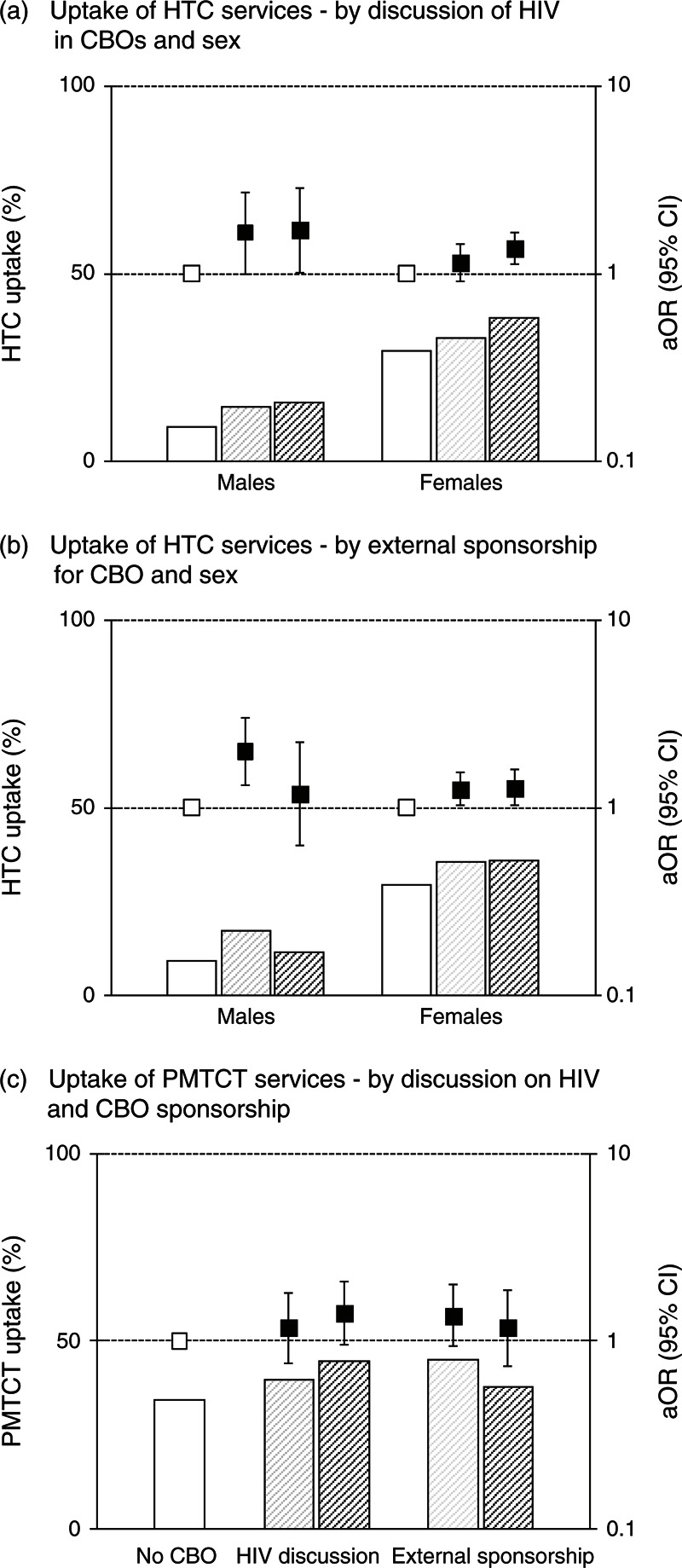
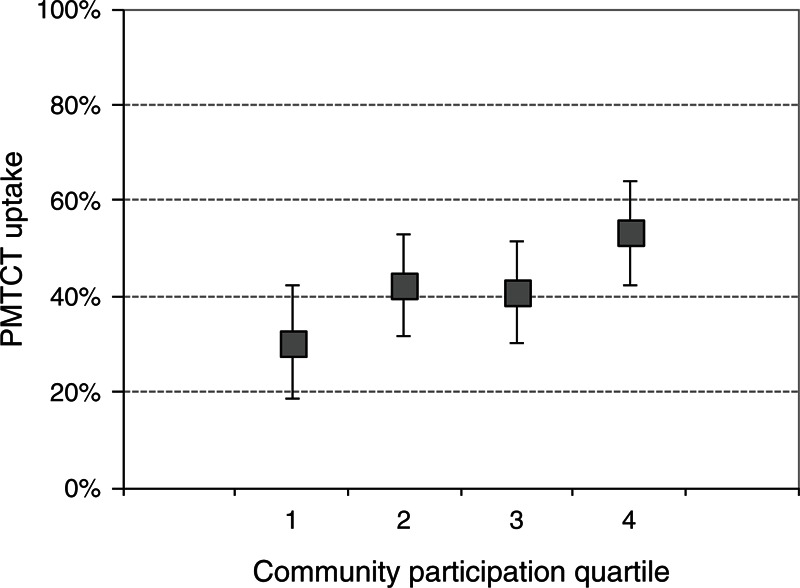
Sixteen percent of men and 47% of women were consistent members of community organizations; 58 and 35% of these people discussed HIV in their meetings and were members of externally sponsored organizations, respectively. Fewer men (10.1%) than women (32.4%) took up HTC during follow-up [adjusted odds ratio (aOR)=4.08, 95% confidence interval (CI) 3.43-4.86, P<0.001]. HTC uptake was higher for members of community organizations than for nonmembers: men, 15.0 versus 9.2% (1.67, 1.15-2.43, P=0.007); women, 35.6 versus 29.6% (1.26, 1.06-1.49, P=0.008). Membership of community organizations showed a nonsignificant association with PMTCT uptake amongst recently pregnant women (42.3 versus 34.2%; 1.30, 0.94-1.78, P=0.1). The most consistent positive associations between community participation and HTC and PMTCT uptake were found in organizations that discussed HIV and when external sponsorship was absent.
Grassroots organizations contributed to increased uptake of HTC services in eastern Zimbabwe in the mid-2000s. Partnerships with these organizations could harness community support for the further increases in HIV testing needed in sub-Saharan Africa.
研究社区参与(参与基层组织)是否有助于增加津巴布韦的艾滋病毒检测。
2003 年至 2008 年间,在津巴布韦东部进行了两次连续的一般人群队列调查,共对 5260 名成年人进行了访谈,收集了关于参加地方社区组织(如妇女团体和丧葬协会)和接受艾滋病毒检测和咨询(HTC)以及预防母婴传播(PMTCT)服务的成员资格以及在此期间接受服务的前瞻性数据。使用逻辑回归调整观察到的混杂因素,测量社区参与对服务利用的影响。
16%的男性和 47%的女性是社区组织的长期成员;在这些人中,58%和 35%的人在会议上讨论了 HIV,分别是外部赞助组织的成员。在随访期间,男性(10.1%)接受 HTC 的比例低于女性(32.4%)[调整后的优势比(aOR)=4.08,95%置信区间(CI)3.43-4.86,P<0.001]。与非成员相比,社区组织成员接受 HTC 的比例更高:男性,15.0%对 9.2%(1.67,1.15-2.43,P=0.007);女性,35.6%对 29.6%(1.26,1.06-1.49,P=0.008)。社区组织成员与最近怀孕的妇女中 PMTCT 的利用呈非显著关联(42.3%对 34.2%;1.30,0.94-1.78,P=0.1)。在讨论 HIV 时,以及在没有外部赞助的情况下,社区参与与 HTC 和 PMTCT 利用率之间存在最一致的正相关关系。
21 世纪 00 年代中期,基层组织有助于提高津巴布韦的 HTC 服务利用率。与这些组织建立伙伴关系可以利用社区的支持,进一步提高撒哈拉以南非洲地区的艾滋病毒检测率。