Department of Biological Sciences, Northern Kentucky University, SC 204, Highland Heights, KY 41099, USA.
Molecules. 2013 Sep 17;18(9):11537-52. doi: 10.3390/molecules180911537.
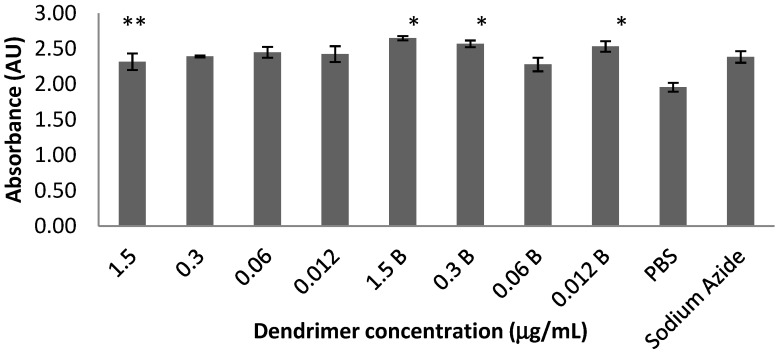
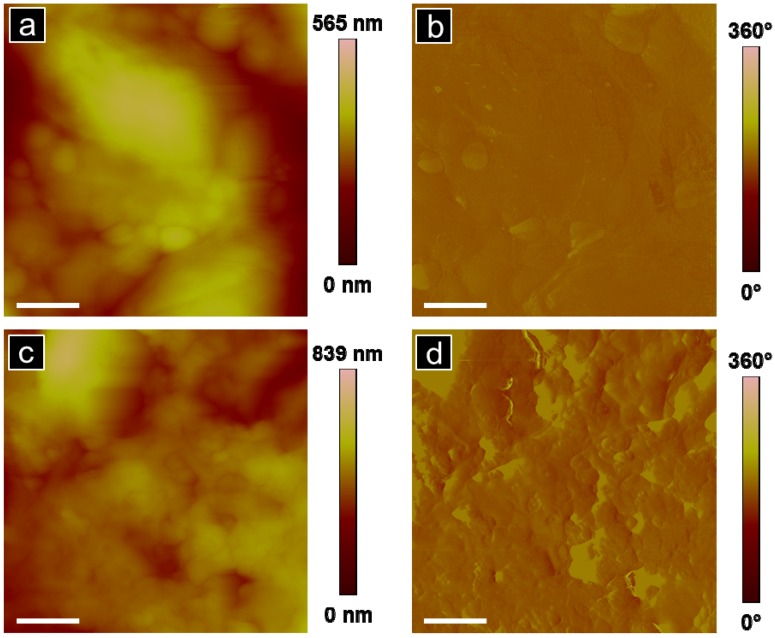
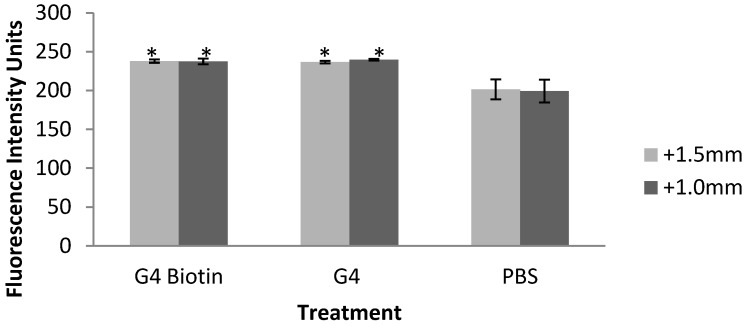
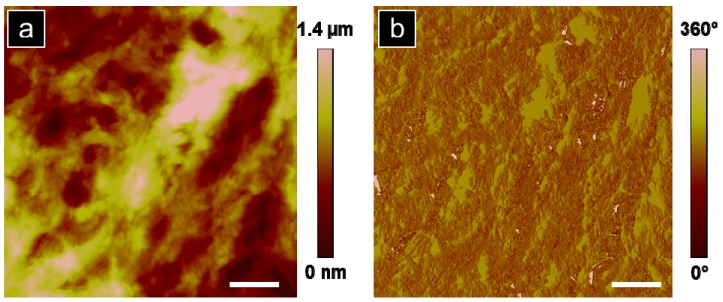
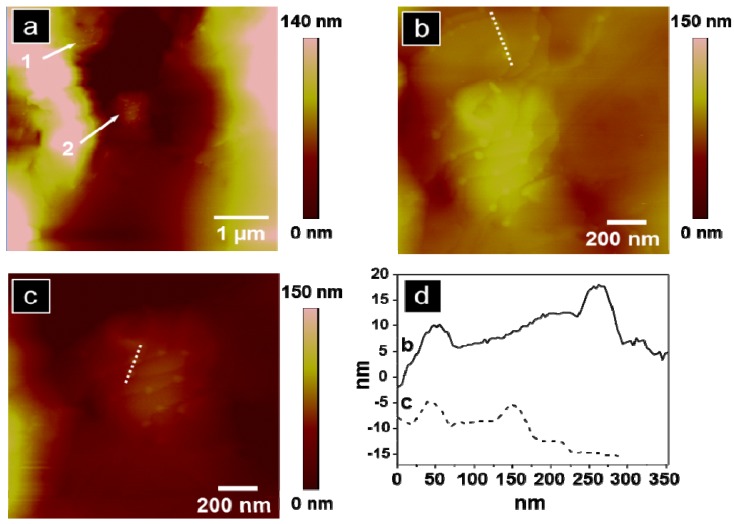
Dendrimers are highly customizable nanopolymers with qualities that make them ideal for drug delivery. The high binding affinity of biotin/avidin provides a useful approach to fluorescently label synthesized dendrimer-conjugates in cells and tissues. In addition, biotin may facilitate delivery of dendrimers through the blood-brain barrier (BBB) via carrier-mediated endocytosis. The purpose of this research was to: (1) measure toxicity using lactate dehydrogenase (LDH) assays of generation (G)4 biotinylated and non-biotinylated poly(amidoamine) (PAMAM) dendrimers in a co-culture model of the BBB, (2) determine distribution of dendrimers in the rat brain, kidney, and liver following systemic administration of dendrimers, and (3) conduct atomic force microscopy (AFM) on rat brain sections following systemic administration of dendrimers. LDH measurements showed that biotinylated dendrimers were toxic to cell co-culture after 48 h of treatment. Distribution studies showed evidence of biotinylated and non-biotinylated PAMAM dendrimers in brain. AFM studies showed evidence of dendrimers only in brain tissue of treated rats. These results indicate that biotinylation does not decrease toxicity associated with PAMAM dendrimers and that biotinylated PAMAM dendrimers distribute in the brain. Furthermore, this article provides evidence of nanoparticles in brain tissue following systemic administration of nanoparticles supported by both fluorescence microscopy and AFM.
树状聚合物是高度可定制的纳米聚合物,具有使其成为药物传递的理想选择的特性。生物素/亲和素的高结合亲和力为在细胞和组织中荧光标记合成的树突状聚合物缀合物提供了一种有用的方法。此外,生物素可以通过载体介导的内吞作用促进树突状聚合物通过血脑屏障 (BBB) 的递送。这项研究的目的是:(1) 使用乳酸脱氢酶 (LDH) 测定法测量代 (G)4 生物素化和非生物素化聚 (酰胺-胺) (PAMAM) 树突状聚合物在 BBB 共培养模型中的毒性,(2) 确定树突状聚合物在大鼠脑、肾和肝中的分布在全身给予树突状聚合物后,(3) 在全身给予树突状聚合物后对大鼠脑切片进行原子力显微镜 (AFM) 分析。LDH 测量表明,生物素化树突状聚合物在治疗 48 小时后对细胞共培养具有毒性。分布研究表明,在脑中有生物素化和非生物素化的 PAMAM 树突状聚合物的证据。AFM 研究表明,只有在处理过的大鼠脑组织中才存在树突状聚合物。这些结果表明,生物素化不会降低与 PAMAM 树突状聚合物相关的毒性,并且生物素化的 PAMAM 树突状聚合物在大脑中分布。此外,本文提供了支持荧光显微镜和 AFM 的系统给予纳米颗粒后纳米颗粒在脑组织中存在的证据。