Chandra Subhash, Barth Rolf F, Haider Syed A, Yang Weilian, Huo Tianyao, Shaikh Aarif L, Kabalka George W
Department of Biomedical Engineering, Cornell University, Ithaca, New York, United States of America.
PLoS One. 2013 Sep 18;8(9):e75377. doi: 10.1371/journal.pone.0075377. eCollection 2013.
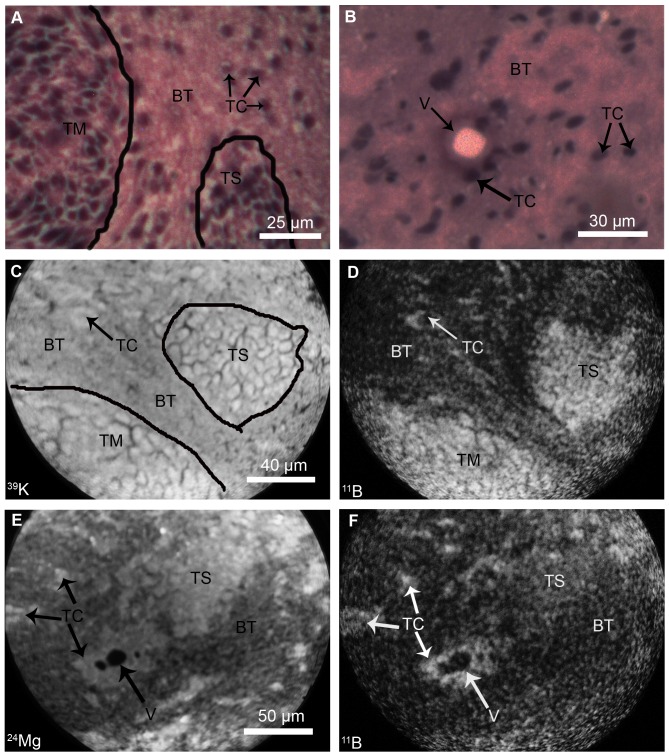
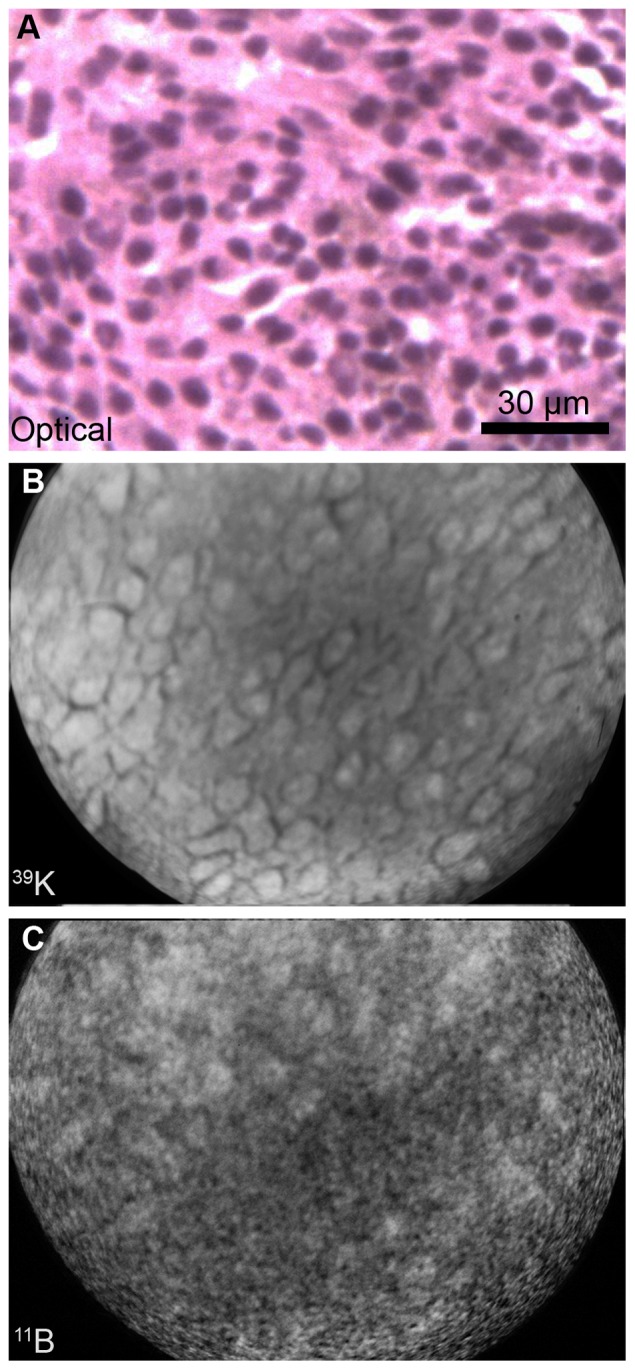
The development of new boron-delivery agents is a high priority for improving the effectiveness of boron neutron capture therapy. In the present study, 1-amino-3-borono-cyclopentanecarboxylic acid (cis-ABCPC) as a mixture of its L- and D-enantiomers was evaluated in vivo using the B16 melanoma model for the human tumor and the F98 rat glioma as a model for human gliomas. A secondary ion mass spectrometry (SIMS) based imaging instrument, CAMECA IMS 3F SIMS Ion Microscope, was used for quantitative imaging of boron at 500 nm spatial resolution. Both in vivo and in vitro studies in melanoma models demonstrated that boron was localized in the cytoplasm and nuclei with some cell-to-cell variability. Uptake of cis-ABCPC in B16 cells was time dependent with a 7.5:1 partitioning ratio of boron between cell nuclei and the nutrient medium after 4 hrs. incubation. Furthermore, cis-ABCPC delivered boron to cells in all phases of the cell cycle, including S-phase. In vivo SIMS studies using the F98 rat glioma model revealed an 8:1 boron partitioning ratio between the main tumor mass and normal brain tissue with a 5:1 ratio between infiltrating tumor cells and contiguous normal brain. Since cis-ABCPC is water soluble and can cross the blood-brain-barrier via the L-type amino acid transporters (LAT), it may accumulate preferentially in infiltrating tumor cells in normal brain due to up-regulation of LAT in high grade gliomas. Once trapped inside the tumor cell, cis-ABCPC cannot be metabolized and remains either in a free pool or bound to cell matrix components. The significant improvement in boron uptake by both the main tumor mass and infiltrating tumor cells compared to those reported in animal and clinical studies of p-boronophenylalanine strongly suggest that cis-ABCPC has the potential to become a novel new boron delivery agent for neutron capture therapy of gliomas and melanomas.
开发新型硼递送剂是提高硼中子俘获疗法有效性的当务之急。在本研究中,使用人肿瘤的B16黑色素瘤模型和人胶质瘤的F98大鼠胶质瘤模型,对作为其L-和D-对映体混合物的1-氨基-3-硼代环戊烷羧酸(顺式ABCPC)进行了体内评估。使用基于二次离子质谱(SIMS)的成像仪器CAMECA IMS 3F SIMS离子显微镜,以500 nm的空间分辨率对硼进行定量成像。黑色素瘤模型的体内和体外研究均表明,硼定位于细胞质和细胞核中,细胞间存在一定差异。在B16细胞中,顺式ABCPC的摄取具有时间依赖性,孵育4小时后,硼在细胞核与营养培养基之间的分配比为7.5:1。此外,顺式ABCPC将硼递送至细胞周期的所有阶段,包括S期。使用F98大鼠胶质瘤模型的体内SIMS研究显示,主要肿瘤块与正常脑组织之间的硼分配比为8:1,浸润性肿瘤细胞与相邻正常脑之间为5:1。由于顺式ABCPC是水溶性的,并且可以通过L型氨基酸转运体(LAT)穿过血脑屏障,由于高级别胶质瘤中LAT的上调,它可能优先在正常脑的浸润性肿瘤细胞中积累。一旦被困在肿瘤细胞内,顺式ABCPC就无法代谢,要么留在游离池中,要么与细胞基质成分结合。与对硼苯丙氨酸的动物和临床研究报道相比,主要肿瘤块和浸润性肿瘤细胞对硼的摄取有显著改善,这强烈表明顺式ABCPC有潜力成为一种新型的用于胶质瘤和黑色素瘤中子俘获治疗的硼递送剂。