Yao Dianbo, Peng Songlin, Dai Chaoliu
Department of Hepatobiliary and Splenic Surgery, Shengjing Hospital, China Medical University, Shenyang 110004, Liaoning Province, China.
BMC Cancer. 2013 Sep 23;13:432. doi: 10.1186/1471-2407-13-432.
Mesenchymal-epithelial transition (MET) is now suggested to participate in the process of metastatic tumor formation. However, in hepatocellular carcinoma (HCC) the process is still not well revealed.
Paraffin-embedded tissue samples were obtained from 13 patients with HCC in Shengjing Hospital of China Medical University. The expression of E-cadherin, Fibronectin, N-cadherin, Vimentin, Hepatocyte nuclear factor 4alpha (HNF4alpha), Snail and Slug was assessed in primary tumors and their corresponding metastases by immunohistochemical staining. Next, the expression of HNF4alpha and E-cadherin in four HCC cell lines was examined. Furthermore, SK-Hep-1 cells were transfected with human HNF4alpha expression vector, and the change of E-cadherin expression was assessed.
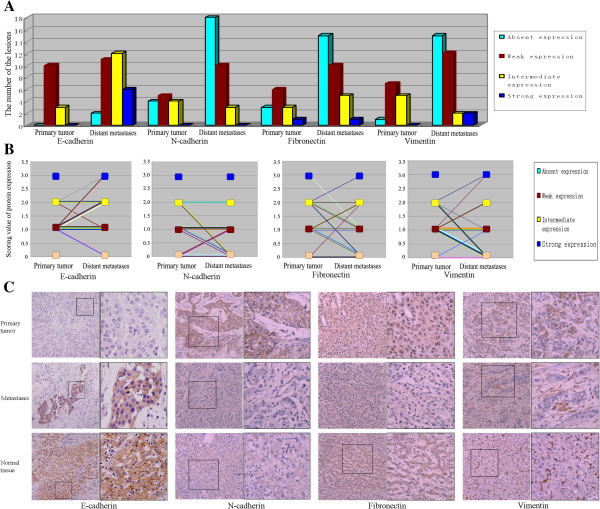
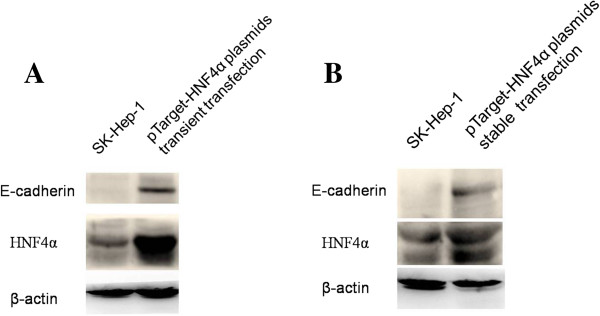
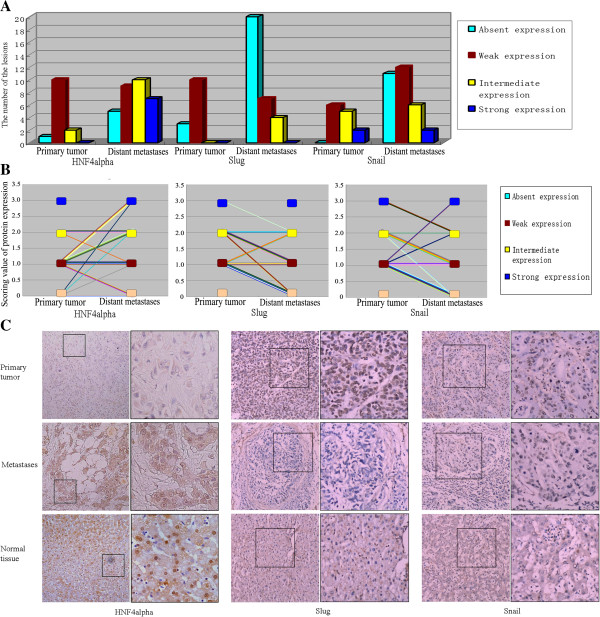
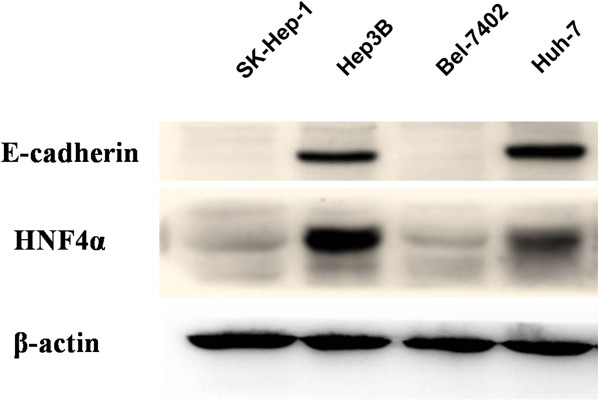
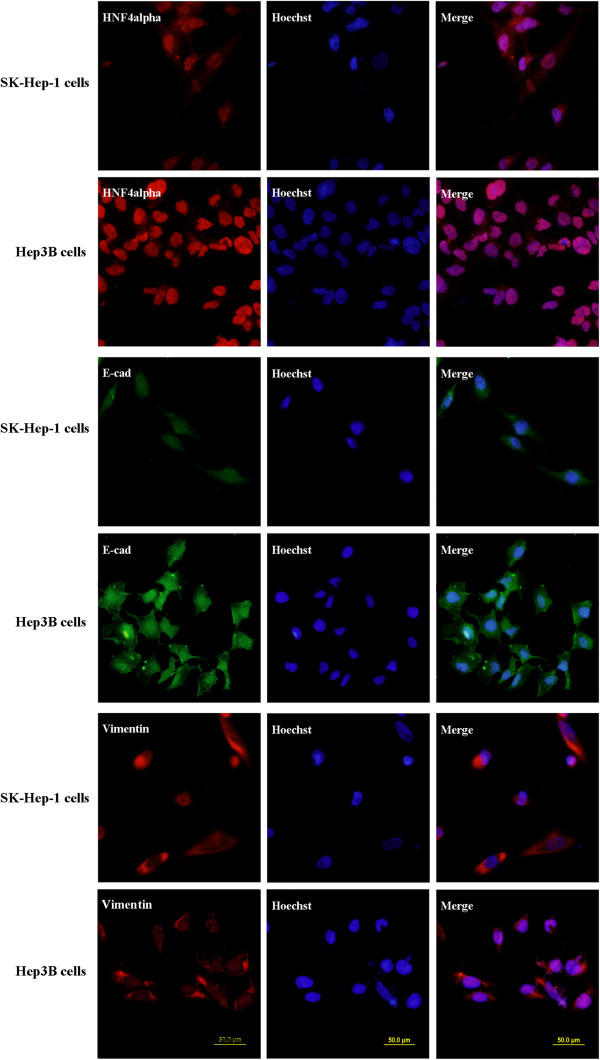
45.2% (14/31) of the lesions in the metastases showed increased E-cadherin expression compared with the primaries, suggesting the possible occurrence of MET in metastatic tumor formation of HCC, as re-expression of E-cadherin is proposed to be the important hallmark of MET. The occurrence of MET was also confirmed by the reduced expression of Fibronectin (54.8%, 17/31), N-cadherin (38.7%, 12/31) and Vimentin (61.3%, 19/31) in the metastases. 45.2% (14/31) of the lesions in the metastases also showed increased HNF4alpha expression, and 67.7% (21/31) and 48.4% (15/31) of metastases showed decreased Snail and Slug expression respectively. Statistical results showed that the expression of HNF4alpha was positively related with that of E-cadherin, and negatively correlated with that of Snail, Slug and Fibronectin, suggesting that the expression change of the MET markers in the metastatic lesions might be associated with HNF4alpha. Among the four HCC cell lines, both HNF4alpha and E-cadherin expressed high in Hep3B and Huh-7 cells, but low in SK-Hep-1 and Bel-7402 cells. Furthermore, the expression of E-cadherin increased accordingly when SK-Hep-1 cells were transfected with human HNF4alpha expression vector, further confirming the role of HNF4alpha in the regulation of E-cadherin expression.
Our clinical observations and experimental data indicate that HNF4alpha might play a crucial role in the metastatic tumor formation of HCC, and the mechanism may be related with the process of phenotype transition.
间充质 - 上皮转化(MET)现被认为参与转移性肿瘤形成过程。然而,在肝细胞癌(HCC)中该过程仍未完全明确。
从中国医科大学盛京医院的13例HCC患者获取石蜡包埋组织样本。通过免疫组织化学染色评估原发性肿瘤及其相应转移灶中E - 钙黏蛋白、纤连蛋白、N - 钙黏蛋白、波形蛋白、肝细胞核因子4α(HNF4α)、Snail和Slug的表达。接下来,检测4种HCC细胞系中HNF4α和E - 钙黏蛋白的表达。此外,用人类HNF4α表达载体转染SK - Hep - 1细胞,并评估E - 钙黏蛋白表达的变化。
与原发性肿瘤相比,45.2%(14/31)的转移灶中E - 钙黏蛋白表达增加,提示在HCC转移瘤形成中可能发生了MET,因为E - 钙黏蛋白的重新表达被认为是MET的重要标志。转移灶中纤连蛋白(54.8%,17/31)、N - 钙黏蛋白(38.7%,12/31)和波形蛋白(61.3%,19/31)表达降低也证实了MET的发生。45.2%(14/31)的转移灶中HNF4α表达也增加,67.7%(21/31)和48.4%(15/31)的转移灶中Snail和Slug表达分别降低。统计结果显示,HNF4α的表达与E - 钙黏蛋白呈正相关,与Snail、Slug和纤连蛋白呈负相关,提示转移灶中MET标志物的表达变化可能与HNF4α有关。在4种HCC细胞系中,Hep3B和Huh - 7细胞中HNF4α和E - 钙黏蛋白均高表达,而在SK - Hep - 1和Bel - 7402细胞中低表达。此外,当用人类HNF4α表达载体转染SK - Hep - 1细胞时,E - 钙黏蛋白的表达相应增加,进一步证实了HNF4α在调节E - 钙黏蛋白表达中的作用。
我们的临床观察和实验数据表明,HNF4α可能在HCC转移瘤形成中起关键作用,其机制可能与表型转变过程有关。