Department of Epidemiology, Gillings School of Global Public Health, University of North Carolina, Chapel Hill, North Carolina, United States of America.
PLoS One. 2013 Sep 16;8(9):e73825. doi: 10.1371/journal.pone.0073825. eCollection 2013.
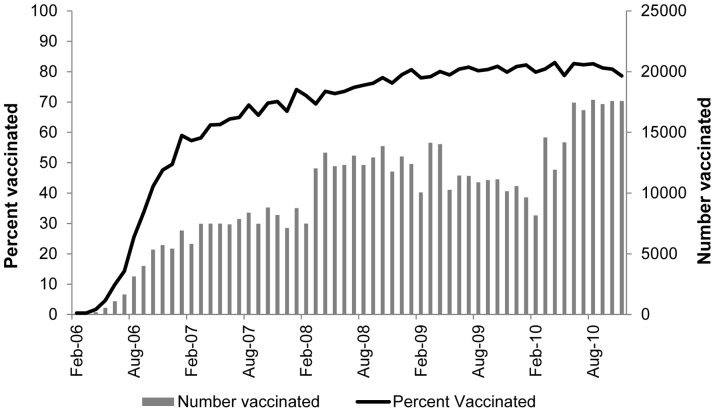
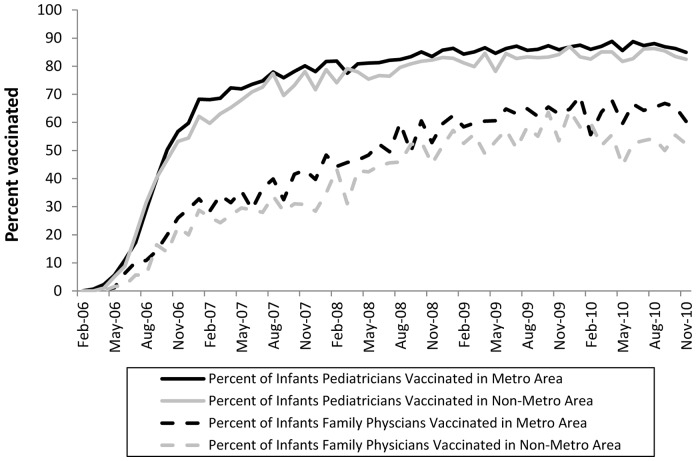
Rotavirus vaccines are highly effective at preventing gastroenteritis in young children and are now universally recommended for infants in the US. We studied patterns of use of rotavirus vaccines among US infants with commercial insurance. We identified a large cohort of infants in the MarketScan Research Databases, 2006-2010. The analysis was restricted to infants residing in states without state-funded rotavirus vaccination programs. We computed summary statistics and used multivariable regression to assess the association between patient-, provider-, and ecologic-level variables of rotavirus vaccine receipt and series completion. Approximately 69% of 594,117 eligible infants received at least one dose of rotavirus vaccine from 2006-2010. Most infants received the rotavirus vaccines at the recommended ages, but more infants completed the series for monovalent rotavirus vaccine than pentavalent rotavirus vaccine or a mix of the vaccines (87% versus 79% versus 73%, P<0.001). In multivariable analyses, the strongest predictors of rotavirus vaccine series initiation and completion were receipt of the diphtheria, tetanus and acellular pertussis vaccine (Initiation: RR = 7.91, 95% CI = 7.69-8.13; Completion: RR = 1.26, 95% CI = 1.23-1.29), visiting a pediatrician versus family physician (Initiation: RR = 1.51, 95% CI = 1.49-1.52; Completion: RR = 1.13, 95% CI = 1.11-1.14), and living in a large metropolitan versus smaller metropolitan, urban, or rural area. We observed rapid diffusion of the rotavirus vaccine in routine practice; however, approximately one-fifth of infants did not receive at least one dose of vaccine as recently as 2010. Interventions to increase rotavirus vaccine coverage should consider targeting family physicians and encouraging completion of the vaccine series.
轮状病毒疫苗在预防婴幼儿肠胃炎方面非常有效,目前已被普遍推荐用于美国婴儿。我们研究了美国有商业保险的婴儿使用轮状病毒疫苗的模式。我们在 MarketScan 研究数据库中确定了一个大型婴儿队列,时间为 2006 年至 2010 年。该分析仅限于没有州资助轮状病毒疫苗接种计划的州的居住的婴儿。我们计算了汇总统计数据,并使用多变量回归评估了患者、提供者和生态级别的轮状病毒疫苗接种和系列完成情况的变量之间的关联。在 2006 年至 2010 年期间,大约 69%的 594117 名符合条件的婴儿至少接种了一剂轮状病毒疫苗。大多数婴儿按建议的年龄接种轮状病毒疫苗,但更多的婴儿完成了单价轮状病毒疫苗的系列接种,而不是五价轮状病毒疫苗或混合疫苗(87%比 79%比 73%,P<0.001)。在多变量分析中,轮状病毒疫苗系列启动和完成的最强预测因素是接种白喉、破伤风和无细胞百日咳疫苗(启动:RR=7.91,95%CI=7.69-8.13;完成:RR=1.26,95%CI=1.23-1.29),与儿科医生而不是家庭医生就诊(启动:RR=1.51,95%CI=1.49-1.52;完成:RR=1.13,95%CI=1.11-1.14),以及居住在大城市而非较小的城市、城市或农村地区。我们观察到轮状病毒疫苗在常规实践中的快速传播;然而,截至 2010 年,大约五分之一的婴儿没有接种至少一剂疫苗。增加轮状病毒疫苗覆盖率的干预措施应考虑针对家庭医生,并鼓励完成疫苗系列。