Department of Nutrition & Graduate Group in Nutritional Biology, University of California, One Shields Avenue, Davis, CA 95616, USA.
Nutrients. 2013 Aug 26;5(9):3352-66. doi: 10.3390/nu5093352.
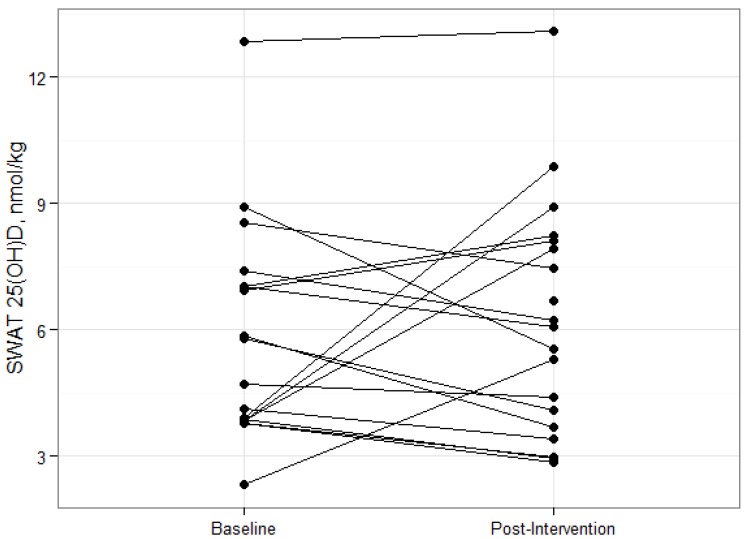
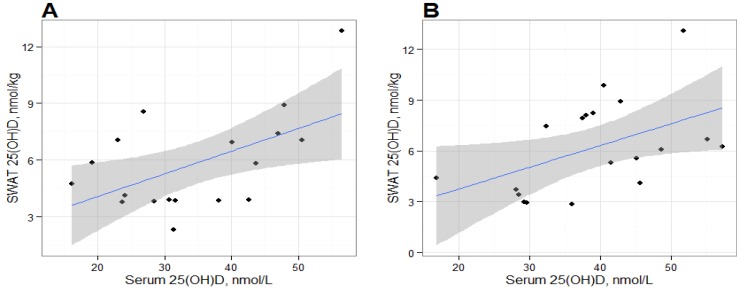
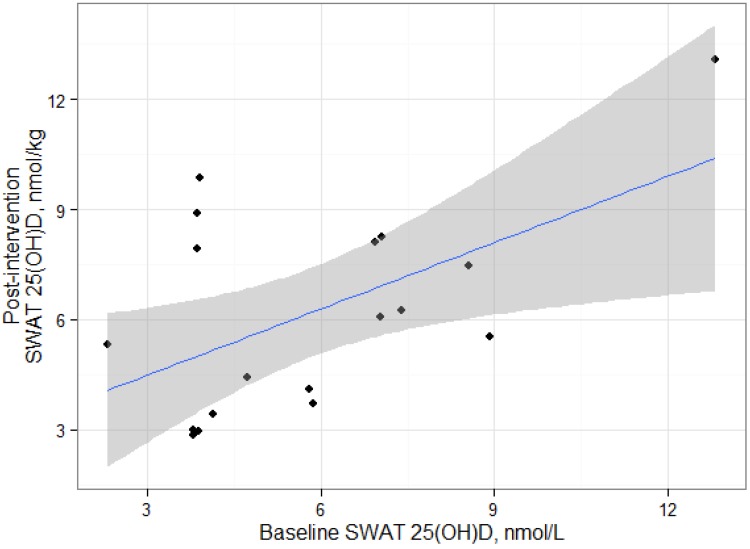
Cholecalciferol is known to be deposited in human adipose tissue, but it is not known whether 25-hydroxyvitamin D (25(OH)D) is found in detectable concentrations. Therefore, our objective was to determine whether 25(OH)D is detectable in subcutaneous white adipose tissue (SWAT) in overweight and obese persons enrolled in a twelve week energy restricted diet. Baseline and post-intervention gluteal SWAT biopsies were collected from 20 subjects participating in a larger clinical weight loss intervention. LC-MS/MS was utilized to determine SWAT 25(OH)D concentrations. Serum 25(OH)D and 1,25(OH)2D were measured by RIA. Body composition was assessed by dual energy x-ray absorptiometry. SWAT 25(OH)D concentrations were 5.8 ± 2.6 nmol/kg tissue and 6.2 ± 2.7 nmol/kg tissue pre- and post-intervention SWAT, respectively. There was a significant positive association between SWAT 25(OH)D concentration and serum 25(OH)D concentration (r = 0.52, P < 0.01). Both SWAT and serum 25(OH)D concentrations did not significantly change after a twelve-week period of energy restriction with approximately 5 kg of fat loss. In conclusion, we have demonstrated our LC-MS/MS method can detect 25(OH)D3 in human subcutaneous fat tissue from overweight and obese individuals and is consistent with previously reported concentrations in swine. Additionally, our findings of no significant changes in SWAT 25(OH)D3 or serum 25(OH)D after a 6% loss of total body weight and 13% reduction in total fat provides the first human evidence that adipose 25(OH)D does not likely contribute to serum 25(OH)D with moderate weight loss; whether this is also the case with larger amounts of weight loss is unknown. Weight loss alone is not sufficient to increase serum 25(OH)D and increases in dietary or dermal biosynthesis of vitamin D appear to be the most critical contributors to in vitamin D status.
胆钙化醇已知沉积在人体脂肪组织中,但 25-羟维生素 D(25(OH)D)是否以可检测的浓度存在尚不清楚。因此,我们的目的是确定超重和肥胖者在进行为期 12 周的能量限制饮食时,是否可在皮下白色脂肪组织(SWAT)中检测到 25(OH)D。从参与更大规模临床减重干预的 20 名受试者中采集基线和干预后臀 SWAT 活检。利用 LC-MS/MS 测定 SWAT 25(OH)D 浓度。通过 RIA 测定血清 25(OH)D 和 1,25(OH)2D。采用双能 X 射线吸收法评估身体成分。SWAT 25(OH)D 浓度分别为干预前和干预后 SWAT 的 5.8 ± 2.6 nmol/kg 组织和 6.2 ± 2.7 nmol/kg 组织。SWAT 25(OH)D 浓度与血清 25(OH)D 浓度呈显著正相关(r = 0.52,P < 0.01)。在进行为期 12 周的能量限制后,体重减轻约 5 公斤,SWAT 和血清 25(OH)D 浓度均无显著变化。总之,我们已经证明我们的 LC-MS/MS 方法可以检测超重和肥胖个体的人皮下脂肪组织中的 25(OH)D3,并且与以前在猪中报告的浓度一致。此外,我们发现,在体重减轻 6%和体脂减少 13%后,SWAT 25(OH)D3 或血清 25(OH)D 无显著变化,这首次提供了人类证据,表明中等程度的体重减轻不太可能导致脂肪 25(OH)D 对血清 25(OH)D 的贡献;在更大程度的体重减轻时是否也是如此尚不清楚。单独减肥不足以增加血清 25(OH)D,增加饮食或皮肤合成维生素 D 似乎是维生素 D 状态的最关键因素。