Division of Nutrition and Biochemical Medicine, Department of Medicine, Faculty of Medicine Ramathibodi Hospital, Mahidol University, Bangkok 10400, Thailand.
Graduate Program in Nutrition, Faculty of Medicine Ramathibodi Hospital, Mahidol University, Bangkok 10400, Thailand.
Nutrients. 2022 Jul 27;14(15):3075. doi: 10.3390/nu14153075.
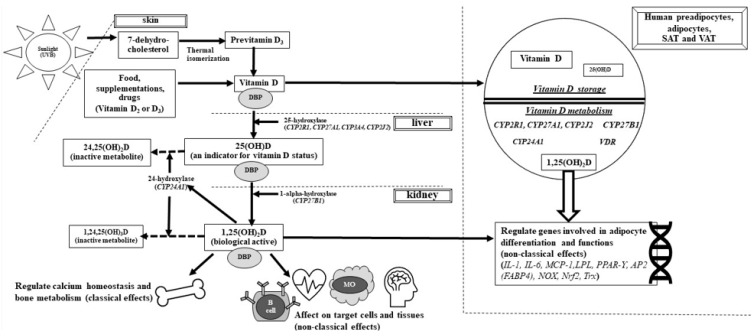
The extraskeletal effect of vitamin D on adipose tissue biology and modulation in human obesity is of great interest and has been extensively investigated. Current evidence from preclinical and clinical studies in human adipose tissue suggests that the anti-inflammatory effects of vitamin D are evident and consistent, whereas the effects of vitamin D on adipocyte differentiation, adipogenesis, and energy metabolism and the effects of vitamin D supplementation on adipokine levels are inconclusive. Interventional studies related to medical and surgical weight loss in humans have shown small or no improvement in vitamin D status. Additionally, the benefit of vitamin D supplementation for the reduction in visceral adipose tissue has only been demonstrated in a few studies. Overall, the findings on the relationship between vitamin D and visceral adipose tissue in humans are still inconclusive. Further studies are required to confirm the beneficial effects of vitamin D on ameliorating adipose tissue dysfunction.
维生素 D 对人体脂肪组织生物学的骨骼外作用及其在肥胖症中的调节作用非常重要,已得到广泛研究。目前来自人体脂肪组织的临床前和临床研究的证据表明,维生素 D 的抗炎作用是明显而一致的,而维生素 D 对脂肪细胞分化、脂肪生成和能量代谢的影响以及维生素 D 补充对脂肪因子水平的影响尚无定论。与人体医学和外科减肥相关的干预性研究表明,维生素 D 状态的改善很小或没有改善。此外,只有少数研究表明,维生素 D 补充对减少内脏脂肪组织有好处。总的来说,关于维生素 D 与人体内脏脂肪组织之间关系的研究结果仍不确定。需要进一步的研究来证实维生素 D 对改善脂肪组织功能障碍的有益作用。