Department of Biostatistics.
Genome Res. 2014 Feb;24(2):177-84. doi: 10.1101/gr.157743.113. Epub 2013 Sep 25.
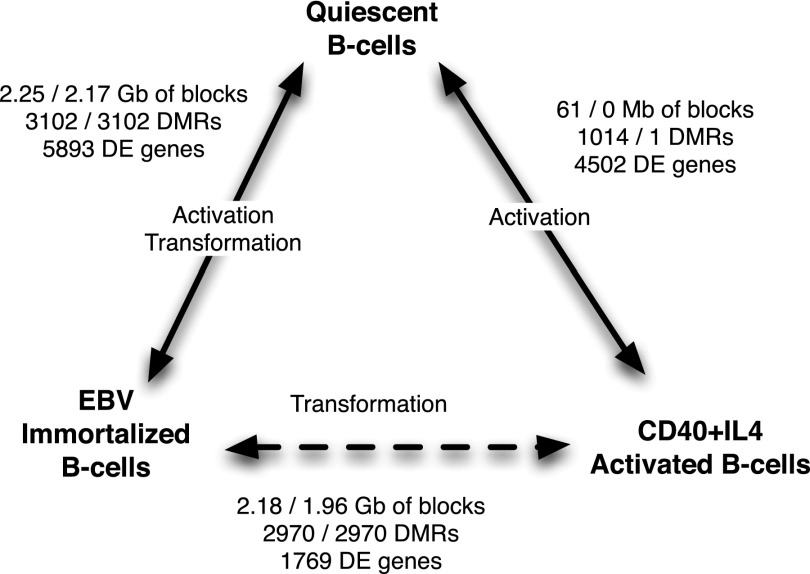
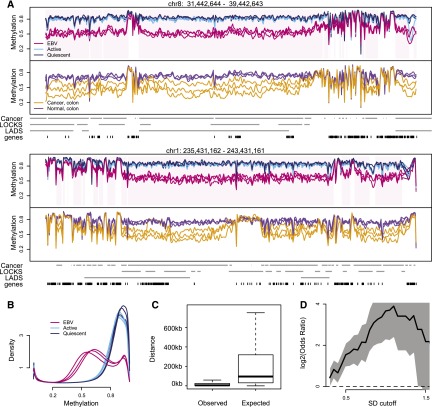
Altered DNA methylation occurs ubiquitously in human cancer from the earliest measurable stages. A cogent approach to understanding the mechanism and timing of altered DNA methylation is to analyze it in the context of carcinogenesis by a defined agent. Epstein-Barr virus (EBV) is a human oncogenic herpesvirus associated with lymphoma and nasopharyngeal carcinoma, but also used commonly in the laboratory to immortalize human B-cells in culture. Here we have performed whole-genome bisulfite sequencing of normal B-cells, activated B-cells, and EBV-immortalized B-cells from the same three individuals, in order to identify the impact of transformation on the methylome. Surprisingly, large-scale hypomethylated blocks comprising two-thirds of the genome were induced by EBV immortalization but not by B-cell activation per se. These regions largely corresponded to hypomethylated blocks that we have observed in human cancer, and they were associated with gene-expression hypervariability, similar to human cancer, and consistent with a model of epigenomic change promoting tumor cell heterogeneity. We also describe small-scale changes in DNA methylation near CpG islands. These results suggest that methylation disruption is an early and critical step in malignant transformation.
在人类癌症的最早可测量阶段,DNA 甲基化的改变普遍存在。分析致癌剂作用下癌变过程中 DNA 甲基化的改变,是理解其机制和时机的一个合理方法。EB 病毒(EBV)是一种人类致癌疱疹病毒,与淋巴瘤和鼻咽癌有关,但也常用于实验室中使人类 B 细胞在培养中永生化。在这里,我们对来自这三个人的正常 B 细胞、激活的 B 细胞和 EBV 永生化的 B 细胞进行了全基因组亚硫酸氢盐测序,以确定转化对甲基组的影响。令人惊讶的是,EBV 永生化而非 B 细胞激活本身诱导了包含基因组三分之二的大规模低甲基化块。这些区域主要与我们在人类癌症中观察到的低甲基化块相对应,并且与人类癌症一样,与促进肿瘤细胞异质性的表观基因组变化模型一致。我们还描述了 CpG 岛附近 DNA 甲基化的小规模变化。这些结果表明,甲基化破坏是恶性转化的早期和关键步骤。