Institute of Modern Physics, Chinese Academy of Sciences, 509 Nanchang Rd, Lanzhou, Gansu 730000, P,R, China.
BMC Microbiol. 2013 Sep 28;13:213. doi: 10.1186/1471-2180-13-213.
Dietzia natronolimnaea is one of the most important bacterial bioresources for high efficiency canthaxanthin production. It produces the robust and stable pigment canthaxanthin, which is of special interest for the development of integrated biorefineries. Mutagenesis employing 12C6+ irradiation is a novel technique commonly used to improve microorganism productivity. This study presents a promising route to obtaining the highest feasible levels of biomass dry weight (BDW), and total canthaxanthin by using a microdosimetric model of 12C6+ irradiation mutation in combination with the optimization of nutrient medium components.
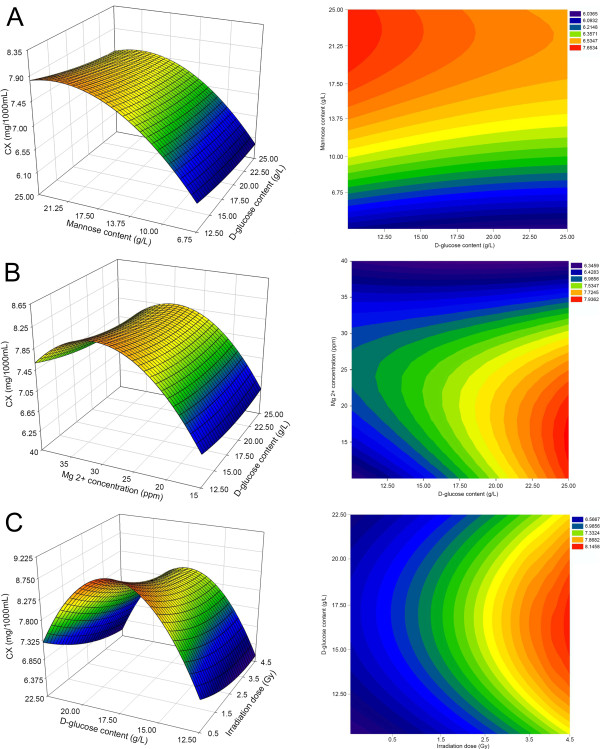
This work characterized the rate of both lethal and non-lethal dose mutations for 12C6+ irradiation and the microdosimetric kinetic model using the model organism, D. natronolimnaea svgcc1.2736. Irradiation with 12C6+ ions resulted in enhanced production of canthaxanthin, and is therefore an effective method for strain improvement of D. natronolimnaea svgcc1.2736. Based on these results an optimal dose of 0.5-4.5 Gy, Linear energy transfer (LET) of 80 keV μm-1and energy of 60 MeV u-1 for 12C6+ irradiation are ideal for optimum and specific production of canthaxanthin in the bacterium. Second-order empirical calculations displaying high R-squared (0.996) values between the responses and independent variables were derived from validation experiments using response surface methodology. The highest canthaxanthin yield (8.14 mg) was obtained with an optimized growth medium containing 21.5 g L-1 D-glucose, 23.5 g L-1 mannose and 25 ppm Mg2+ in 1 L with an irradiation dose of 4.5 Gy.
The microdosimetric 12C6+ irradiation model was an effective mutagenic technique for the strain improvement of D. natronolimnaea svgcc1.2736 specifically for enhanced canthaxanthin production. At the very least, random mutagenesis methods using 12C6+ions can be used as a first step in a combined approach with long-term continuous fermentation processes. Central composite design-response surface methodologies (CCD-RSM) were carried out to optimize the conditions for canthaxanthin yield. It was discovered D-glucose, Mg2+ and mannose have significant influence on canthaxanthin biosynthesis and growth of the mutant strain.
盐生盐杆菌是生产高效类胡萝卜素虾青素的最重要的细菌生物资源之一。它产生稳定且强劲的类胡萝卜素虾青素,这对于开发综合生物炼制厂具有特殊意义。利用 12C6+ 辐照进行诱变是一种常用的提高微生物生产力的新技术。本研究提出了一条很有前途的途径,即通过微剂量模型的 12C6+ 辐照诱变与营养培养基成分的优化相结合,获得最高可能的生物量干重 (BDW) 和总虾青素。
本工作使用模型生物盐生盐杆菌 svgcc1.2736 对 12C6+ 辐照的致死和非致死剂量突变进行了特征描述,并建立了微剂量动力学模型。用 12C6+ 离子辐照可提高虾青素的产量,因此是一种有效的盐生盐杆菌 svgcc1.2736 菌株改良方法。基于这些结果,最佳辐照剂量为 0.5-4.5 Gy,线性能量传递 (LET) 为 80 keV μm-1,12C6+ 辐照能量为 60 MeV u-1,有利于细菌中虾青素的最佳和特异性生产。通过响应面法的验证实验,得出了二次经验计算,响应值与独立变量之间的 R2 值很高(0.996)。在 1 L 培养基中,当葡萄糖为 21.5 g L-1、甘露糖为 23.5 g L-1 和 Mg2+为 25 ppm 时,用 4.5 Gy 辐照剂量,可获得最高的虾青素产量(8.14 mg)。
微剂量 12C6+ 辐照模型是盐生盐杆菌 svgcc1.2736 菌株改良的有效诱变技术,特别是用于提高虾青素产量。至少,使用 12C6+ 离子的随机诱变方法可以作为与长期连续发酵过程相结合的综合方法的第一步。采用中心复合设计-响应面法 (CCD-RSM) 对虾青素产量的条件进行了优化。结果发现,葡萄糖、Mg2+和甘露糖对虾青素生物合成和突变株的生长有显著影响。