Ballard Elizabeth D, Horowitz Lisa M, Jobes David A, Wagner Barry M, Pao Maryland, Teach Stephen J
From the *Department of Psychiatry and Behavioral Sciences, Johns Hopkins School of Medicine, Baltimore; and †National Institute of Mental Health, NIH, Bethesda, MD; ‡Department of Psychology, The Catholic University of America; and §Division of Emergency Medicine, Children's National Medical Center, Washington, DC.
Pediatr Emerg Care. 2013 Oct;29(10):1070-4. doi: 10.1097/PEC.0b013e3182a5cba6.
Although validated suicide screening tools exist for use among children and adolescents presenting to emergency departments (EDs), the associations between screening positive for suicide risk and immediate psychiatric hospital admission or subsequent ED use, stratified by age, have not been examined.
This is a retrospective cohort study of a consecutive case series of patients aged 8 to 18 years presenting with psychiatric chief complaints during a 9-month period to a single urban tertiary care pediatric ED. Eligible patients were administered a subset of questions from the Risk of Suicide Questionnaire. Outcomes included the odds of psychiatric hospitalization at the index visit and repeated ED visits for psychiatric complaints within the following year, stratified by age.
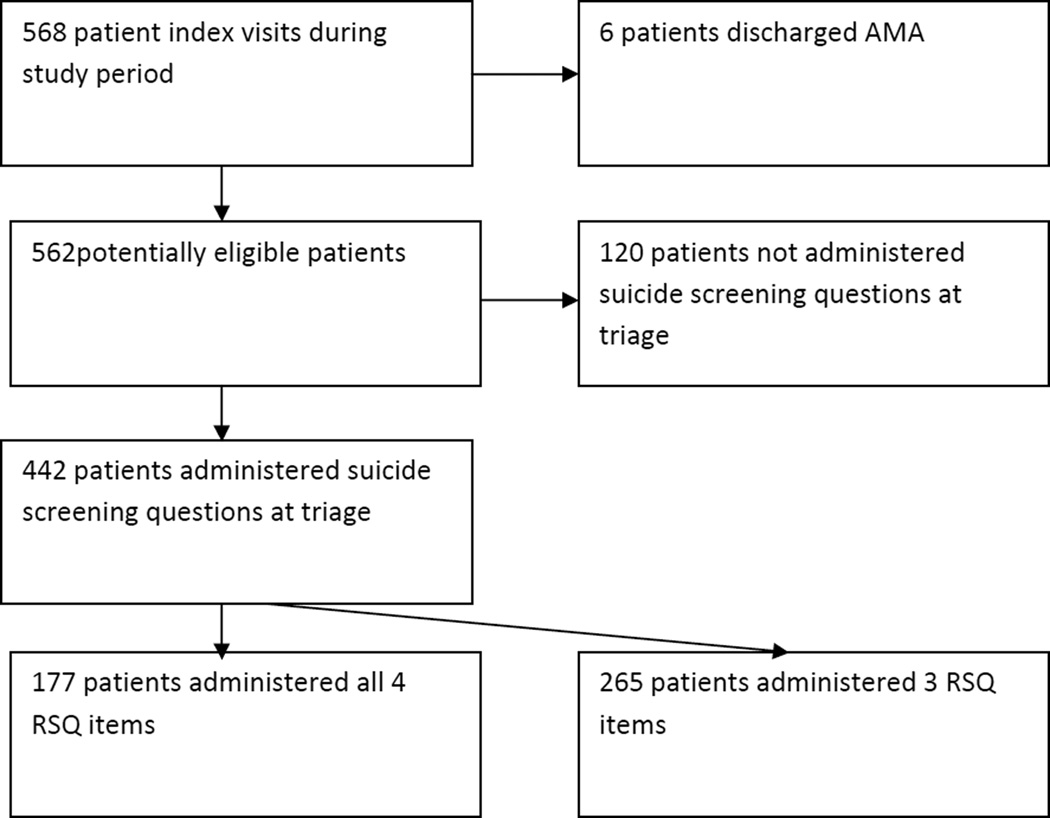
Of the 568 patients presenting during the study period, responses to suicide screening questions were available for 442 patients (78%). A total of 159 (36%) of 442 were hospitalized and 130 (29%) of 442 had 1 or more ED visits within the following year. The proportion of patients providing positive responses to 1 or more suicide screening questions did not differ between patients aged 8 to 12 years and those aged 13 to 18 years (77/154 [50%] vs 137/288 [48%], P = 0.63). A positive response to 1 or more of the questions was significantly associated with increased odds of psychiatric hospitalization in the older age group [adjusted odds ratio, 3.82; 95% confidence interval, 2.24-6.54) and with repeated visits to the ED in the younger age group (adjusted odds ratio, 3.55 95% confidence interval, 1.68-7.50).
Positive responses to suicide screening questions were associated with acute psychiatric hospitalization and repeated ED visits. Suicide screening in a pediatric ED may identify children and adolescents with increased need of psychiatric resources.
虽然存在经过验证的自杀筛查工具可用于就诊于急诊科(ED)的儿童和青少年,但按年龄分层后,自杀风险筛查呈阳性与立即入住精神病医院或随后再次前往急诊科就诊之间的关联尚未得到研究。
这是一项回顾性队列研究,研究对象为在9个月期间因精神科主诉就诊于一家城市三级护理儿科急诊科的8至18岁连续病例系列患者。符合条件的患者接受了《自杀风险问卷》中的部分问题。结局包括首次就诊时入住精神病医院的几率以及次年因精神科主诉再次前往急诊科就诊的情况,并按年龄分层。
在研究期间就诊的568例患者中,442例患者(78%)有自杀筛查问题的回复。442例患者中共有159例(36%)住院,442例患者中有130例(29%)在次年有1次或更多次前往急诊科就诊。8至12岁患者与13至18岁患者中对1个或更多自杀筛查问题给出肯定回答的患者比例无差异(77/154 [50%] 对137/288 [48%],P = 0.63)。对1个或更多问题给出肯定回答与年龄较大组入住精神病医院的几率增加显著相关[调整后的优势比为3.82;95%置信区间为2.24 - 6.54],与年龄较小组再次前往急诊科就诊显著相关(调整后的优势比为3.55,95%置信区间为1.68 - 7.50)。
对自杀筛查问题给出肯定回答与急性精神病住院和再次前往急诊科就诊相关。儿科急诊科的自杀筛查可能会识别出对精神科资源需求增加的儿童和青少年。