Lopez-Marques Rosa L, Theorin Lisa, Palmgren Michael G, Pomorski Thomas Günther
Pflugers Arch. 2014 Jul;466(7):1227-40. doi: 10.1007/s00424-013-1363-4.
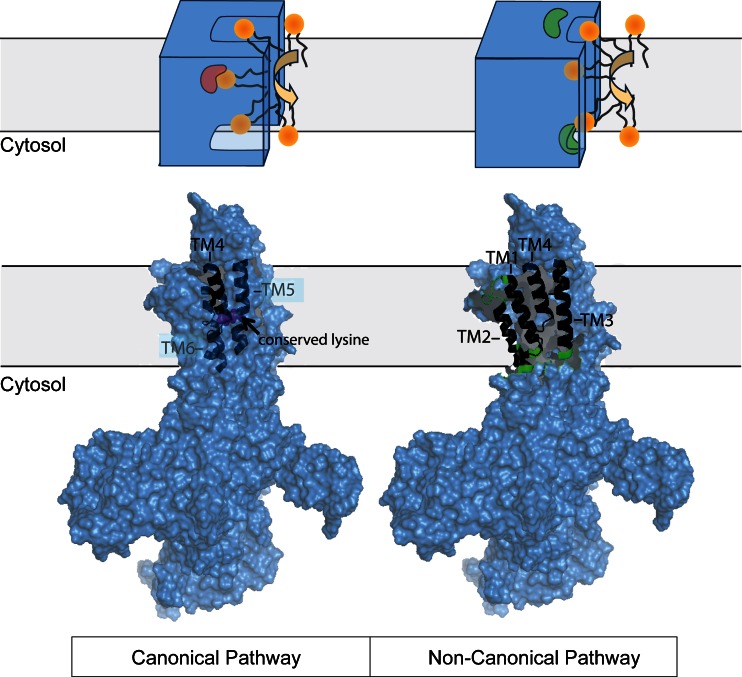
Cellular membranes, notably eukaryotic plasma membranes, are equipped with special proteins that actively translocate lipids from one leaflet to the other and thereby help generate membrane lipid asymmetry. Among these ATP-driven transporters, the P4 subfamily of P-type ATPases (P4-ATPases) comprises lipid flippases that catalyze the translocation of phospholipids from the exoplasmic to the cytosolic leaflet of cell membranes. While initially characterized as aminophospholipid translocases, recent studies of individual P4-ATPase family members from fungi, plants, and animals show that P4-ATPases differ in their substrate specificities and mediate transport of a broader range of lipid substrates, including lysophospholipids and synthetic alkylphospholipids. At the same time, the cellular processes known to be directly or indirectly affected by this class of transporters have expanded to include the regulation of membrane traffic, cytoskeletal dynamics, cell division, lipid metabolism, and lipid signaling. In this review, we will summarize the basic features of P4-ATPases and the physiological implications of their lipid transport activity in the cell.
细胞膜,尤其是真核生物的质膜,配备有特殊的蛋白质,这些蛋白质能将脂质从一个小叶主动转运到另一个小叶,从而有助于产生膜脂不对称性。在这些由ATP驱动的转运蛋白中,P型ATP酶(P4-ATP酶)的P4亚家族包括脂质翻转酶,它们催化磷脂从细胞膜的细胞外小叶转运到细胞质小叶。虽然最初被鉴定为氨基磷脂转位酶,但最近对来自真菌、植物和动物的单个P4-ATP酶家族成员的研究表明,P4-ATP酶的底物特异性不同,并介导更广泛的脂质底物的运输,包括溶血磷脂和合成烷基磷脂。与此同时,已知直接或间接受这类转运蛋白影响的细胞过程已扩展到包括膜运输、细胞骨架动力学、细胞分裂、脂质代谢和脂质信号传导的调节。在这篇综述中,我们将总结P4-ATP酶的基本特征及其脂质转运活性在细胞中的生理意义。