Hum Genet. 2014 Jan;133(1):1-9. doi: 10.1007/s00439-013-1358-4.
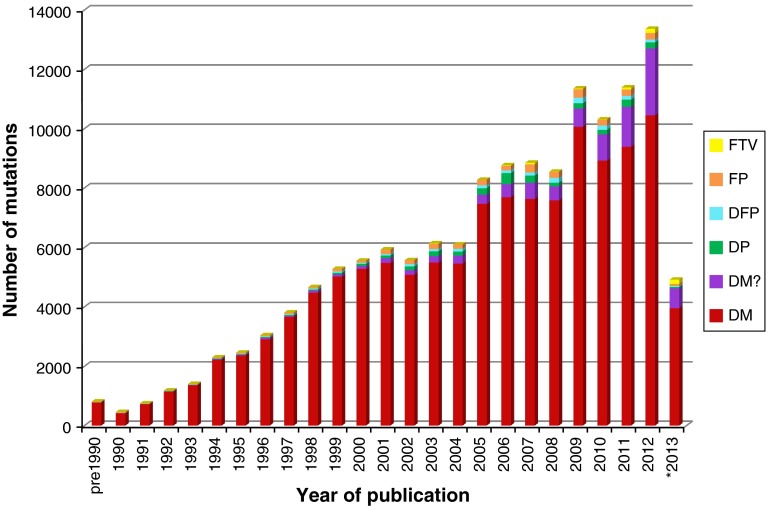
The Human Gene Mutation Database (HGMD®) is a comprehensive collection of germline mutations in nuclear genes that underlie, or are associated with, human inherited disease. By June 2013, the database contained over 141,000 different lesions detected in over 5,700 different genes, with new mutation entries currently accumulating at a rate exceeding 10,000 per annum. HGMD was originally established in 1996 for the scientific study of mutational mechanisms in human genes. However, it has since acquired a much broader utility as a central unified disease-oriented mutation repository utilized by human molecular geneticists, genome scientists, molecular biologists, clinicians and genetic counsellors as well as by those specializing in biopharmaceuticals, bioinformatics and personalized genomics. The public version of HGMD (http://www.hgmd.org) is freely available to registered users from academic institutions/non-profit organizations whilst the subscription version (HGMD Professional) is available to academic, clinical and commercial users under license via BIOBASE GmbH.
人类基因突变数据库(HGMD®)是一个包含核基因突变的综合数据库,这些基因突变是人类遗传疾病的基础或与之相关。截至 2013 年 6 月,该数据库包含了超过 5700 个不同基因中检测到的超过 141000 个不同的病变,目前每年新增突变条目超过 10000 个。HGMD 最初成立于 1996 年,用于研究人类基因中的突变机制。然而,自那时以来,它已经具有更广泛的用途,成为一个集中的统一的面向疾病的突变知识库,被人类分子遗传学家、基因组科学家、分子生物学家、临床医生和遗传顾问以及专门从事生物制药、生物信息学和个性化基因组学的人员使用。HGMD 的公共版本(http://www.hgmd.org)可供学术机构/非营利组织的注册用户免费使用,而订阅版本(HGMD Professional)则通过 BIOBASE GmbH 以许可证的形式提供给学术、临床和商业用户使用。