J Neurovirol. 2013 Oct;19(5):495-504. doi: 10.1007/s13365-013-0204-8.
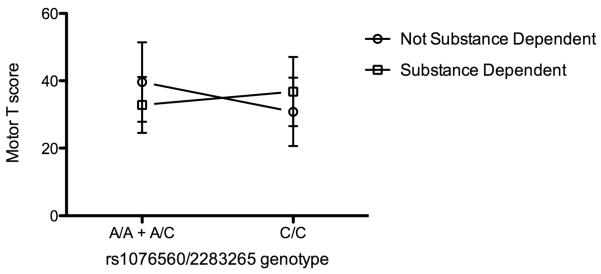
It has been postulated that drugs of abuse act synergistically with HIV, leading to increased neurotoxicity and neurocognitive impairment. The CNS impacts of HIV and drug use converge on the mesocorticolimbic dopamine (DA) system, which contains two main receptor subtypes: dopamine receptors 1 (DRD1) and 2 (DRD2). DRD1 and DRD2 have been linked to substance dependence; whether they predict HIV-associated neurocognitive disorder (HAND) is unclear. Using an advanced-stage HIV+ population, we sought to determine if drug dependence impacts the contribution of DA receptor polymorphisms on neurocognition. We observed that both DRD1 and DRD2 polymorphisms were associated with opiate and cocaine dependence (P < 0.05) in Caucasian subjects, but not African-American individuals. Using linear regression analysis, we examined the polymorphisms for associations with neuropsychological performance in global and cognitive domain T-scores (Motor, Processing Speed, Verbal Fluency, Learning, Memory, Executive Functioning, Working Memory) while controlling for opiate and cocaine dependency. In the Motor domain, we observed an association for two DRD2 polymorphisms (P < 0.05) in Caucasian subjects. The effects differed for substance dependence groups as the direction of the correlations with DRD2 were opposite to what was seen in subjects without these dependencies. In African-American subjects, associations were observed in nearly every domain, and again, the direction of the correlation differed between substance-dependent and substance-independent groups. We conclude that studies to examine genetic risk for HAND must carefully account for substance dependence patterns when assaying dopaminergic systems, as the neurobiological substrates of cognition in HIV populations may vary with tonic alterations secondary to chronic substance exposures.
据推测,滥用药物与 HIV 协同作用,导致神经毒性和神经认知障碍增加。HIV 和药物使用对中枢神经系统的影响集中在中脑边缘多巴胺(DA)系统上,该系统包含两种主要的受体亚型:多巴胺受体 1(DRD1)和 2(DRD2)。DRD1 和 DRD2 与物质依赖有关;它们是否预测 HIV 相关的神经认知障碍(HAND)尚不清楚。使用晚期 HIV+人群,我们试图确定药物依赖是否会影响 DA 受体多态性对神经认知的贡献。我们观察到,在白种人群体中,DRD1 和 DRD2 多态性与阿片类药物和可卡因依赖有关(P < 0.05),但在非裔美国人中没有。使用线性回归分析,我们在控制阿片类药物和可卡因依赖的情况下,检查了这些多态性与全球和认知域 T 评分(运动、处理速度、言语流畅性、学习、记忆、执行功能、工作记忆)的神经心理表现之间的关联。在运动域,我们观察到两个 DRD2 多态性(P < 0.05)在白种人群体中的关联。在物质依赖组中,相关性的方向与没有这些依赖性的受试者相反,因此,相关性的方向与物质依赖组不同。在非裔美国人中,几乎在每个领域都观察到了关联,而且,在物质依赖组和非物质依赖组之间,相关性的方向也不同。我们的结论是,在研究 HAND 的遗传风险时,必须仔细考虑物质依赖模式,因为在 HIV 人群中,认知的神经生物学基础可能因慢性物质暴露引起的紧张改变而有所不同。